Tuesday, February 28, 2006

Mardi Gras - Laissez les bons temps roulez!


Happy fat Tuesday y'all! Good luck N'Orleans, get down!


Mardi Gras 2006
Betsy McKenzie

Not for the drunken revelry,
It is the glitter and bright color
That draws me.
Like exotic birds, they dance,
Parading through the streets
Most unlike the rest of
Prosaic America –
Making up in laughter and music
For what they lack in basic services.
Feathers, beads, jazz,
Hip and cool: New Orleans
Dancing out of its grave.

Why Haven't E-books Met Their Promise?


When electronic books were first being developed for law school purposes, I saw a lot of promise. Lexis-Nexis had some very creative people and let them develop some very good adjuncts to the electronic casebooks that I saw shown. You could highlight in your casebook, and make notes in the margins. You could tie your classnotes to the text. It looked very interesting. But it failed. Why?

It wasn't for lack of adoption by professors -- I knew some professors who adopted the e-case books, that were packaged with print and a CD for students to slide into their laptop to bring to class. No more lugging heavy books to school! Why did such a terrific-sounding idea fall flat?

I have linked the title above to a study done in 2001 in California, about what it would take for e-books to succeed in academic settings. As far as I can see the publishers have not moved on any of the bullet points. That's too bad, since they apply as much to electronic databases as to e-books! Pay attention out there.

I. Problems with Flexibility of the Hardware and Software
* Non-proprietary software and hardware for interoperability of files
E-book readers and librarians alike need to have software and hardware that is flexible. Don't make the classic mistake that Apple made of tying everything to one platform and them not letting anybody write for your system. Make it all apply to any platform, any system, and let that be the standard. Only then, will the whole system take off.

* Identifiers
* Metadata
These two work together to make the data work together on any system. It makes the software portable. We don't want to have to purchase and carry around your clunky brand of reader. Let us read it on our PDAs or laptops or whatever.

* ADA compliance.
Duh. Metadata helps make electronic material accessible to screen readers for vision-impaired readers. There are lots of other small steps that make a big difference to our many users who need accessibility compliance.

II. Problems with Digital Rights Management
Time to get with the program, guys. E-books and digital libraries will never get off the launch pad until you get your minds around the concept that libraries need to be able to spend the same amount for the same rights as before. Our budgets are not getting bigger. Our patrons need the same or more research support as before. We are happy to work with you and understand that you need to maintain a business; we want to help you protect your copyrights. Please help us maintain our business of supporting our patrons' research need and protecting our institutions' financial solvency! It will help nobody for us to fight each other or drive each other to ruin.

III. Access and Archiving and Cost Models
Again, this goes somewhat to solving the problem with digital rights management. But e-books and digital libraries will never be successful until instant, constant and anywhere access is there for the patron. It should be platform independent, it should be portable, and it should be easy to use, intuitive. And as a librarian, I want to keep the access I paid for, doggone it. If you charge me the cost of the book, I want to keep the book's worth on my digital shelf. If you charge me a month's worth of subscription, I want that the first to the last issue's worth on my shelf, permanently readable by all my patrons.

IV. Privacy
Some electronic vendors are selling information from searches (can you imagine?). This should be unthinkable.

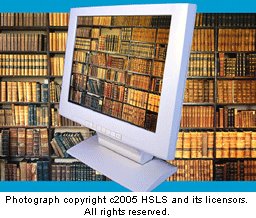
I really recommend you go and read this report in full. I am merely noting my personal pet peeves that the report underscores in this blog note. This nice image is courtesy of the Health Sciences Library at University of Pittsburgh. Thanks!

Monday, February 27, 2006

Reorganize your library with this New Library Grant!


A new library grant for organizing libraries following disasters or other libraries desiring a quick-coding arrangement. Designing library arrangements for easy access and retrieval according to color and size of materials. Funding available from the U.S. Dept. of Education. This is a radical new model of library organization, based around human conceptualization of information. Newer understanding of how the mind handles organizing information drives this model for organizing a library by color and size of books. The red books sit together, the brown books sit together, and all the tall books sit together. See model training website:

http://www.itcompany.com/shelveit.htm

You have to modify this tutorial, since it was created to teach such retro formats as Dewey Decimal and Library of Congress. In the wake of recent sea changes to library arrangement thought, a few changes will make this tutorial ready to train your students and assistants in color and size-shelving. This is the new wave in librarianship. Your patrons have been asking for this for generations -- isn't about time we gave it to them?

Sunday, February 26, 2006

Thank you, Emily Dickinson


Emily Dickinson, American poet living and writing in Amherst, Massachussetts between 1830 and 1886, had a dramatic way with her sometimes short verse. She is one of my favorite American poets. Thanks to Bartleby.com where the full text of many selections of verse and other literature and dictionaries are available, though right now with incredibly annoying ads. Here is a short poem:

Emily Dickinson. Complete Poems. 1924.

Part One: Life

XIX

PAIN has an element of blank;
It cannot recollect
When it began, or if there were
A day when it was not.

It has no future but itself,
Its infinite realms contain
Its past, enlightened to perceive
New periods of pain.


************

While this poem may seem rather morbid, it is a very exacting and precise observation of a true phenomenon. When a person is absorbed in pain, whether it is physical, mental or emotional, they really cannot process anything else. This is important to understand. If we read the news, interact with others, or even just deal with yourself with this insight in mind, it might make a difference in how we look at what is happening.

This Law Sounds Oddly Familiar

From Unclaimed Territory - by Glenn Greenwald: Specter proposes a new law -- something called "FISA":

This article from today's Washington Post is nothing short of surreal:

"The federal government would have to obtain permission from a secret court to continue a controversial form of surveillance, which the National Security Agency now conducts without warrants, under a bill being proposed by Senate Judiciary Committee Chairman Arlen Specter (R-Pa.)."...

It is, of course, so disorientingly bizarre to hear about a proposed law requiring FISA warrants for eavesdropping because we already have a law in place which does exactly that. It's called FISA. That's the law the Administration has been deliberately breaking because they think they don't have to comply with it and that Congress has no power to make them. Reading this article about Specter's proposed legislation is somewhat like hearing that a life-long, chronic bank-robber got arrested for robbing a bank over the weekend and, in response, a Senator introduces legislation to make it a crime to rob banks....

I actually think that the Administration's theories vesting George Bush with law-breaking powers are so radical and dangerous that people like Specter can't get themselves to actually accept that the Administration has really embraced these theories and is living them. Notwithstanding the fact that the Administration has expressly advocated these positions in numerous instances in many different contexts over several years now, it's as though people in Congress -- and the media -- think they're not really serious about believing them. I wonder what else needs to be revealed about the Administration's law-breaking for people to start realizing that this Administration really does not only believe that George Bush has these law-breaking powers, but also that they have been exercising those powers for quite some time now and have vowed to continue to do so.

Saturday, February 25, 2006

Archiving Edits; Rewriting History


In the last post, yesterday, I spoke about my desire that edits to remove racist or politically incorrect material from songs or cultural items should not totally remove the evidence that the racism or politically inflammatory attitude existed. That amounts to rewriting history, and is uncomfortably like the "Newspeak" in George Orwell's novel 1984, where the totalitarian government casually changes history for its own convenience and requires all citizens to go along.

In my cheerful ignorance, I was just thinking about rewriting songs and changing websites. Those are, indeed problems and worth thinking about. I spoke with my Advanced Legal Research class last week about why we always want to include the date last visited in citations to websites: the web changes so fast that the site is very likely to have changed between the time YOU cite to the page and the time I go to look at it myself. One saving grace is the Internet Archive (www.internetarchive.org) Yay! and its entertaining WayBack Machine.

However, there is a much more unnerving rewrite of history underway. See the link above at George Washington University, National Security Archive website. This is a report on a secret program by the Pentagon and the intelligence community in the U.S. to reclassify a huge number of documents that had been previously declassified. This is really worrisome to government documents librarians. It ought to be worrisome to lawyers, law librarians generally, and to all citizens! Plus, it is really stupid, and makes our government look like incompetent dopes! Many of the documents that they are carefully stamping Classified and putting away again have been copied and distributed around the world, reproduced in textbooks and on the web. They can't be put back in the box. (Thank heavens, I say). How silly they look, though, trying to mark them Classified, after that. It is rather like old King Canute who tried to order the tide back. Many thanks to Matthew Aid, who seems to be spearheading this project! You can join -- please take a look at the website, read the report and any links that are still working (the newspaper reports might have closed up). Excellent and very important issue!

The decoration above is a play poster designed for a theater company, from the website: http://www.synapseproductions.org/about/archives.html

Friday, February 24, 2006

Rewriting History -- Political Correctness or Whitewash?

On February 23, in the blog entry here "Black History in America - the Peculiar Institution," I mentioned the fact that Kentucky's state song, "My Old Kentucky Home," had its lyrics changed. Stephen Foster, who wrote the song before the Civil War, original wrote a line, "The darkies roll on the little cabin floor,..." At this website, you can see the lyrics as they exist now in the official version that is sung each year at the Kentucky Derby, changed to "They young folks roll on the little cabin floor,..." http://www.netstate.com/states/symb/song/ky_my_old_kentucky_home.htm

The reason given for the change made in the state legislature, was that the original lyrics, written during the days when slavery was legal and common in the Commonwealth, now seemed very racist. That is certainly true. And the song is a particularly beautiful one. Not many state songs are as beautiful as "My Old Kentucky Home." Stephen Foster was a gifted songwriter, with both an ear for melody and for lyrics that would stay with the listener. He wrote more big hits that remained in the American songbook than perhaps any other songwriter until the guys that wrote for musical movies and now, write for musical videos.

But I am troubled by the removal of evidence of our racist past. While it discomforts me, and probably offends others more deeply than it does me, if we remove it completely, we whitewash away the evidence of where we have been. Each year, some schoolboard or library is asked to remove Mark Twain's Huckleberry Finn from the shelves or classroom, because it uses "nigger" in the text. The folks who ask sadly miss the point that Samuel Clemens, writing at a time when too many whites used that terrible epithet freely, wrote in opposition to the attitude behind it. The white adults in the book who claim to be upright and good are depicted as evil, cowardly and grasping. The only noble adult in the book is the runaway slave, Jim, one of the main targets of that ugly word. The crux of the story is when Huck, against all his teaching and upbringing, against the culture in which he was raised, decides to be a "bad" boy, and help Jim escape. He reckons he'll go to Hell, but that's just how it will have to be. He just can't bring himself to turn against Jim. Far from being a book putting down people of color, Huckleberry Finn is a merciless indictment of the "Christian" society that could bind a human being into slavery, and sell him away from wife and children, then go to church and congratulate itself on being better than those next door.

To remove the book, to remove the words, to remove the evidence of our racism, is to do a hurt to our current selves and our future as well. If we edit the song, to avoid being racist in the here and now, we must be certain to retain the evidence of the edit and the original.

Law Library Journal is Rockin'!

I just looked through the Winter, 2006 issue of LLJ, and it has several articles that are just fabulous! I especially commend to your attention:

Susan Nevelow Mart, Let the People Know the Facts: Can Government Informatin Removed from the Internet Be Reclaimed?
Prof. Mart's article is very eye-opening in terms of the amount and type of government information being removed from websites in recent days under the aegis of "national security." She lists several public interest groups that have challenged such removals successfully. She suggests that the concerted use of the Freedom of Information Act is the public's best tactic to protect their access to government information.

Susan N. Lerdal, Evidence-Based Librarianship: Opportunity for Law Librarians?
Prof. Lerdal introduces the law librarian community to Evidence-Based Librarianship (EBL), which seems to have originated in Health Sciences Libraries in the United Kingdom. EBL is the use of empirical research to make better decisions in libraries. She provides an interesting introduction to the field, and a good bibliography for those who want to educate themselves further. This excellent article should lead law librarians both to better decision-making, and to better research projects. The article also calls on library educators to include more classes, and to create standards for, educating library-science students to consume and produce research at a more sophisticated level. Hooray!

There are lots more great articles, including a charming one on Bollywood movies, and a very helpful bibliography on library design, construction and renovation (very helpful, Tom!). And Frank Houdek provides an FAQ on AALLS's First Hundred Years. What more could you ask?

If you can't beat 'em

From Shakespeare's Sister: "If you can't beat 'em"

If an Ohio lawmaker's proposal becomes state law, Republicans would be barred from being adoptive parents.

State Sen. Robert Hagan sent out e-mails to fellow lawmakers late Wednesday night, stating that he intends to 'introduce legislation in the near future that would ban households with one or more Republican voters from adopting children or acting as foster parents.' The e-mail ended with a request for co-sponsorship…

Hagan said his 'tongue was planted firmly in cheek' when he drafted the proposed legislation. However, Hagan said that the point he is trying to make is nonetheless very serious…

To further lampoon Hood's bill, Hagan wrote in his mock proposal that 'credible research' shows that adopted children raised in Republican households are more at risk for developing 'emotional problems, social stigmas, inflated egos, and alarming lack of tolerance for others they deem different than themselves and an air of overconfidence to mask their insecurities.'

However, Hagan admitted that he has no scientific evidence to support the above claims.

Just as 'Hood had no scientific evidence' to back his assertion that having gay parents was detrimental to children, Hagan said.

Life, the Universe and Everything


HITCHHIKER'S GUIDE TO THE GALAXY

DON'T PANIC


Before there was the movie, there was a very hip television series (short-lived, like most great things), from the BBC. Before there was the television series, or maybe sort of simultaneously, sort of, there was a series of books, all the brainchildren of Douglas Adams (so long, and thanks for all the fish, may he rest in peace!). And before that, there was a radio series.

Now there is a new radio series, from the BBC, if you can get it. Find out at the link above.

If you have never been exposed to Douglas Adams' excellent brand of humor, this is a very good time to do so. There are copies of his many books everywhere. Run, do not walk, to your nearest library or bookstore, and procure a copy of the first book: The Hitchhiker's Guide to the Galaxy. I think it's probably the best of the lot, though he went on from there. You can get the original TV series on DVD now (watch Zaphod Beeblebrox with 2 heads and 3 arms and marvel and how amazingly cool he still manages to come off). The special effects still manage to rock even after 25 years! It is to laugh, and laughing is good for the heart.

Find out how the amazing Babblefish, which excretes translation in any language through the ear into the brain, manages to set off more wars since the various life forms can actually understand each other! Learn why the planet earth was created, and for whom. And what is the meaning of Life, the Universe and Everything.

New Frontiers in Digital Libraries: Open Content Alliance

Brewster Kahle, among other great ideas, came up with the Internet Archive (see the information on Mr. Kahle and others behind the Archive, and a nice link to the Archive itself at http://www.archive.org/about/bios.php. Now, he has looked at the Google Library idea, and said, why stir up all this angst about the copyright issue?

Mr. Kahle has started an Open Content Alliance which focuses only on material outside of copyright. The link in the title here takes you to an article from the Chronicle of Higher Education, January 27, 2006, which discusses the project. They have Microsoft, Yahoo, and more than twenty libraries, including such stand-out research libraries as Columbia, Johns Hopkins, University of Virginia, the Smithsonian Institution libraries, York University and a number of other great Canadian universities, all signed on to cooperate in the project. The Alliance is suddenly bigger than the Google Library project.

While Google is creating a giant, searchable database, a sort of OCR card catalog, the Alliance is actually scanning the books and making the PDF files, electronic books available for free, to the masses. See this more rousing article from the San Francisco Chronicle: http://www.sfgate.com/cgi-bin/article.cgi?f=/c/a/2005/11/22/MNGQ0FSCCT1.DTL&hw=brewster+kahle&sn=001&sc=1000

Thursday, February 23, 2006

Black History in America: The Peculiar Institution


Only in Christian times and Christian countries has slavery become so twisted that in addition to denying the freedom of the slaves, it also denied the very humanity of the slaves. American slaveholders (and I presume British slaveholders, while slavery lasted in that country), salved their consciences by the elaborate fiction that black Africans were less than human. Thus, it was not only fair that they work for the white masters, but humane, because the white masters could save their proto-human souls by teaching them the rudiments of Christianity, and the beginnings of humanity.

If you look back at the publications of slave-holiding states in the United States and the Confederate States during the Civil War, you will see outright statements such as these. There are many depictions of the happiness of the slaves in their wretched quarters, singing and dancing in their rags, glad to be close to the masters. The verse in My Old Kentucky Home is rarely sung any more out of political correctness, but perhaps it is closer to re-writing history, in order to forget the ugliness of the whites. See this website that at least relates the re-writing of the song to edit out the inherent racisim of the song, written during slavery days.

The United States as it exists today, actually has done an amazing job of amalgamating a broad number of races, ethnic types and religions into a mostly stable and mostly friendly country. The biggest exception to this very optimistic statement is the Black community. While there is a large, stable Black middle class and some quite wealthy Black professionals, there is a permanent underclass of Blacks. They feel very hopeless, and are treated largely as if they don't matter and have no choice. I believe that most of the things that go on in the neighborhoods that are predominated by Blacks would never be tolerated in other neighborhoods. It only happens because it is a poor neighborhood, and mostly Black. And in America, that translates to THEM and Invisible.

This is at least in large part the terrible heritage of those slaveholders who had to salve their consciences. They could not simply own a human being as the Greeks, Romans, Egyptians did. They had to find an excuse to square it within their Christian religion. And they did this by perpetrating the monstrous sin on their slaves, of denying them, not only their freedom, and that of their families, but denying them their very humanity. And this echoes down through our history and culture. It poisons the slaves' great grandchildren, and it poisons all of us.

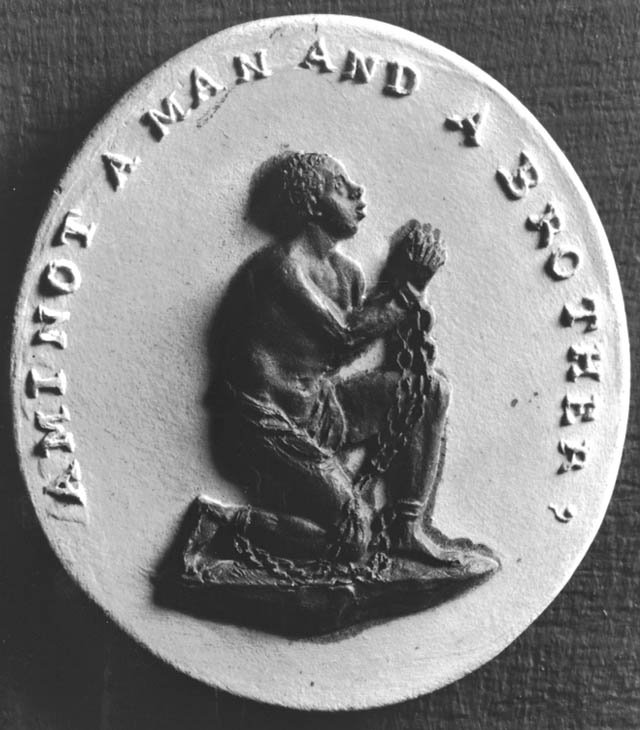
The decoration on this page is a medal made of the very famous anti-slavery image, with its slogan, "Am I not a man and a brother?" It comes from Steven Weisenberger's webpage at SMU.

Wednesday, February 22, 2006

George Washington's Birthday


George Washington has had a mythic stature in our country's mind. In past centuries, he was revered as the Father of Our Country. Frankly, his patina probably kept people by the end of the 20th Century from imagining him as a real person. He was never one of my favorite presidents, to tell you the truth. But recent books and articles have begun to remedy that. What was it that made him so vital to our countrymen in his own time, and so revered for generations after?

From what I understand, at a time when Britain could not imagine the Colonies as more than that, George Washington was able to present to them an image of himself as a very regal leader of an increasingly real nation. It was this ability to REPRESENT, not only to the British, but also to his own countrymen, the possibility of a nation, with dignity equal to England's own, that made him so crucial at the moment of Revolution.

Washington did not seem to be a great general, although he certainly seemed to mature and learn as he went along. He did become a much better general by the end of the Revolustion. What he was absolutely peerless at, was leading men. George Washington seemed to know how to secure the faith and hopes of his very volunteer army, and to hold them to his vision. His wife was invaluable in this effort, apparently, but I do think that Washington himself was the key. He knew how to select officers and delegate authority. He showed trust and got it in return. When he gave his farewell address to his troops, I believe the weeping of his volunteers was quite genuine.

The formation of the Sons of Cincinnatus reflects the feelings at the time about Washington as a general and leader. He was the reincarnation of the Roman who left his farm to lead the Republic, but modestly retired rather than accept a crown. While books and articles seem to portray Washington as strikingly self-aware and willing to manipulate his image with the public, he used that image for the public good and did not take undue advantage of the trust that was given him. He served for two terms as President, did not make money off the position, and retired to Mount Vernon voluntarily, when he could very easilty have become President for life.

So, Happy Birthday, George! Nobody much is paying attention this year. I think better of you as I learn more, and look beyond that simpering cherry tree story. There is a good lesson here for librarians, I think. We all serve as figureheads in some way or other. We need to be aware of that function. We mean more than our private selves. George showed us the way. Let us learn!

More on George Washington at Wikipedia
http://en.wikipedia.org/wiki/George_Washington

Digital Publishing: The Scientific Activist: Reporting from the Crossroads of Science and Politics: Science Gets Googly

The Scientific Activist: Reporting from the Crossroads of Science and Politics: Science Gets Googly

This fascinating blogger is reporting on a very interesting controversy in science and science librarianship over how to measure the relative status of various electronic publications. This is our future as legal publishing and other fields of academia move more into electronic publishing exclusively. Take a look at his in-depth report on the fights and varying measures of quality and influence. They are arguing over Google's linking and links to the linkers algorithm (fascinating in its own right) versus other measures of quality and influence in the scientific community. Then the discussion branches out into a nightmare of what happens to academic diversity under the influence of grantsmanship and tenure pressures to all write for the same sorts of journals. Wow!

This is worth thinking about. Up until now, we have had the luxury of letting editors at journals and publishing houses do our sorting for us. Now that everything is going electronic, we have to find other measures of quality. This is one of the biggest barriers that I see in academic discussion of using electronic-only publishing for tenure decisions. There is a real level of discomfort in trying to sort the quality decision based on in-house expertise. And I agree with that. There is so much room for mistake and personal bias in your own field -- "Wow, you're not a Crit and I am! I can't vote for you!" Or decisions along any other theoretical fault line -- not to pick on the crits, it's just the theory that popped into the old brain.

The choice to use a sort of "popular acclaim" model mixing the Google linking algorithm with other measures of quality is an interesting one. What works in the sciences may not work in various social-based fields like law, but what the heck! I am very glad that somebody else is pioneering this thinking. Let's watch what they do and how it works out. Thank you so much Scientifici Activist and company!

It's all good: Change at the Human Level

From George Needham at It's all good: "Change at the Human Level"

For a couple of years now, I've been on the road talking about how libraries need to change. Based on the environmental scan (and more recently the Perceptions report), my talks have focused on changing the direction of library public services, about becoming more user-centric, about implementing aspects of self-service, disaggregation, and collaboration.

Not long ago, I spent some time with a very good friend who is in middle to upper management in a library. Both she and the library shall remain nameless. Her library is in the process of implementing a lot of these changes, and, basically, she blamed me and OCLC for destroying her life.

She was kidding.

I think.

Her library is studying and has proposed a variety of changes. They are thinking of taking out a whole level of middle management (which could cause her a demotion, or perhaps even cost her her job). They are considering de-emphasizing reference, moving to a readers' advisor/roving support model that we have heard described in several places, deprofessionalizing the positions along the way. They are centralizing materials selection, and administration wants staff to be trained and willing to work at multiple locations rather than the single location for which they were hired.

The kicker is that my friend supports every one of these changes. But she is seen as being part of the ancien régime of the library, and, as a result, not part of the modern, agile leadership that the administration seeks. She faults herself for being more deliberative than assertive in the system. She feels that her skills in teaching and building consensus are out of the current mainstream in her system. And she's not sure that she's ready to make a major change in her approach to the world at the age of 54.

The fact is that changing an institution, whether it's a large, complex academic library or a suburban public library or a one room school media center is never easy, and it's frequently very painful. People are invested in the status quo, and we as librarians take a great deal of pride in what we do. As the world around us has changed, we sincerely believe that the processes and services we provide hold enduring value.

I don't know what to tell my friend. She's a smart, thoughtful, dedicated professional who feels the way the monks in a scriptorium must have felt the first time they saw a Gutenberg printing press.

If you are in a situation like this, from whatever position, I would love to know more about your experience. Maybe you can help me help my friend. Maybe we can come up with some new strategies for dealing with change. Because the only thing of which we can be very sure is that the change is going to happen either with us or to us.

Tuesday, February 21, 2006

Tis the Gift to Be Simple, Tis the Gift to Be Free


'Tis the gift to be simple,
'tis the gift to be free,
'tis the gift to come down
where we ought to be,
and when we find ourselves in the place just right,
'twill be in the valley of love and delight.
When true simplicity is gained
to bow and to bend we shan't be ashamed,
to turn, turn, will be our delight
till by turning, turning we come round right.

You may recognize this short snippet of the Shaker hymn, which you can find with music at the link in the title. You can find out more about Shaker spirituality at http://www.passtheword.org/SHAKER-MANUSCRIPTS/

The Shakers were founded in the late 1700's on the visions of Mother Ann Lee, and are generally considered an off-shoot of the Quakers. The Shakers were celibate, and have very nearly died out (there are a few new converts at the remaining Shaker houses in the United States). The Quakers were never celibate. The full name of the Quakers is the Religious Society of Friends, and are very serious about non-violence and peace.

My mother's family were Quakers for many generations. In fact, that is why the earliest member of that part of my family shows up in the U.S. Quakers in Britain were "non-conformists." That is, they were not members of the Church of England. That meant they could not own property. They suffered under a number of other legal and social disabilities as well. So that early Harris left England in the early 1700's to come to America. Over the years, about every other generation was expelled from the church when the father would feel compelled to join the current U.S. war effort, usually as a stretcher bearer. That was too much war for the Quaker comunity, and the violator was expelled from the Church. I don't imagine they threw the family out, but the family chose to follow the father. We finally stayed gone after WWI and my grandfather got tossed for being a stretcher carrier.

Both Shakers and Quakers are Protestant Christian sects. Find out more about Quakers at what seems to be their official website: http://www.quaker.org/

Monday, February 20, 2006

More on Internet Privacy

Wikipedia articles:

Anonymizer http://en.wikipedia.org/wiki/Anonymizer

Internet Privacy http://en.wikipedia.org/wiki/Internet_privacy


Organizations:

EPIC (Electronic Privacy Information Center) A U.S.-based organization. Lots of
information here on the history in the U.S. of the efforts to keep the privacy rights of internet surfers:

http://www.epic.org/

EFF (Electronic Frontier Foundation) A U.S. based organization that has done a lot of advocacy and litigation:

http://www.eff.org/

Anonymous Web Browsing - Not just for U.S. paranoids anymore

The U.S. government was really ticked off for quite a while at the Electronic Frontier Foundation (EFF). John Ashcroft took them to task for developing methods for Internet surfers to surf the Web while masking their identity. That made government agents at the FBI and Department of Justice generally really anxious. What sort of American citizen would want to hide their identity while surfing the Internet? Geez, they must be doing something they would not want their government to know about!

Well, the EFF fought off attempts by the government to shut down their TOR organization and affiliated Privoxy system. These two systems effectively break down an internet search packet into tiny bits, and encrypt them so they cannot be read. Then they scatter the bits among many computers, and route them on a very circuitous way from requestor to answer and back. Along the way, no computer can "see" farther than one computer back or forward along the chain. So no snooper can trace the packet or decrypt it. Or if they do, they only get a tiny bit. Very effective.

Now, they turn into heroes. Just as Google and Internet Explorer bow to demands by the People's Republic of China to allow censoring of the Internet, the providers of such masking tools as TOR and Privoxy start to look like heroes. Suddenly they look like the Voice of America. Wow! How the worm turns! There are more than just Tor, but it's my personal favorite. See Tor and its helpmate, Privoxy.


See an article in the Boston Globe about "Beating Censorship on the Internet" for a discussion of the various organizations working on masking or other work-arounds.

Sunday, February 19, 2006

Thomas Frey on The Future of Libraries

Thomas Frey, futurist and Executive Director of the DaVinci Institute, recently published "The Future of Law Libraries: Beginning the Great Transformation." I'm actually not a great believer in futurists. In the short term, some trends are predictable, and I still stand by my observation that at some point in the next future--meaning the next five to twenty years--law library collections will be almost completely digital; I just don't see how that can be considered debatable. But larger global trends and worldwide changes are much more slippery, and anyone who claims to predict with any confidence on that scale is likely to look foolish. While the article is surprisingly poorly written, some of Frey's comments are provocative, and some are indisputable--but others are sheer nonsense.

Frey lists "ten key trends that are affecting the development of the next generation library." Right off he sets himself up for error by neglecting to consider the differences in types of libraries: public libraries generally are different from academic libraries as a whole, and within academia, general university libraries are different from law libraries, health science libraries, engineering libraries, business libraries, music libraries, and so on. Still, looking at libraries generally, let's see what Frey has to say.

Trend #1 - Communication systems are continually changing the way people access information

OK, I'll buy that. But that observation raises what is for Frey "one obvious question to consider: what is the ultimate form of communication, and will we ever get there?" First, that's two questions; second, neither question makes sense. What on earth does "ultimate form of communication" means, and who on earth is looking for it? Depending on the circumstances, the best form of communication at the time might be a multi-volume treatise or a journal article; in other circumstances, it might be a touch of the hand or shared silence. Communication is not always reducible to technology.

Trend #2 - All technology ends. All technologies commonly used today will be replaced by something new.

My friend and co-blogger Betsy McKenzie, like me a student of the late Walter J. Ong, S.J., will recognize this as nonsense. Most communications technologies used in history have not been replaced, but still survive. Handwriting still comes in handy from time to time. Radio did not replace the telephone, television did not replace radio. Particular hardware components may become obsolete, but that does not render a technology dead; I haven't seen a rotary phone for years, but I still use a fountain pen. It is a common observation that computers have not replaced print, but rather produced great floods of it. How many piles of papers do you have stacked on your desk?

Trend #3 - We haven’t yet reached the ultimate small particle for storage. But soon.

Could be. Maybe. I don't know. But let's see what follows.

Trend #4 - Search Technology will become increasingly more complicated

An alarmingly sloppy choice of words. Will the search interface become more complicated, or the algorithms behind it? Does "complicated" mean "confusing and hard to use," or "sophisticated and easy to use"?

Trend #5 - Time compression is changing the lifestyle of library patrons

"Basically, we have more needs faster. However, 'needs' are a moving target, so the library of the future will need to be designed to accommodate the changing needs of its constituency." Again, a sloppy choice of words. Does the library's "need" for changing design mean the same as the consituency's changing "need"?

Trend #6 - Over time we will be transitioning to a verbal society

We have always been a "verbal society." Arguably, verbalization--language--is what makes society possible, and what makes homo sapiens human. Frey probably means "oral society"--and ignores decades of research that have long recognized this "key trend."

Frey goes on to predict that "by 2050 literacy will be dead." I find this extremely unpersuasive, and not least because it ignores the existence of over 5,000 years of humanity's written record.

Trend #7 - The demand for global information is growing exponentially

Trend #8 - The Stage is being set for a new era of Global Systems

Trend #9 – We are transitioning from a product-based economy to an experience based economy

"As the world’s population ages and the Baby Boom generation approaches retirement, many of them will begin to shed their belongings to create a more free and mobile lifestyle. Each item that a person owns demands their attention, and the accumulation of physical goods to demonstrate a person’s wealth is rapidly declining in importance. Experience becomes the key.

"How would you rate your last library experience? Chances are that you’ve never been asked that question. However, in the future, the patron experience will become a key measurement criteria."

True, perhaps, for the wealthier among us. But ask 80% of the world's population if the accumulation of physical goods is becoming less important for them.

Trend #10 - Libraries will transition from a center of information to a center of culture

"With the emergence of distributed forms of information the central role of the library as a repository of facts and information is changing. While it is still important to have this kind of resource, it has proven to be a diminishing draw in terms of library traffic."

After all of this, Frey's "Recommendations for Libraries" are something of a disappointment. "Evaluate the library experience." "Embrace new information technologies." "Preserve the memories of your own communities." "Experiment with creative spaces so the future role of the library can define itself." Nothing there is particularly new, but perhaps if Frey's article finds its way to some librarians, teachers, and administrators who do find it new and thought-provoking, it will have served its purpose.

Cheney's Got a Gun

The long-awaited parody has finally come about.

Old Cat


Betsy McKenzie

When you were a young cat,
Supple, all the bones were knit tight
And moved so smoothly.
So long you chose to sleep alone:
“Do not pick me up!” When at last
I carried you, what a shock!
All those bones come unhinged. So
Light and loose; they didn’t quite
Fit in your skin any more.
Fur that had been sleek, now
Shopworn, eyes gone filmy.
Still, it is the bones that I recall.

January 29, 2006


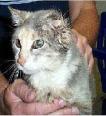
This image of a very old and shopworn cat is a rescued cat from:
www.all-creatures.org/ak/ak-OldCat-Rescue2.jpg

Saturday, February 18, 2006

Library Rant

So while I offer you some laughs with the one hand, here is a serious big stick with the other! Jim's Podcast opens with that snippet "It's quiet here... Nobody bothers a librarian." That's the good AND the bad of librarianship. It is very pleasant in many ways to be left to our own devices. We can experiment with new ideas, research to our hearts' content, and usually run the library the way we see fit.

The downside is that hardly anybody has any idea what we really do! And that goes double for the Human Resources folks who have to make decisions about pay scales! They tend to look at what all the other schools are paying their librarians, and go according to that. And I think it must all be set by a combination of somebody's memory of their third grade school librarian (card catalog, shelving and stamping books), and what they believe we will put up with. And dammit, they seem to be right!

The problem is that the salary is basically set when you accept the darned job! Ever after that, it's just a matter of small percentage increases to the original salary you negotiate. Once you accept, that original salary is IT, guys! And the problem is that, like, me, most folks are just giddy with delight that, Golly, gee, they WANT me, they like me! Librarians are helpful folks; we are not by nature tough negotiators. (A fact the vendors and publishers have figured out and are often using to their advantage, I might add! See if you have tougher-minded people on your staff who can negotiate the contract for you and you sign it!)

So, once you take that job, you are stuck with percentages on the original salary until and unless you are willing to jump ship and go to another position. This is tough news. It is possible that if you move within the same library to another position, you can raise your salary considerably, so that's some consolation. But be aware, that the salary you negotiate going in, it so going to be IT.

Unless and until librarians either

1. challenge the HR people sharing information as a form of collusion along the lines of anti-trust violations (WOW! I think this might actually be more of a violation than sharing how much I pay student workers!); or

2. unionize across the country (gee, as a manager, I can't believe I said that! I might totally regret that),

I do not believe that librarian salaries will significantly improve. I am royally pissed off. I do not see any significant or effective action from AALL. They are piddling around making tiny tempests in tiny teapots lest WE violate antitrust talking to each other about student worker pay levels (the student workers are not competing with each other for the positions, how can this be anti-trust?), while the salary survey shows year after year, clear evidence that university pay levels are within pennies in the same region. Isn't that how the baseball players' union busted the owners' chops for collusion? I'd like to see some action here!

Ba-da-bing!


Here is a bunch of one-liners that build. By they time they zipped into my e-mail, they were unattributed:


1 . Two antennas meet on a roof, fall in love and get married. The
ceremony wasn't much, but the reception was excellent.

2. Two hydrogen atoms walk into a bar. One says, "I've lost my
electron." The other says, "Are you sure?" The first replies,
"Yes, I'm positive."

3. A jumper cable walks into a bar. The bartender says, "I'll
serve you, but don't start anything."

4. Two peanuts walk into a bar, and one was a salted.

5. A sandwich walks into a bar. The bartender says, "Sorry we
don't serve food in here."

6. A dyslexic man walks into a bra.

7. A man walks into a bar with a slab of asphalt under his arm and
says: "A beer please, and one for the road."

8. Two cannibals are eating a clown. One says to the other: "Does
this taste funny to you?"

9. "Doc, I can't stop singing 'The Green, Green Grass of Home.'"
"That sounds like Tom Jones Syndrome."
"Is it common?"
Doc says, "It's not unusual."

10. Two cows standing next to each o ther in a field. Daisy says
to Dolly,
"I was artificially inseminated this morning."

"I don't believe you," said Dolly.
"It's true, no bull!" exclaimed Daisy.

11. An invisible man marries an invisible woman. The kids were
nothing to look at either.

12. A man takes his Rottweiler to the vet and says, "My dog's
cross-eyed, is there anything you can do for him?"


"Well," says the vet, "let's have a look at him."

So he picks the dog up, examines his eyes, then checks his teeth.
Finally, he says, "I'm going to have to put him down."

"What? Because he's cross-eyed?"

"No, because he's really heavy."

13. I went to buy some camouflage trousers the other day but I
couldn't find any.

14. I went to see the butcher the other day and I bet him 50 bucks
that he couldn't reach the meat off the top shelf. He said, "No,
the steaks are too high."

15. What do you call fish with no eyes? Fsh.

16. Two termites walk into a bar. One asks, "Is the bar tender here?"

17. A nurse walks into a bank, preparing to endorse a check. She
reaches in her pocket , pulls out a rectal thermometer and tries to
write with it. She looks up at the teller, pauses for a moment, then
realizing her mistake, says, "Well that's great, just great.
Some behind got my pen."


18. I went to a seafood disco last week... and pulled a mussel.

The decoration is courtesy of:
http://images.animationfactory.com/imagedir/animations/web_text_h_o/misc_text/badabing_ba_da_bing/badabing_ba_da_bing_lg_wm.gif

Friday, February 17, 2006

Had you noticed the Bush scandal at NASA?

Yet another Bush appointee bites the dust in disgrace. George C. Deutsch, appointed to be the NASA public affairs officer, with no credentials besides having worked on George W. Bush's re-election campaign, was, at 24, the guy who worked to shut up the NASA climate scientist mentioned here earlier, James E. Hansen. It turns out that Deutsch had lied on his resume and had not even graduated from Texas A & M, with an undergraduate degree. So, he resigns in disgrace, but not because he was attempting to censor scientific truth, which is the real disgrace in all this. His resignation came only because he lied to his employer. See further article at:

Houston Chronicle
http://www.chron.com/disp/story.mpl/space/3644847.html

and commentary on the NASA censorship scandal (and lots more besides, you might have to scroll down or search) at:

Scientific Activist Blog
http://scientificactivist.blogspot.com/

Cheer Up -- Share a couple cups of coffee with a friend


This excellent essay actually comes from my bar journal, which attributed it to "Author Unknown." It ran in Kentucky Bench & Bar, Sept., 2005, p. 30.

Two Cups of Coffee

When things in your life seem almost too much to handle, when 24 hours in a day are not enough, remember the mayonnnaise jar...and the 2 cups of coffee.

A professor stood before his philosophy class and had some items in front of him. When the class began, wordlessly, he picked up a very large and empty mayonnaise jar and proceeded to fill it with golf balls. He asked the students if the jar was full. They agreed that it was.

The professor then picked up a box of pebbles and poured them into the jar. He shook the jar lightly, and the pebbles rolled into the open areas between the golf balls. He then asked the students again if the jar was full: they agreed it was.

The professor next picked up a box of sand and poured it into the jar. Of course, the sand filled up everything else. He asked once more if the jar was full. The students responded with an unanimous "yes."

The professor then produced two cups of coffee from under the table and poured the entire contents into the jar, effectively filling the empty space between the sand. The students laughed.

"Now," said the professor, as the laughter subsided, "I want you to recognize that this jar represents your life. The golf balls are the important things: your family, your children, your health, your friends and your favorite passions -- things that if everything else was lost and only they remained, your life would still be full.

"The pebbles are the other things that matter--like your job, your house and your car. The sand is everything else: the small stuff.

"If you put the sand into the jar first," he continued, "there is not room for the pebbles or the golf balls. The same goes for life; if you spend all your time and energy on the small stuff, you will never have room for the things that are important to you.

"Pay attention to the things that are critical to your happiness. Play with your children. Take time to get medical checkups. Take your partner out to dinner. Play another 18. There will always be time to clean the house and fix the disposal.

"Take care of the golf balls first, the things that really matter. Set your priorities. The rest is just filler."

One of the students raised his hand and inquired what the coffee represented. the professor smiled. "I'm glad you asked. It just goes to show you that no matter how full your life may seem, there's always room for a couple of cups of coffee with a friend."

The lovely-looking coffee is from
http://cafejack.blogspot.com/2004_09_01_cafejack_archive.html

Thursday, February 16, 2006

E-mail is not private!


Click on the link in the title above to read a story from the Boston Globe newspaper. I am so sorry to tell you that this is true and that it involved a Suffolk graduate. Object lesson: Do not e-mail anything you would not be willing to have sent messaging around the world! You will recognize the painting as Evard Munch's "The Scream," the reproduction was found at http://www.mystudios.com/treasure/munch/munch-scream.jpg

How Terms and Connectors Searching Works

Many law students write off terms and connectors searching all too quickly these days. Either they stick with the apparent magic of Natural Language, or they think they know it all when they get the basics of Terms and Connectors. Let's look under the hood.

Basic Terms and Connectors searching commands: AND, OR, BUT NOT, are also called Boolean logic connectors. George Boole was a mathematician who lived in the 1800s and understood that these connectors could work as "logic gates." That is, they open or shut in a way to filter the right sort of information into your sieve.

If you want documents with both crimes and torts in them, you write a query:

crime AND tort

of course, you might want to do tricks with pluralizing or truncating the terms, but we won't fool with that since we are focusing on the connectors in this essay. If you want to look at documents that deal with either crimes or torts or both, your query might be:

crime OR tort

This is a very broad query. You are going to get a LOT of documents, but maybe you need to look at all of them. And then, maybe you need to look at those documents that talk about:

crime BUT NOT tort

(This may seem like a silly query to law-trained folks right now, but I assure you that there is a coming field of Criminal Torts. It makes a handy query.) You can see how these logic gate commands work. This last one takes all the documents that mention crime but not the word tort.

The computer works very literally. Understand that it is a very literal servant, and that your query is carried out perfectly to the letter that you put in. That means if your query has a typo, you will only find documents with the exact same typo in them, and no documents typed perfectly. Even though Westlaw and Lexis are terribly sophisticated computer systems, and now appear very smooth and nearly like artificial intelligence, understand that

LEXIS/WESTLAW ARE NOT ARTIFICIAL INTELLIGENCE.
THE COMPUTER IS ONLY AS GOOD AS THE QUERY YOU PUT INTO IT
.


Lexis and Westlaw continue to refine their search systems. They have added long since proximity search terms of great subtlety: same sentence, same paragraph, within X words, X words BEFORE term, phrase searching. They also have Segment Searching in Lexis and Field Searching in Westlaw. This tags parts of a document, a court decision, for instance, with metadata tags, naming them as: Title (lawyers might say the "style of the case"), Date, Court, Judge, Syllabus, Digest (in West, these are the headnote paragraphs), Text, and so forth. Each tag can be separately searched, as a Segment or Field, giving the trained searcher even more precision for searching. Now this can be accomplished by using forms provided online as well as using the query command.

If you are a student at a law school, you have the opportunity to take brush-up classes and advanced classes in Lexis and Westlaw, and to experiment and practice for "free." Your law school pays a fee based on the number of full-time equivalent students, and then receives a flat rate contract. This means that it does not matter how long you are online, and usually, it does not matter how much you print. As somebody who wants to learn, and with an eye to the future, you should use this golden opportunity to improve your skills, practice becoming more efficient and effective in both services, and think about the costs each time you search. You can look at the time spent for every search, and basically, the multiple jurisdiction databases cost 1.65 times the single jurisdiction databases. Smaller costs less and is more efficient to search as long as it is large enough to have what you are looking for!

Here is the rule for the best way to make a search in either Natural Language or Terms and Connectors:

You have to be able to imagine the language in the document of your dreams.

Different workplaces have different arrangements about Westlaw and Lexis. Whenever you start a job or internship, you should be sure you understand about the office rules and the contract they have. Some contracts are like the law school one -- flat rate, at least for certain databases. Be sure you know which databases are flat rate, and which will cost extra to search! Other contracts charge by the search or modification of a search. Still other contracts charge by the minute or second online. All of them charge to print! Be aware of the contract and you will not be one of the sad stories I tell in my advanced legal research class each year of people who have a summer internship or clerkship, run up thousands of dollars on a thoughtless search and blow it all!

Wednesday, February 15, 2006

Natural Language Searching

How Natural Language Search Engines Work (based on my articles on Westlaw’s WIN; aging but basically still sound)
By Betsy McKenzie
1. Make a Question into a Query by filtering out introductory clauses (“how can I find” or “what is...” and leave the concept terms for the search. There are now many other stop lists as well, all designed to allow the search system to sort out human chat and select concept terms for a query. There is also a list of commonly misspelled words (like judgement to judgment) and common phrases (like “underground storage tank” or “Saturday night special”) stored. This does not yet amount to artificial intelligence, but an increasingly sophisticated tool to translate human speech patterns into a workable query.

2. Beyond Wild Cards: The Natural Language systems do what the Terms and Connector searches do, automatically creating a plural form of any noun in your query. But they go far beyond this step. They will create a single form if you enter a plural. And they will stem verbs in a most sophisticated way: “design” will generate [designing, designs, designed] but not
“designate!” which is pretty darned sophisticated. The program will also work with irregular verbs, so that “sell” will generate “sold.”

3. Specialized Features: Westlaw’s WIN recognizes West Key numbers. I am sure both Lexis and Westlaw recognize legal citations in whole and in part. Westlaw tells me that they give partial credit for a partial citation or phrase.

Westlaw for many years had stop lists that would refuse to search common words such as “of” and “at.” This meant you could not search “at will” or “statute of limitations.” Now they have made a rule allowing you to search such common stop words if they are the first of last word in a phrase, so you can now search both. The trick for “Statute of limitations” or other phrases with a stop word inside, is to break the phrase so the stop word is at the end or beginning: Statute +1 “of limitations.” This will work in Terms & Connectors as well as Natural Language in Westlaw. This might still cause problems in calculating the relevancy if the program counted every occurrence of the stop word “at” or “of” anywhere in the ocument. Westlaw’s WIN program was modified to only count these stop words when they occur within the designated legal phrase.


The Thesaurus feature has to be selected in Westlaw by the user. That means it is underused. It is a great feature, and you should look at it and decide about how useful it is for each search. At least, it can give you ideas for search terms. (Actually, this was written a while ago, and I think they are pushing the Thesaurus more to the forefront. It is a great tool, and you should look for ways to use it).


WIN functions by scoring words for uniqueness based on frequency of appearance in the whole Westlaw database. An infrequent term scores higher, presumptively being more specific or unique. Thus a clever researcher might strive for a query including lesser used terms, and then use the thesaurus function to broaden the query. But the success of a query depends, in Natural Language searching as in Boolean, upon the researcher being able to guess the terms that will appear in the ideal document.


Once the query is formed, the WIN system searches the concordance, the list of all words occurring in the selected database, just as the Terms and Connectors system does. But while a Boolean search looks for every occurrence of the specified terms in the specified relationship, the Natural Language search performs a statistical analysis of the words in each document. This analysis in WIN is based on:

1) Frequency of each term in the database as a whole -- the more unusual term will score higher.
2) Weight assigned each term based on frequency, proximity, length of the document(a smaller document with the same terms is a more concentrated focus, and scores higher);
3) Score of the document itself;
4) Score of portions of each document. This looks for clusters of the query terms.

Clusters are defined as multiple occurrences of terms surrounded by a “desert” of forty or more words with no terms. This is unique to Westlaw’s Natural Language search system. It allows a more sophisticated search that will fin