Monday, September 05, 2005

Technology Helps Us Reach Out

Jim Milles suggested that I write about the ways technology has been and is being used in relief efforts following Hurricane Katrina. I will focus on the law, technology, and library communities.


When Katrina hit the Gulf Coast, people had two first thoughts – how are my friends and colleagues? and what can I do to help? These questions were emailed to discussion lists and posted on blogs, the same sources of information on which we rely for information and support in our professions.


Our electronic communities came through, helping people find each other and providing information on how the rest of us could help. Answers to questions and references to other sources of information, including relief agencies and advice on how to contribute or volunteer, were quickly posted.


The American Association of Law Libraries set up the AALL LawLib Assist blog as a place for members to share information about their safety, whereabouts, and needs, or to make offers of placement and assistance. Eric Muller, of UNC Law, set up two blogs, one for each of the New Orleans law schools to post announcements and other information: Tulane Law Post-Hurricane Blog and Loyola-New Orleans Law School Post-Hurricane Blog . See Law Librarian Blog for more "I'm safe" lists. See also the ALL-SIS Resources on post-Hurricane Katrina Recovery Efforts .


But answering the immediate need for information was just the beginning. Other forms of assistance, likely to last longer, were quickly put into motion, facilitated by technology and channels of communications already in place.


Within just a couple of days of losing their web servers, Tulane and Loyola New Orleans law schools had new websites, and the administrations of the two schools began posting information for students, faculty, and staff. The temporary Tulane Law School Official Site , which links to an email announcement list registration, is hosted by Emory Law School, and Emergency Updates from Loyola University New Orleans is part of "the design site of jacee bergeron ." There is also a Loyola New Orleans blog , started by Rhonda Cartwright.


In the meantime, the Association of American Law Schools and the American Bar Association were working on a plan to enable students from the New Orleans law schools to complete their fall semester at other law schools. Dozens of law schools stepped forward and offered places at their law schools, many waiving tuition and expediting enrollment. Law book publishers offered free books to law students. See Information for Law Students Affected by Hurricane Katrina and Update on New Orleans Law Schools and Help for New Orleans Law Students .


The ABA also created a portal for Hurricane Katrina Disaster Relief , which has information on volunteering, donating, and accessing legal services. The Business Section sent out a request for materials that could be added to an online library at the portal. The Legal Technology Resource Center compiled a page of Technology Related Resources for Hurricane Katrina Disaster Relief for lawyers, law firms and others affected by Hurricane Katrina.


Lawyers offered office space to displaced attorneys and technology firms offered server space. Ross Kodner of MicroLaw Legal Technology Consultants is organizing resources and volunteers to help law firms, courts and other parts of the legal infrastructure in the Katrina Aftermath. See Between Lawyers for more information. Between Lawyers also has links to other resources where Lawyers are Helping Lawyers , including two Quick Topic pages where lawyers can logon to get in touch with other members of their firm or opposing counsel. See also the Dennis Kennedy's starting points for New Orleans Relief .


Our communities reacted quickly in response to the emergency. Thanks to technology, we were able to share information and coordinate efforts among large groups of people quickly. There will be many opportunities to help out in the coming months. Watch Out of the Jungle and the websites linked here for more information.


Note – the preceding list is only a sampling of the efforts of these communities to help the areas affected by the hurricane devastation. If I have left off something you think should be included, please include it in the comments below.

DHS

The U.S. Department of Homeland Security reminds you that September is National Preparedness Month.

Sunday, September 04, 2005

Guest Blogger: Diane Murley

I am pleased to welcome this week's guest blogger, Diane Murley of Southern Illinois University School of Law Library, and a contributor to SIU's Law Dawg Blawg. Thank you, Diane!

White Washing the Black Storm

South Texas College of Law professors Tracy McGaugh and Kathleen Bergin are volunteering at the Astrodome and blogging about what they see at White Washing the Black Storm.

Saturday, September 03, 2005

Red Cross Not Allowed Into New Orleans

Courtesy of Crooked Timber:


Like many people, I made a donation to the Red Cross – then took up Ted’s offer.

I do not regret this decision. And I am sure the money will help people in need.

But I thought some of it might help the people who are trapped and dying in New Orleans. Turns out, the Red Cross is not allowed into New Orleans (tip to Atrios):

As the National Guard delivered food to the New Orleans convention center yesterday, American Red Cross officials said that federal emergency management authorities would not allow them to do the same.”

There are understandable security concerns, but the main reason seems to be the following: “The goal is to move people out of an uninhabitable city, and relief operations might keep them there.”

I am (once again) speechless – and literally trembling. How is it even conceivable that someone would think that relief operations would keep victims there – and that depriving them of emergency food and water would be the the extra little nudge that would convince them to get out?

One legal response to Hurricane Katrina

Courtesy of Body and Soul:

Are Republicans capapble of using the word 'relief' without adding 'tax' as a modifier?

"Republican leaders said they were considering an economic stimulus package that probably would include tax relief for hurricane victims."

Somehow I doubt that tax cuts are the main thing on the minds of people left in New Orleans.

Friday, September 02, 2005

Friday notes

I have such conflicted thoughts at the end of this day. First, I want to thank Simon Fodden for his very provocative contributions as our first guest blogger. I only regret that we happened to schedule him for this week. I've been thoroughly preoccupied by the tragedy in Louisian and Mississippi, but I wish I had been able to respond more thoughtfully to Simon's postings. I'm sure many of our readers feel the same. Fortunately, Simon's postings will remain in the blog archives, and I plan to return to them in the weeks ahead.

I will be sending metta (loving kindness) to all those still in New Orleans, and hoping the rescue efforts get everyone out quickly and provide the care they need. I will also be thinking of all those in the Louisiana diaspora who were fortunate enough to get out earlier. Finally, I will be thinking of all of us, and hoping that we as a nation will finally confront the racism and apathy that led to our unforgivable abandonment of the poor in New Orleans.

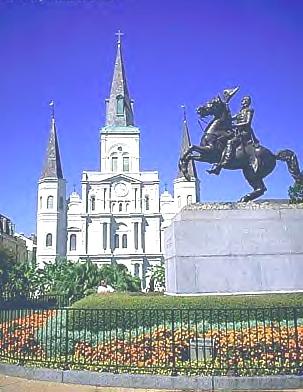
Jackson Square, Jazz City Blues


New Orleans is the most culturally distinctive, cosmopolitan city in America. We sit in our living rooms across the country and opine about people sinking to the level of beasts without thinking about the fact the most of the folks left New Orleans under forced evacuation. Too many of the people left in the city when Hurricane Katrina hit were those too poor, too sick, old, disabled, criminal or drug/alcohol-raddled to evacuate. Those few folks in the media, medical or law enforcement, and a small assortment of other able-bodied, law-abiding folks aren't enough to balance this. Most of the middle and upper class had left the city, folks, so lets not beat up the New Orleans population for what happened after that. There are other people, in higher places that need to take the blame, not New Orleans. This beautiful image of Jackson Square with the St. Louis Cathedral in happier days is from http://www.napoleonic-alliance.com/events/2003-NewOrleans.htm

Departing Guest

I'm disinclined to post anything about technology or legal education today, given the real and necessary preoccupation of the U.S. with Katrina, New Orleans, and the terrible aftermath throughout the delta region about which we probably haven't heard the half, alas. I feel that another "ordinary" post would be too much like the lecturer who continues in a louder voice after someone has yelled "fire" in the lecture hall.

Connie Crosby posted yesterday in Slaw, asking what, if anything, we in the Canadian legal community could do to help our colleagues in trouble. I've sent out a couple of feelers to see if any of our civil lawyers could offer sensible assistance. But I suspect we are condemned to watch and worry from a distance. Technical resources we have; but then so does the U.S., in even greater supply. Perhaps something will emerge in time that will allow us to participate in the necessary work of reconstruction.

By way of personal commentary, let me only refer to something in today's Globe and Mail, a tiny filler item on page 14:

Britons were more content overall during the dark days of the Great Depression of the 1930s than they are in these affluent days, according to a study into illness and the causes of social exclusion published yesterday by the University of Cardiff in Wales.

"The things that relate to happiness across countries and cultures, but are particularly relevant to the UK, are family relationships, social networks, support networks and a sense of belonging," according to the study, headed by Mansel Aylward a professor in the university's psychology department.

This is not news -- or shouldn't be. I realize that "happiness" isn't necessarily the ultimate goal, though its pursuit does come right after life and liberty in the American mythology. But what we know about it suggests strongly that, in the words of the distinguished English economist, Richard Layard:
....when all is said, a happy life is about a lot more than money can buy and, besides adequate income, happiness research points to six main factors affecting happiness: mental health, satisfying and secure work, a secure and loving private life, a secure community, freedom, and moral values.
[Lionel Robbins Memorial Lectures, 2002/2003, PDF]
Connectedness, not money. Enough money, yes. Indeed, we also now know that too wide a gap between rich and poor produces serious problems for the health of a society and its individual citizens. So not just a level playing field but a fairly level distribution of wealth, caring, shared social spaces... these matter more than... well, than we in the West seem to give them credit for. We will reach out towards the "baby in the well," spending wildly disproportionate sums to rescue one compared to the meagre resources we devote to "rescuing" the rest. So we can expect -- should celebrate -- the outpouring of concern and aid that has already begun in connection with Katrina. But when the flood waters have receded and the dove flies but does not return, will we continue to care and share and support and nurture and include?

Finally, a word of thanks for being allowed to post as a guest blogger. It's been a real honour, even if I spell it with a 'u.'

Law, Psychology, and Katrina

Here is an op-ed piece from Canada's The Globe and Mail that brings together Simon's comments on law and psychology with the chaos in Louisiana:

Americans, who rely on faith and fortune for so many of their most successful endeavours, are beginning to ask how those qualities have failed them so badly. Why is it that in some places struck by catastrophes of similar magnitude, entire societies pull together in enriching acts of mutual assistance, while other societies collapse into self-annihilation?

"Philosophers like John Locke and Thomas Hobbes tried to imagine what a 'state of nature' looked like -- we're now seeing it inside the United States and it's really brutal," says Alan Wolfe, a political scientist at Boston University who has written widely on the fragile foundations of U.S. society. "We're going to have to ask: 'How did we allow this to happen?'"

In much poorer societies, such as Indonesia and Sri Lanka after the Boxing Day tsunami, or in more polarized societies like Montreal during the 1998 ice storm, scenes of looting, violence and selfish desperation did not occur. But the large U.S. cities of the South have a very different sort of group psychology, in which faith in individual fortune replaces the fixed social roles that keep other places aloft during crises.

In U.S. cities like New Orleans, in the analysis of the American-British organizational psychologist Cary Cooper, social cohesion depends on a shared belief that individual hard work, good luck and God's grace will bring a person out of poverty and into prosperity. But those very qualities can destroy the safety net of mutual support that might otherwise help people in an emergency.

"Fear itself motivates people in the U.S. -- the fear that you could lose everything," Prof. Cooper said in an interview yesterday from his office at the University of Lancaster. "That creates the best in American society, the inventiveness, but the moment the net is pulled out, it becomes a terrible jungle." . . .

There are exceptions: The extraordinary mass acts of mutual support that followed the Sept. 11 attacks in Lower Manhattan or the floods in the Dakotas, for instance, or the charitable activity that has all but ended the AIDS crisis in the United States.

But historians point to a constant threat of self-destructive breakdowns that seem to dot U.S. history, belying the thin veneer of civility that sits between entrepreneurial prosperity and mass chaos. The individualistic, egalitarian, anti-authoritarian values that have made the United States succeed have always been accompanied by an every-man-for-himself ethos that can destroy the system itself.