Tuesday, October 31, 2006

More reaction to Harvard's curricular changes


Picking up on Jim's post the other day, wherein a blogger at Law School Innovation called Harvard's changes "wimpy," check out these related entries at that blog:

Dean of Stanford on why tinkering with 1-L is barking up the wrong tree: link
Dean Larry Kramer notes that when he speaks to alumni, they inevitably tag the first year of law school as the most formative period of their law school career. He wonders why students in 2nd and 3rd year lose interest, and thinks we need to tinker in those upper year curricula and leave 1-L alone, since it seems to be working reasonably well.

And Orin Kerr responds on Volokh Conspiracy here,

I agree with a great deal of what Larry says, although I think he is overlooking something important: j-o-b-s. By a month into their second year, many students (and almost all at a school like Stanford) are going to have lined up summer jobs at law firms. As long as they don't act like freaks over the summer, they will get full-time job offers. As a result, the rat race is effectively over for many students the moment they accept their summer positions; they pay less attention than before because, well, they can.


Pretty insightful. Check out the many comments at both sites. The image above is a refrigerator magnet with Harvard Law's coat of arms, available for purchase at http://www.seaboston.pointshop.com/ : link

Wikipedia roundup

The Chronicle of Higher Education, Oct. 27, 2006, has several articles about Wikipedia. The main article, linked above, discusses several academic studies on the reliability of Wikipedia, testing error rates and grading its quality. The second article link, discusses Larry Sanger's new spin-off encyclopedia written (he hopes) by experts. And a third article,
here, briefly recaps the development of Wikipedia from an original effort by Sanger and Jim Wales to create a free encyclopedia written by scholars, Nupedia. All articles by Brock Read. They do a nice job summarizing "our story to date," adding some detail that I had not known about several of the studies.

Monday, October 30, 2006

Harvard 1L Curriculum Reform: Tool of the Devil?

(Updated below.)

The law blogs are buzzing, in their refined, professorial way, about the recently announced 1L curriculum reforms at Harvard--adding a course in legislation/regulation, a course dealing with international law, and a course on legal problem solving. Law School Innovation calls it "wimpy"; notes that "none of the components is particularly innovative, in the sense that many law schools have added something like one of them to their curricula. If there’s anything distinctive about the Harvard revision, is that it does all three, and for the entire first year class rather than for one section (as at Georgetown), or as electives (as is true of the Regulatory State course in various incarnations)." The right-wing Focus on the Family's CitizenLink, however, sees decidedly sinister implications:

Some of America's leading law schools — Harvard, Stanford and the University of Michigan — are steeping first-year students in an education with a decidedly international bent.

Instead of establishing American basics of law like contracts and the Constitution, the schools are offering courses on global-law systems — in some cases before students are told about American law.

Harvard, for instance, modified its first-year curriculum to include global law because of the "imprint" the first year of study has on students. University officials argue that postponing classes on international law puts it in the category of an "add on."

That bothers David French, senior legal counsel for the Alliance Defense Fund.

"To be honest, a lot of these colleges are very sympathetic with the leftist drift of international law," he told Family News in Focus. "And in the international legal community there aren't the same kind of civil rights that we have in the U.S."

Bruce Hausknecht, judicial analyst for Focus on the Family Action, said law schools are following the lead of liberal judges who increasingly look to foreign law to interpret the U.S. Constitution.

"We saw (Supreme Court) Justice Anthony Kennedy in the Lawrence v. Texas decision on sodomy look to Europe and some of the courts of human rights elsewhere to help him justify striking down a Texas law prohibiting sodomy," he said.

The shift is all part of getting future lawyers to think globally, Hausknecht added. Unfortunately, it's lessening their respect for the Constitution.

"There is no guidance to be taken from how foreign courts interpret their own constitutions or their own laws when it comes to interpreting our own," he said.
(Hat tip to AELR Blog.)

UPDATE: I don't know how I failed to make this connection earlier, but note this: As Roger Alford at Opinio Juris observes, Section 6 of the Military Commissions Act provides that the terms of the Act "fully satisfy the obligation under Article 129 of the Third Geneva Convention for the United States" and that "[n]o foreign or international source of law shall supply a basis for a rule of decision in the courts of the United States in interpreting the prohibitions enumerated"--in other words, U.S. courts are purportedly barred from considering international law in the interpretation of the Geneva Convention. Alford asks:
I am not aware of comparable legislation that limits the power of Courts to rely on particular source material in their interpretive process. It clearly reflects a conservative backlash against the movement toward international comparativism generally and Hamdan specifically. I would be curious if others know of similiar provisions in other legislation. Does this portend a similar approach with future legislation?

Sunday, October 29, 2006

Redefining Open Access for the Legal Information Market

My latest article, "Redefining Open Access for the Legal Information Market," appears in the Fall 2006 issue of Law Library Journal. I have also posted it on SSRN. Here is the abstract:

The open access movement in legal scholarship, inasmuch as it is driven within the law library community over concerns about the rising cost of legal information, fails to address - and in fact diverts resources from - the real problem facing law libraries today: the soaring costs of nonscholarly, commercially published, practitioner-oriented legal publications. The current system of legal scholarly publishing - in student-edited journals and without meaningful peer review - does not face the pressures to increase prices common in the science and health disciplines. One solution to this problem is for law schools to redirect some of their resources - intellectual capital, reputation, and student labor - to publishing legal information for practitioners rather than legal scholars.
I have two points to make here:

  1. I hope this article will start a dialogue on innovative solutions to the increasing prices of legal information products. The responses that have been adopted in other disciplines, such as open access scholarly publication, do not apply in our context where the cost of scholarly information is negligible compared to the price of practitioner-oriented publications.

  2. Law library literature is almost universally below the radar for law scholars. SSRN offers one medium for law librarians to bring their scholarship to the attention of the professoriate. Why are so few of us taking advantage of SSRN?
(Cross-posted at BWTR).

Saturday, October 28, 2006

Practical Skills on Bar Exams - Legal Research may be tested


Back in August, 2006, Jim passed along a note that Legal Writing Prof Blog (here) was reporting a possible move to add legal research to bar examinations. I heard that rumor again this weekend, with the comment that New York state is most likely to adopt such an addition to their bar exam in 2009. Evidently, there would be 50 multiple choice questions administered in a stand-alone test before the "main" bar exam. The original story was reported in the Bar Examiner issue of May, 2006 (link), but I don't see any article that discusses this issue in the archive.

The issue was mentioned twice at Legal Information and the Development of American Law: Further Thinking about the Thoughts of Bob Berring (Friday, October 20-21, 2006
Prof. Roy Mersky, of University of Texas, Austin, reports on this as well, as noted in the program here.
They even held a debate on the question of whether this should be added to bar exams:


Legal Research v. Legal Writing Within the Law School Curriculum


Roy M. Mersky (Tarlton Law Library, University of Texas at Austin)

The National Conference of Bar Examiners has proposed the development of a stand alone legal research component to the bar exam. This recognition of the importance of legal research skills highlights the need for increased attention to legal research instruction in law schools. The author looks at the history of legal writing and legal research programs in law schools, notes the continued demand by practitioners and the judiciary for improved legal research skills among recent graduates, and suggests curricular and instructional changes within the academy to address both these on-ongoing concerns and the expectations of a new generation of students.

(snip)


Should Legal Research Be Included in the Bar Exam?


Steven M. Barkan (Professor & Director of Library and Information Services, University of Wisconsin Law School)

Moderator: Kathleen Vanden Heuvel (Director, Law Library; Adjunct Professor of Law; University of California School of Law, Berkeley)


I haven't yet found a bar examiner's site actually saying they are considering this new type of test. But I do know of 2 law schools which have added a required special class in research to prepare students for this skills test.

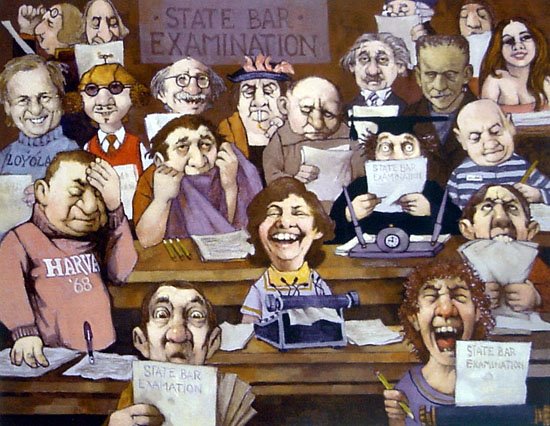
The wonderfully comic illustration by Charles Bragg, can be purchased at http://www.clfinearts.com/Charles%20Bragg.htm

Friday, October 27, 2006

Changing the LSAT

The LSAT is changing again, according to this article in the October 26th edition of Inside Higher Education. A section on comparative reading will be added in June 2007, in order to make the test more predictive of aptitude for the law. The new section will ask students to "read two passages and answer questions on how they relate to one another." The difference from the current test is that now students answer "questions on one single, longer passage." Even though this change will neither help nor hurt most students who take the LSAT, Kaplan, the big test-prep company, is recommending that students take the test now, before the changes go into effect. According to Steven Marietti, Kaplan's director of pre-law programs, "Anytime there is uncertainty in the exam, regardless of the magnitude, it should be avoided if you have the opportunity." The same argument was, of course, was made recently when the format of the SAT changed with the addition of a writing section and when changes in the scoring of the exam were instituted (1800 maximum points to 2400 maximum points). Princeton Review, on the other hand, is not suggesting that students consider changing the timing of when they take the LSAT. According to Jeff Meanza, Princeton's director of graduate programs, the changes are "only a slightly more sophisticated way of looking at these comparative passages; however, a lot of the passages that students see already require that kind of comparative logic to be used." Frankly, based on conversations I've had at law school recruiting fairs I've attended recently, students will panic about the LSAT despite all attempts to calm them down. They rightly understand that their LSAT score plays a large role in which schools accept them, and they want to be well prepared for the test.

Thursday, October 26, 2006

Constitution Day!


Happy Constitution Day! At my law school, we are celebrating today, with a panel of speakers. Evidently, it was celebrated in September at the National Archives, link in the title above. See another link here, which explains that Sept. 17 is Constitution Day, as founded by Louise Leigh in 1997. This is the tenth anniversary. This site has a video and lots of information.

The Constitution is 219 years old this year (see About.com link. Here is a Constitution Day Made Easy site at Justice Learning.org. Link for educational materials. Another link here. The Bill of Rights institute here announces that Sept. 18 is Constitution Day, so there is a lack of unanimity, which, I suppose, makes it OK that Suffolk is celebrating in the middle of October!

Happy Constitution! This image is courtesy of our National Archives website:
http://www.archives.gov/national-archives-experience/charters/constitution.html

Wednesday, October 25, 2006

Upcoming Elections: Rock the Vote reports pols using peer-to-peer networks


In an Oct. 19 post, Rock the Vote, Paul Riemer, reports that politicians are turning to peer-to-peer networks like Facebook and My Space to reach young voters. Rock the Vote notes that they are active there as well, hoping to galvanize young voters, though they appear to be non-partisan (maybe I just didn't read far enough back!). They also note Young Voters Stragies as a youth vote activist website. That website notes 15 partner organizations, focused on young women, geographical areas, Public Interest Research Groups, among others. Interesting movement. I hope they manage to engage more young voters.

The Census Bureau link reports on voter turnout (the link is for 1998, but they have other years, too). And academics study this sort of thing (see link to Columbia University webpage on voting and age, looking at voter registration and behavior among age groups they call DotNet, GenX, Boomer and Dutiful. They have graphs from 1972 - 2004 (the illustration for this post!). Very interesting site. What is shows is that the younger you are, the less likely you are to be registered or to vote regularly. Not a very good democracy if so many folks opt out of the system!

Teaching -- the ultimate "confidence game"


If you teach, I wonder how much time you allow yourself to consider how you look to your audience. This is one question I cannot allow myself to think about! I avidly read the comments on each semester's student evaluations of the class. Sometimes, I get hurt feelings, sometimes I'm disappointed. Many times, I am elated and thrilled. But what about the occasional cruel comments that I hear about: colleagues who tell me the evaluations ding them on fashion sense or other personal appearance items. That sort of freaks me out to consider.

When I stand up in front of a group of strangers at the start of every semester, I hope they are not looking at me, but through me, to the knowledge I am trying to impart. If I could make myself transparent, and they could just see into my thoughts and make a brain transfer, wouldn't that be handy?! If I stop to think about judgemental thoughts floating through those student minds, I don't know if I'd be able to teach again! One more reason to never visit one of those teacher rating sites!

Tuesday, October 24, 2006

New online map tools to track election results and more


SearchEngineWatch reports on some interesting new mapping tools that you can use to track election results:

Google Earth link has added "U.S. Elections Guide" and "U.S. Congressional Districts" information layers [link to story]. By selecting these layers in Google Earth (not available on Google Maps) you can see boundaries of U.S. voting districts, links to information and news about the candidates, where to vote, campaign finance data and other election-related information.

Map-based real estate site HotPads link (it seems to have crashed today!) has also created an interactive elections map for the coming November election. Click on any state and you can drill down on U.S. Congressional districts and information on representatives from Wikipedia and other sources.


Boing Boing link reports on another "map mash-up:"

Launching today, outside.in link is a tool for participating in the online conversations taking place about your community within your community. After you locate yourself on a map, real-time blog posts, reviews, and news relevant to that area appear. Drag the map and the content changes. The system draws from a wide variety of placeblogs, user-contributed links, and tagged neighborhood data. All of that hyperlocal information is then aggregated together and linked to the physical places where the news matters most.


From Outside.in:

Every day, the web collects new essential information about your local community: the open house around the corner; a restaurant review in the local paper; a rant from a parent about a declining public school; a concert that's just been announced; a police report on a recent break-in; gossip about a celebrity sighting. But while that information is all grounded in a real-world place, on the web it is scattered everywhere: in blogs, online newspapers, discussion threads, government sites.

outside.in is designed to change all that, as a bridge between information space and real-world space -- a place to see in a single glance all the interesting things that are happening around you.

Philosophically, this site is all about letting locals share their knowledge in ways that make sense to them, and so we've tried to make the tools here simple ones that will encourage many different ways of using the site.

(image is Google Earth)

The Information Divide - North Korea, the ultimate have-not


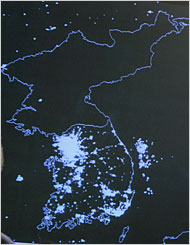
The New York Times column by Tom Zeller, Jr., linked above, calls North Korea the Black Hole of the Internet. Where in the People's Republic of China, Internet access is monitored and filtered, in North Korea, Internet access is pretty much non-existent. Read the article. This image is a Department of Defense satellite night image of the two Koreas. The column equates the light sparkling across South Korea with information access.

Monday, October 23, 2006

More on search engine optimization

One of the links from the blog entry, 20 Ways Search Engines May Rerank Results, just below this post, is a paper presented at a conference, Search Engine Strategies, 2005. Dr. E. Garcia presents, in fairly accessible language, a study of how Google and other search engines select and rank web pages. He approaches the matter from the point of view of consultants who wish to increase the click-throughs to a client's web page. But the methods of comparing and selecting web pages are fascinating. Somewhat like the methods of the natural language search engines in Lexis and Westlaw, the algorithms snip text, sort out stop words and account for duplication of words. The search engines create a window of about 100 characters or about 15 terms to compare, and work through the document creating these little windows of terms to judge relevance This is the Snippet Optimization Process (SOP).

Dr. Garcia notes

Understanding SOP permits the optimizer to conduct some tests just in case he or she suspects that a given search engine is using snippet-based filtering techniques. The optimizer or copywriter not only may be able to avoid unexpected surprises but can actually identify specific portions of text and optimize these according to the local contextual information or surrounding text.

From the development side, understanding SOP enables developers and marketers to design hierarchical clustering interfaces for content categorization.


Of course, librarians may want to increase the selection of their web pages or blogs, but more likely, our attitude is that we want to understand how the search engine works so we can write better searches. The information is equally applicable to our library aims. Read the link!

How do search engines rank results?


The flip side of searching is designing websites and search engines to show up what you need. The link in the title above is to a terrific post on a blog by a search engine optimization guy. He lists 20 ways that search engines reorder rank, with links to a number of patents. The list is nice plain language and very interesting for even the casual web surfer. The patents are more technical, but it's terrific to have the varying ranking methods pulled together in one place. Visit SEO by the Sea, above, to read his Oct. 14, 2006 post.

If you've ever wondered why a search turns out different results even using the same search engine on different days, look at this!


Some of the more amazing rank-ordering methods include:

3. Personalizing search results based on your prior searching. That's part of what those cursed cookies are for.

5 & 6. Re-0rdering rank based on country or language preference.

8. Re-ranking based on history -- age of website, age of documents, and links, among other things.

9. Ranking based on reading levels -- wow!

Looking at pages for things like reading levels, use of stop words, and other textual features. A patent filing from Yahoo! that describes one way to do this, allows searchers to use an interface to choose results that are introductory and ones that are advanced, and a few degrees between:


10 & 11. Ranking based on mobile-device or screen-reader accessibility.

14. Creating a new automatic query based on generated terms and similarity of language (more like this, I think):

This Google/Berkeley document describes reranking of results for a news search by considering and adding additional query terms, and by looking at document similarities.

* Query-Free News Search


15. Ranking based on visitor behavior. Boosting or busting rank based on the behavior of prior visitors to a website, and looking at their click-throughs.

18. Ranking based on creation of "story lines!"

This document from IBM takes search results, and reorganizes them into storylines which it expands upon in some ways, and filters in others, before presenting those storylines to a searcher

* System for identifying storylines that emerge from highly ranked web search results

19. Reranking by looking at blogs, news, and web pages as infectious disease

An analogy is used to disease-propagation models in this IBM patent application to describe how segmentation into topics paying attention to time-based changes and additions to those topics in the blogosphere and on bulletin boards might tell a search engine which topics and terms are popular, and where information about those might be located. While the process is described in the context of providing news-based alerts, the concept could be expanded to help with the reordering of search results based upon measures of popularity and burstiness (for instance, in the next section.)

20. Reranking based upon conceptually related information including time-based and use-based factors

In a number of ways, this next patent application describes a process similar to the last two methods listed. It involves grouping together concepts, and looking how those change over time and how different people participate in those changes. One of the co-inventors listed is Apostolos Gerasoulis, from Ask.


It will certainly change the way I look at search results and think about choosing search engines to realize that there are these various algorithms chugging along in the background. I was amazed enough when I began to understand the complexity of Natural Language search engines. And reading about ALEXA (query-free search engine that locates pages of interest by looking at links and click-throughs. This posting goes way beyond those astonishing ways of sorting information. There are popularity factors, like looking at the blogosphere and social networks like "My Space" for terms and links. Cool!

Thanks to Susan Sweetgall for pointing me to this website.
The illustration of a thinking cap is from Mark A. Hicks, illustrator at school.discovery.com

Sunday, October 22, 2006

Success as a law librarian -- in the courthouse

Betsy’s list of the qualities needed for the successful academic law librarian applies to court house librarians. For a court house librarian, the emphasis may be different because court house librarians work within a public institution; we have a duty to promote the aims of the justice system. We do this by providing not only reference service, but by developing and maintaining a collection and instructing users in the resources available; and we do it usually within the twenty minutes allotted for trial recess. Court house libraries operate under the time pressure of the court rules and over-scheduled attorneys.


More members of the public are coming to the public access law libraries to prepare cases that do not fit within the standardized forms created for the most frequently issues for self-represented litigants. These users are issue driven and do not want to spend the time learning legal research. They want to be given the answer. Since it takes a set amount of time to describe how to use the West’s key digest system, reference productivity can only be increased by automating the more basic knowledge of legal reference. Public access law libraries need to be redesigned to help new users.

People hate being handed a book on legal research, but if they could touch a flat screen that led through the process of how to use the codes and digests, they would be thrilled. I have tried hand-outs and people toss them aside. Once a patron sees a librarian, they want personal service. Harsh as it sounds, I think we need to de-emphasize personal interaction in reference encounters.

Court house librarians need to develop more on-line guides that describe how to how the law library and rely less upon individual personal service. The problem will be designing these portals to appeal to users. AALL has some very good guides on its web site, but I have never seen a new patron with a print-out from that website. AALL is not an obvious source for litigants. I think these instructional portals will have to be on court websites; the courts take the access to justice initiatives seriously and would appreciate our contributions.


Friday, October 20, 2006

A Rival to Wikipedia?

It looks as if a rival to Wikipedia is in the works. According to The Chronicle of Higher Education for October 18, 2006, Larry Sanger, a disaffected co-founder of Wikipedia, has "announced the creation of the Citizendium, an online, interactive encyclopedia that will be open to public contributors but guided by academic editors." Sanger wants academics to have more control over the site than currently exists on Wikipedia, where anyone can edit an article. Citizendium will soon start a six-week pilot project to determine its operating procedures.

The new open-source encyclopedia will be like Wikipedia in that anyone will be able to contribute an article; it will differ from Wikipedia in having scholars editing these contributions. Only a scholar-editor will be able to authorize modifications to articles and to approve the inclusion of new articles. The plan is for Citizendium to "import the entire collection of Wikipedia articles, delete entries deemed unnecessary, and let contributors and editors mold the remaining material." Mr. Sanger's goal, however, is for the site to become more trustworthy than Wikipedia through the participation of scholars. Time will tell whether two open-source encyclopedias can be sustained over the long haul.

Wednesday, October 18, 2006

Gay Marriage vs. DOMA: Gerry Studds' legal spouse denied Congressional death benefits

Although former congressman Gerry Studds was legally married in Massachusetts to his companion, Dean Harra, in 2004, the federal Defense of Marriage Act (DOMA) prevents Harra from collecting Congressional death benefits. Studds was the first openly gay member of Congress. He came out of the closet on the Hill after a relationship with a male page was revealed.

This is the first case of the federal DOMA barring a congressional spouse from collecting death benefits:

Gary Buseck, legal director for the group Gay and Lesbian Advocates and Defenders, said Studds's case may offer "a moment of education for Congress."

"Now they have a death in the congressional family of one of their distinguished members whose spouse is being treated differently than any of their spouses," Buseck said.


quoted from the Washington Post article linked in the title of this post.

Crooks and Liars » Olbermann: The Day Habeas Corpus Died

Crooks and Liars » Olbermann: The Day Habeas Corpus Died:

KO-HabeusCorpus.jpg Today, 135 years to the day after the last American President (Ulysses S. Grant) suspended habeas corpus, President Bush signed into law the Military Commissions Act of 2006. At its worst, the legislation allows President Bush or Donald Rumsfeld to declare anyone — US citizen or not — an enemy combatant, lock them up and throw away the key without a chance to prove their innocence in a court of law. In other words, every thing the Founding Fathers fought the British empire to free themselves of was reversed and nullified with the stroke of a pen, all under the guise of the War on Terror.

Video-WMP Video-QT

Jonathan Turley joined Keith to talk about the law that Senator Feingold said would be seen as "a stain on our nation's history."

Turley: "People have no idea how significant this is. Really a time of shame this is for the American system.—The strange thing is that we have become sort of constitutional couch potatoes. The Congress just gave the President despotic powers and you could hear the yawn across the country as people turned to Dancing With the Stars. It's otherworldly..People clearly don't realize what a fundamental change it is about who we are as a country. What happened today changed us. And I'm not too sure we're gonna change back anytime soon."

Tuesday, October 17, 2006

Jacqueline Cantwell on Google!

OOTJ co-blogger Jacqueline Cantwell, at the Brooklyn Supreme Court Law Library, has written an excellent and thought-provoking article in the SCCLL Newsletter, link above, see page 25 in the PDF. She begins:

Why do patrons love Google? I suspect Google's appeal is more than its lauded technology. The true reason is probably darker; Google does not threaten a user's authority.


Wow! Read her article and comment, please! This is an interesting view from a court librarian, working with the judges and their clerks and interns. She goes on to state:

Google gains an authority because it does not assume authority. ... Authority is something we law librarians only think of as precedent. We need to expand our understanding of authority and power. How a fact is presented affects how it is believed.


Jacqueline makes some interesting and very challenging observations about the huge popularity of Google and the future of libraries. Excellent analysis and presentation!

Contemplating law librarian requirements for success


What makes a great law school librarian?

* Skill and willingness to keep learning new tricks, new skills and new resources. You start with the basics of legal research, or the tech services skills of cataloging, systems work or circulation/reserve, etc. But you have to keep learning new things every day! You learn how to do it with the collection and databases available at YOUR library. You learn who to contact, who to work with to get the job done.

* Great memory (or a good note/index system) -- So much of how to do things is kept in our heads. You have to learn from every question you answer, and build a database in your mind (or palm or laptop or rolodex or somewhere!)

* Student focused -- ya gotta be fond of them, and have sympathy for the demands and stresses they labor under. But you also have to remember that this is a teaching environment -- you teach them how to do it, not do it for them. And hopefully, you also help them see how to be a professional as well.

* Flexible and Tough -- it helps to be able to change your plans, your judgements and your presentation at a moment's notice. The Internet connection goes down. The administration calls a meeting. The material you planned to use or present is missing from the shelf. Deal with the dean (or prof) who needs it yesterday. Don't get rattled, think up a new approach! Talk to the outraged patron, listen to the frustrated faculty member, and remain unruffled yourself. Wow!

* Hard to Faze -- every time you think you've seen it all, something pops up to surprise you: The professor who put his laptop in the freezer, the student who needs special settings on the computer, the new billing department at Westlaw where nobody understands what subscriptions they are dealing with. You gotta go with the flow, and handle it all with a smile and never a blink.

* Collegial -- A huge amount of your job is interfacing with other librarians, both in your institution and at other libraries. You also have to build good working relationships with the other administrators around your law school and your university. And working with faculty and deans to support the educational enterprise, absolutely key!

* Sense of Humor!!! Gotta laugh!

* Enjoy the job.

Do you have anything to add? This is a job that is evolving every moment, morphing from its deep roots in the written word to a digital world. It's like riding a big wave, keeping your balance and finding the center to work from.

Image is Jon Roseman: a BIG day in Tavarua, Fiji - on www.bessellsurf.com, a surfboard manufacturer.

Monday, October 16, 2006

Flickr in Law Libraries

See Why Flickr Is So Great for Libraries at The Shifted Librarian.

Are any law libraries doing anything with Flickr? I know a few (not many) of my librarian friends have Flickr accounts, and I've posted photos from our 2005 fire and 2006 flood. How are others using photo sharing services like Flickr to show your patrons and funders what goes on behind the scenes?

UPDATE: The indefatigable Connie Crosby writes about Flickr at LLRX.com in her column, The Tao of Law Librarianship.

Cognitive Dissidents

Hat tip to Crooked Timber: Cognitive Dissidents

A magazine called Cognitive Dissidents came online several weeks ago, so its long past time that I link to it. The contributors include a core of philosophy grad students from UW Madison, plus other philosophers and intellectuals. It has a magazine rather than a blog format, and promises regular issues rather than the chaotic and teasing semi-regular updating of the blog format. The current issue has several interesting essays on topics ranging from ethical eating through fair trade, global responsibility for poverty and the distinction between war and terrorism to reflections on the relationship between philosopizing and political activism. Worth keeping an eye on.

Saturday, October 14, 2006

Targeted Trojans - new security focus at firms


Mal-ware security experts at the annual Virus Bulletin Conference in Montreal say the worms and phishing and spam attacks are the least of their worries. Evidently, there is a new wave of security attacks specifically aimed at a single multinational corporation or law firms, among a few others. The e-mails tend to exploit un-published security flaws in Microsoft products, and tend to be sent the day after the monthly patch. These attacks are called targeted trojans or Zero Day attacks (Zero Day apparently meaning the day right after patch days). C/Net reports:

The use of zero-day flaws circumvents traditional signature-based security products. These products rely on attack signatures (the "fingerprint" of the threat) to block the attack, which requires the attack to have been identified at least once before.

"This is the future of malware attacks," said Andreas Marx, an antivirus software specialist at the University of Magdeburg in Germany. "People affected by this won't be protected by antivirus software because there is no signature."

A signature is created when antivirus companies get a report from an infected company, when they see samples in their own honeypots, or get samples from other antivirus companies. "This doesn't happen with targeted attacks, as only an extremely small number of people get infected," Marx said.

As an example, Shipp said that only four antivirus products today detect one specific targeted attack that was first spotted months ago. Other products still let it through. MessageLabs is able to identity some of the threats by looking at the specific details of Office documents attached to e-mail and pinpointing unusual code in them, he said.

The identity of the attackers is mostly unknown. Security experts have theories of multiple gangs in different parts of the world, but haven't been able to pinpoint them.

The motivation of the attackers is also topic of dispute. From his analysis, Shipp believes the intent is to steal information. "In other words, corporate espionage," he said.

But Symantec's Weafer isn't so sure. "Whether they are for hire, or whether they are simply trying stuff out is not clear," he said.

Security companies are working on behavioral blocking and other techniques that go beyond signature-based detection to protect systems. Heuristics, which are programs that use pattern recognition, instead of being based on algorithms, are one example.

"Antivirus companies have moved in leaps and bounds in terms of heuristic attacks," Cluley said. "It is not completely disastrous, even if it doesn't appear on the radar. Good proactive protection can still defend against a lot of this stuff," he said.

The real good news is that there is a only a very low probability that any specific company was attacked last year, Shipp said. "The bad news is, if you were attacked and it was successful, it is of very high value," he said.


The links for articles on this topic, along with their own links to related articles:

Future of Malware: Trojan Horses

Zero-day Wednesdays

SANS Internet Storm Center

Arizona U. "How to Remove Malware

Michael Horwitz How to Remove Spyware and Malware - This is much more in-depth than the Arizona page above, and discusses the pros and cons of each method, noting that you may be creating new problems, and how some problems mask themselves and look clean when they are not. Written first in 2004, this page was updated July, 2006. Thank you, Michael Horwitz!


The decoration is a detail of Tiepolo's "Procession of the Trojan Horse," from the Wikipedia Commons, http://commons.wikimedia.org/wiki/Image:Tiepolo_-_The_procession_of_the_trojan_horse.jpg

Thursday, October 12, 2006

The Dead Hand of Malware: Cached Exploits Live On!

The very common practice of search engines and others "caching" web images is keeping malware alive and viable long after it has been disabled on the original website! Techworld news website (linked above in title to this post) reports on a Finjan linkreport:

... caching technology used by search engines, ISPs and large companies has been discovered to harbour certain kinds of malicious code even after the website that hosted it has been taken down.

Such "infection-by-proxy" code can remain in caches for as long as two weeks, giving it a "life after death" at a time it would conventionally be assumed to have been neutralised. Although caching does not always save copies of everything on a website, it will still store code embedded in html, including programming formats such as Javascript.

The company offered details of how code designed to exploit a number of vulnerabilities in Microsoft products from 2003 and 2004 was able to continue in the public domain thanks to it hiding in the cache servers of one of three unnamed search engines.
...

"This is more than just a theoretical danger. It is possible that storage and caching servers could unintentionally become the largest 'legitimate' storage venue for malicious code," said Finjan’s CTO Yuval Ben-Itzhak. "Almost every malicious website out there has a copy on a cacheing server," he told Techworld


Isn't this kind of like finding out that the CDC holds vials of smallpox virus? Except that the cached remains aren't under any security at all!

Blessed Ramadan


For my friends and colleagues who are Muslim, we are in the middle of the month-long fast of Ramadan. Between dawn and dusk, observant Muslims from the age of 12 fast. And this is a serious fast -- no food, no drink, no smoking. They typically have a pre-dawn meal at home and then have a major meal after sunset. The month commemorates the revelation of the Koran to the prophet Mohammed. Ramadan is a period of spiritual purification, seeking inner peace through prayer, fasting and charity (even more than the rest of the year). This goes on until Ramadan ends (about Oct. 24, depending on where in the world you are), with the feast of Eid al-Fitr, literally "Breaking the Fast." This is one of two most important Muslim festivals, the other being the Hajj. Ramadan began this year on Sept. 23, the same day that Jewish New Year, Rosh Hashana began. Peace be to all, because as the Muslims (at least used to) say, Allah is one. What a shame there is such enmity with our brothers who all believe they descend from Abraham!

The illustration is a current U.S. stamp celebrating Eid al-Fitr, from the website http://www.factmonster.com/spot/ramadan1.html

Wednesday, October 11, 2006

Blogger Alert: Defamation Judgment $11.3 Million for libel on Blog

The link in the title to this post is a story in USA Today for Oct. 11, 2006, p.4A. Sue Scheff, founder and operator of an educational referral service called Parents Universal Resource Experts (PURE) claims she was libelled on the internet by the defendant Carey Bock. The decision was actually a default, since Bock, whose home was destroyed by Hurrican Katrina, missed the trial and was unrepresented. Bock lives in Louisiana and the trial was in Broward County, Florida. However, the jury did hear the case and awarded Ms. Scheff $11.3 million dollars in damages. Scheff realizes that Ms. Bock cannot possibly pay the damages, or even court costs. But she felt so strongly about her case that she was willing to pay court costs and her attorney fees to have the matter heard.

Bloggers are understandably shaken by the size of the jury award over libel on the Web. Scheff is quoted in the USA Today article as wanting to

make a point to those who unfairly criticize others on the internet. "I'm sure (Bock) doesn't have $1 million, let alone $11 million, but the message is strong and clear," Scheff says. "People are using the Internet to destroy people they don't like and you can't do that."


Interestingly, this is not the only libel case in which Ms. Scheff has been involved. She was the defendant in World Wide Specialty Programs v. PURE, Sue Scheff and Jeff Berryman, a libel suit originating in Utah's federal district court. The case was appealed to the Court of Appeals, 10th Circuit, which decided in favor of Scheff in June, 2006. (Berryman was dismissed as a defendant). Docket No. 04-4312, 450 F.3d 1132.


In the Utah federal case,

A three-day jury trial against Ms. Scheff ended with a verdict in her favor. World Wide then moved for a new trial based on multiple claims of error. The District Court denied the motion and entered judgment against World Wide. World Wide now appeals both judgments. We take jurisdiction under 28 U.S.C. § 1291 and AFFIRM.

Background

World Wide is an association of residential treatment programs for troubled and at-risk teenagers. It does not own or operate schools; rather, it markets its members' schools to parents who might be interested in them. Ms. Scheff was one such parent. Her daughter attended a World Wide member school for nine months before Ms. Scheff decided to remove her from the program. Less than a year later, Ms. Scheff founded PURE. Like World Wide, PURE provides information about programs for families seeking help for their children; PURE-affiliated schools compete with the schools associated with World Wide. PURE schools pay Ms. Scheff a substantial sum whenever a child enrolls in its program based on her recommendation.

After the creation of PURE, Ms. Scheff used various fictitious names to post negative messages about schools for at-risk teenagers on an internet forum. Several of the schools Ms. Scheff disparaged were schools affiliated with World Wide. ...

We agree that World Wide is a limited-purpose public figure. To begin, it is clear that there exists a public controversy as to the most effective method of treating at-risk teenagers. Indeed, the record includes numerous news accounts about the public debate surrounding this question and the use of particular behavior modification programs associated with World Wide. Second, World Wide's participation in this public controversy is extensive. As the District Court pointed out, World Wide's mission as a marketing company is to take an active role in this debate by both promoting its members' programs and defending those programs that are marred by scandal. But more than merely advocating for its individual members, World Wide has injected itself into the debate by promoting itself and all programs associated with it. For example, one article specifically centers on whether World Wide programs are effective and quotes the president of World Wide as saying, "Parents are . . . very much in support [of World Wide programs]." Michelle Ray Ortiz, Behavior Modification: Salvation or Brainwashing? Programs for Troubled Teens get Mixed Reviews, Miami Herald, June 13, 1999, at 4B. Additionally, World Wide's public comments frequently refer to satisfied parents in response to charges of abuse. Accordingly, it is clear that World Wide "thrust [itself] to the forefront of [this] public controvers[y] in order to influence the resolution of the issues involved." Gertz, 418 U.S. at 345. The District Court did not err in deeming World Wide a limited-purpose public figure.


Well, there's a twist! While Ms. Scheff made a big point in Florida court, she managed to escape retribution for the what appears to be the same or greater mis-use of the Internet in Utah federal courts, because the target of her libel was held to be a limited-purpose public figure, requiring it to reach a much higher standard of proof.

And for those who want to see more about the developing area of Internet law, here is an interesting blog, Breaking Oracle News, link here. This is a posting by consultant Donald Burleson, and has some nice links to earlier posts by same, on related Internet and blogging legal issues. I offer no opinion as to Burleson's qualifications, but it is an interesting site.

And see this site with a press release about the Utah decision. According to the press release, (which does not list PURE in its URL, but has banner ads for PURE and links for PURE), the jury was shocked by photos and video footage introduced at the Utah trial purporting to show child abuse at the World Wide facilities. Clearly this is a lightning rod topic with opponents on every side using the Internet to push various agendas. I hope that the default decision in Florida will not cause the public to misinterpret the actual law of defamation and publication, which exists beyond blogs, and yet clearly applies to them as a form of publication.

Statesmanship is Rising above Political Party Polarization

It's so ironic that our current president once characterized himself as a uniter, not a divider. The United States has not been so polarized along party lines in a very long while. With international crises like the North Korean nuclear test, our country needs to move beyond the current political posturing aimed only at convincing the electorate about who is a good guy or a bad guy in time for November elections. Being a statesman means looking at the wide picture and acting for the long term. See the New York Times piece by former President Jimmy Carter with a brief history and recommendation about meeting the North Korean challenge here.

Walter Lippman, journalist and gadfly, in “The Indispensable Opposition,” Atlantic Monthly (Boston, 1939), said of the value of listening to those on the other side of the political aisle:

The opposition is indispensable. A good statesman, like any other sensible human being, always learns more from his opponents than from his fervent supporters. For his supporters will push him to disaster unless his opponents show him where the dangers are. So if he is wise he will often pray to be delivered from his friends, because they will ruin him. But though it hurts, he ought also to pray never to be left without opponents; for they keep him on the path of reason and good sense.


Let us hope somebody in our current government is susceptible of good advice.

Tuesday, October 10, 2006

Negotiation: The Rules of Engagement


I think librarians in general are very poor negotiators. I don't think I am very good at this, and am very happy to delegate purchase and subscription negotiations to staff members who have a real talent and a good track record. But I believe I can learn better skills and am always looking for helpful articles, training and other resources.

Looking in the September, 2006 issue of Information Outlook (vol. 10, no. 9), there is a wonderful little article, The Rules of Negotiation, by Debbie Schachter (pp. 8-9). She has seven main points:

1. Rules of Engagement
- both parties need to be aware of, and honor these rules for a negotiation to be successful. Both parties must intend to reach an agreement, not merely asking for information. The aim is to come out with an agreement that is mutually beneficial. If both parties honestly aim for those two points, the negotiation should be successful. Think, for example, of job shoppers who apply for positions they don't really intend to take -- how annoying and how it messes up the search process for everyone else. Consider librarians contacting vendors with what amounts to an investigation. But if the vendor is not clear and believes the librarian is in good faith shopping for a new product, it wastes everybody's time. Alternatively, publishers and vendors who "negotiate" with a library with no intention of really shifting from the original offer.


Other headings in the article:

2. Do Your Research
-- Prepare yourself for what outcome is possible and what is desirable. You want to know if there is a viable alternate product, for instance. Are there other positions you can look at, or are you happy to stay where you are if the offer does not meet your requrirements?

3. Know What You Want/Need -- What aspects are required to meet your needs or your patrons' needs. What would be icing on the cake? Are there time constraints, budget limits, or other limits to what you plan to negotiate? Can you wait for another budget year, another model or another offer? What changes do you anticipate coming up in your library or your life that affect what you need and what you will need in the near future? Is this the first of a series of steps or purchases?

4. Know Your Motivation -- Is the price, level of service, or another factor the "make it or break it" aspect of your negotiation. If you are looking at a job, how much does location, or type of employer, or pay level, status or benefits affect your choice?

5. Building Trust -- If you are in a one-time negotiation, this won't affect things. But maybe you are dealing with a long-time vendor, somebody with whom you will be working in the future. Or if you are looking for a job, this would also affect your negotiations. Think of the long term effects on your relationship. From the vendor side, this is also important. They are very aware of the effect negotiations have on their relationship with individual libraries and with the library community in general. One proof of this is the common attempt by Lexis, Westlaw and some other vendors to require libraries to keep the terms of their contracts confidential. I am very glad the library community is beginning to rebel against this tactic. It destroys trust between the vendor and library and leads to the assumption that they are trying to screw each of us individually.

5. Be Honest -- this is a good tactic if both sides are negotiating in good faith. I think it must lead to a mutually beneficial arrangement. I don't want to lie to vendors, and I wish I felt they wouldn't lie to me. This is a sad statement to make, but I think it's increasingly true as the publishers and vendors are more and more merged and acquired into a few monopolistic behemoths run by MBAs with little history or loyalty to the law library community.

6. Know When to Leave -- this is a vital skill. When you can see the opposite party is not being honest, or fails to meet one of your basic criteria, it's time to leave. My favorite story about this involves a friend, an unmarried woman, who was buying a car. My friend told the car salesman that she wanted X kind of car, within X price range. The salesman started this all-too-common bait and switch business. As soon as he rolled out the wrong (more expensive) car, my friend looked him in the eye and said, "That's not what I asked for." And she left! She is my hero, and I wish I could have been a fly on the wall.

The article in Information Outlook is a great primer. Here are a few other resources:

How to Negotiate Like a Pro link -- I have no idea who wrote this short advice page, but the advice echoes the Schachter article.

Writeslaw link -- This is a page aimed at parents or guardians negotiating an Individualized Education Plan (IEP) for a child with the school district. It again has good advice, and much of it can be transferred to other types of negotiation. One item they add to the above list is Don't Interrupt. It's not only rude, you may also miss important information and position statements. The author, Brice Palmer, also adds some clarifications to the preparation notes above: Know which points you MUST have, and know which positions are "throw aways" that you can give to achieve another point. For anybody doing this kind of advocacy for K-12 students, this is a good site with links for full text of important federal laws that require school systems to provide certain services. The site also includes many other articles and lots of advice.

Dr. Phil Negotiation -- A helpful, succinct series of bullet points. Much of this echoes the previous articles. But he is very heartenting, with specific phrases suggested. I like this page as a librarian, because he, like Schachter above, proposes that the negotiation can be more like a collaboration, with both sides winning. I like to think that is a possible outcome, despite how cynical I am about some vendors and a few employers. Like Wrightslaw above, he also counsels you not to take the negotiation personally. I think that's one of my problems.

WORC PDF link -- An article from the Western Organization of Resource Councils, this is nice because it is written from the point of view of a representative of public interest groups. The article urges you to have fun in the process (wow, that's a new concept for me!). They also list Getting to Yes: Negotiating Agreement Without Giving In , by Roger Fisher and William Ury. A book - what a novel idea! Try a keyword search in your library catalog for Negotiat* (truncated term), and find a plethora of electronic and print resources for the legal, business and general negotiator.

The adorable poster decorating this essay, with good advice, no less, is from http://wordfeeder.typepad.com/photos/uncategorized/negotiate.jpg, a blog by Dina at BlogFeeder, a copywriter and marketer. Kind of an interesting blog, too!

DocuTicker, Govt & Think tank reports at your fingertips

DocuTickeris a daily update of new reports from government agencies, NGOs, think tanks, and other public interest groups. DocuTicker is compiled by the librarians who bring you ResourceShelf.com.


You can set up an RSS feed, subscribe to a weekly newsletter or just visit the site periodically to search or browse. It's world-wide in scope, and overwhelming in size. But the site is also very nicely organized (of course! they're librarians). It has a search box, and search tips, as well as drill down organization by topic. The archives go back to June, 2004, and has daily updates. What's not to like? Thank you to the editor, Shirl Kennedy and the staff who make this run.

Monday, October 09, 2006

Wi-Max, new connectivity Smart drives

Hiawatha Bray, in the Boston Globe, discusses Wi-Max, the next big thing after WiFi. Already deploying in some areas, and expected to really expand in 2008 with a push by Sprint, Wi-Max offers faster speed, greater distance and reliability. Fixed Wi-Max is available to businesses, who deploy it by pointing an antenna. And Clearwire Corp. is already offering Wi-Max in small towns in a version designed to reach laptops and other portable electronic devices. Wi-Max will probably be standard on portable electronics in coming years.

Bray also reported recently on a new smart drives that make your software and settings portable, even in a thumb drive or Ipod. The entire article is here.

A new product called MojoPac lets iPod users take control of any desktop computer running Microsoft Corp.'s Windows XP operating system.

And major flash memory makers like SanDisk Corp. and Lexar Media Inc. have begun making ``smar