Thursday, November 30, 2006

Trouble in Minnesota

A controversy has erupted at the University of Minnesota Law School about the hiring of Robert Delahunty, currently an associate professor of law at the University of St. Thomas. An article in the November 29 issue of Inside Higher Ed summarizes the controversy surrounding Delahunty, which "stems from a memorandum drafted in 2002 by Delahunty and a Justice Department colleague, John Yoo, a conservative scholar and professor of law at the University of California at Berkeley's Boalt Hall." This is the infamous memo that "concluded that the Geneva Convention did not cover Al-Qaeda suspects captured in Afghanistan, and helped lay the foundation for the Bush administration's handling of prisoners captured during the war on terror." When one considers the damage that our treatment of prisoners has done to our standing in the world community, it is easy to understand why some members of the Minnesota community would object to Delahunty's presence at their law school.

A first-year student is circulating a petition requesting that the dean reconsider bringing Delahunty to Minnesota. The administration at Minnesota has stated that the students' objections were a "gross violation of academic ethics and academic freedom." But the students respond that their objections do not stem from ideology, but rather from legal ethics. The faculty has also become involved in the controversy. Nine Minnesota professors who objected to Delahunty's hire stated in a "sharply worded letter" that "Mr. Delahunty's role in the Torture Memos was not academic and we object to hiring someone of his credentials rather than to anything that he may say in class should he be so hired..." It is shocking to think that an individual who twisted the Constitution in order to make it fit what Bush, Cheney, and Rumsfeld were intent on doing should be entrusted with teaching constitutional law at one of the top law schools in the United States.

Wednesday, November 29, 2006

Can an employer fire or refuse to hire smokers?


Another local development is this Globe story about Scott's lawncare firing an employee for smoking off the job. The former employee has sued. I am a non-smoker who is very grateful for the societal changes that reduce my exposure to second-hand smoke. But even I found it pretty disturbing that an employer would think it right to control employees' private behavior. It leads to all sorts of disturbing scenarios that have been raised as testing for various diseases and genetic pre-disposition for disease became possible.
I found this blog posting tracking announcements of Scotts and other employers that they will no longer employ smokers. North Carolina's Atlantic Beach also decided not to hire smokers link. Here is a CBS News story on employers regulating employees' private lives, titled "Whose Life is it anyway?"


And this announcement that refusing to hire smokers is NOT discrimination in the EU. This website discusses in considerable detail the author's legal analysis of including smokers as a group under "negligent hiring," as being dangerous to other employees. Includes a bibliography and lists of cases on hiring/firing, dangerous cigarettes, and more. Attributed to The Crime Prevention Group link which states as its mission:

# three functions, providing (1) background information on smoking and laws,
# (2) links to more detailed information, and
# (3) letter writing samples for you to take action to promote safe cigarettes by contacting government officials with authority to accomplish that goal.


The MSN money website also mentions an employer firing employees after instituting a no-smoking-employees policy link. This story links to WorkRights, where a search for smoking turns up a number of stories of employers firing, testing, and refusing to hire, smokers here.

The issue is sometimes called "lifestyle discrimination." Under that rubric, you can locate reports from

the ACLU here

Stephen Sugarman paper at U.C. Berkeley e-repository link (dated 6/27/02)

You're Not The Boss Of Me: A Call For Federal Lifestyle Discrimination Legislation, 74 The George Washington Law Review 553 (April 2006).

National Workrights Legislative Brief link Includes model statute, list of states with relevant legislation, and a brief bibliography, which only dates 1980's - 1991.

Washington Post article dated 10/06 on workplace discrimination link

Ungaretti and Harris law firm report on Illinois law prohibiting "lifestyle discrimination." link

Inside Counsel's analysis of how the ADA may prevent lifestyle discrimination here

Seattle Times story from 2004 on employers' refusing to hire smokers, which lists employers I did not see noted elsewhere link

Jackson-Lewis Connecticut Employer article on lifestyle discrimination from 2005 link

Bender's Labor & Employment Bulletin, June 2006 on the legal implications of "Wellness Programs." link through Jackson-Lewis.

Article from American City & County on how wellness programs reduce health care costs (dated March 1, 2005) link


Image courtesy of http://www.cbc.ca/news/background/smoking/

YouLibrary?

Now this is truly a fantastic idea: the Allen County Public Library in Indiana is posting internal training, outreach, and local community videos on YouTube! What a great way to offer training for staff--and for library users--whenever and wherever they like!

Boston Bar's Volunteer Lawyer Project links lawyers to clients for trial opportunities

The article in the title link here is from today's Boston Globe. It details the phenomenon of the "disappearing trial." So many cases now settle out of court, that many newer lawyers have difficulty finding opportunities for trial work. The Boston Bar Association's excellent pro bono program, Volunteer Lawyers Project, is addressing that problem by offering Boston area attorneys the chance to represent landlords and tenants in the Housing Court.

Tuesday, November 28, 2006

No Two Snowflakes Are Alike


Everybody says these things, but who knows if it's true? I mean, have you actually examined snowflakes to see? And how could you ever know -- nobody could examine all the snowflakes in the world. Actually, it turns out that some physicists at CalTech do, in fact know. Statistically speaking, it seems to be true: no two snowflakes are likely to be exactly alike. Visit the link in the title for a nice change of pace and read why.

I'm just living vicariously here -- Boston is preternaturally mild all this November. When we should be having bluster, snow and sleet, it's been soft blue skies and sun or mist. Makes all good New Englanders fear the winter that's surely coming!

Legal Materials Prices

The discussion on pricing of legal materials fascinates me. If I were an economist, I would be better able to approach the question.

In the court libraries, law reviews and SSRN are never used. Practicing attorneys and judges rarely read more than five law reviews a year. SSRN articles are never used. I know that in my library, I could cancel law review subscriptions without any marring of patron satisfaction, Even though law reviews are cheap, the time spent creating serial prediction records and check-in could be better spent.

Judges and attorneys heavily use the commentaries and annotations in the New York State codes. The indexes to print materials are very helpful. The West’s New York Practice series answers almost all of my reference questions that are not answered by the Matthew Bender materials.

What is the value of those items? And is the value applicable to the price? Practicing attorneys don’t pay for these materials. They rely on public investment. My library saves a lot of attorneys a lot of money. The court by subsidizing these materials promotes the more efficient use of court time. For the amount of people working in my unit, my proportion of court moneys is substantial.

The publisher’s editorial enhancements are a substantial intellectual effort to place legal effort within a framework. My most successful attorneys rely upon those editorial efforts. It is the self-represented who sit at the terminals composing searches. The attorneys use Lexis when they know what they want.

My question is—how can this intellectual effort be priced? Value is a different term than price. We are not happy with the price, but the attorneys are happy with the value of these resources. Right now, libraries are cutting back on titles. Will this damage court administration? Will there be less justice in the street because we cancel law reviews?

At some point, the merry-go-around stops. The courts could announce that they will only accept criminal cases. That was threatened at one point during the NYC budget crises. Civil cases would go to private judges and be handled only by boutique firms with their own libraries. That practice has affected court filings in California and by extension the California public access law libraries that rely on civil filing fees for their budgets. Solo practitioners might disappear; people cannot afford attorneys and the poor solos lead lives of desperation.

The states and courts have done a good job of making current law available over the Internet; it is the intellectual work to conceptualize the law which the private sector provides. I don’t see universities or libraries doing as good a job as the private publishers I don’t understand the calls for universities to compete with private publishers. Such an effort would require a complete reorganization of funding, promotions, tenure, and teaching, even clerkships because law reviews would have to be dropped. Law schools have a poor editorial record of supporting courts; the private publishers do a better job. Complain as we do about the prices, the publishers provide a service. We just don’t like the price. Our economy has shifted from manufacturing to information; maybe we have to start new ways of measuring value and price.

Sometimes I think the private publishers have identified government as the last growing part of the economy and price accordingly. They are in a spot. Their classifieds are going down; Craig’s list destroyed newspaper classifieds. The publishers have laid off staff and outsourced production. Where else can they go to make money, but government and courts?


Monday, November 27, 2006

Presidents usurping legislative powers - a longer view

Apparently, a historical view of the issue of executive encroachment into legislative prerogatives reaches back considerably before the signing statements of current President Bush. Interestingly, the Cato Institute issued a report in 1999, Executive Orders and National Emergencies: How Presidents Have Come to "Run the Country" by Usurping Legislative Power link. Note the date, still during the Clinton presidency. See also the Cato analysis of The Problem with Signing Statements, link, which also appeared as an essay in the Chicago Tribune, in July, 2006. You can see an interesting webography on the issue of separation of powers at Cato, here.


Another historical survey of presidential powers, from The Daily Reckoning, here, dated 2006, "The Limits of Presidential Power: All the President's Power," by By Thomas E. Wood Jr. This site describes itself as libertarian.

The American Bar Association's bi-partisan committee studied the effect of presidential signing statements link, in July, 2006. See here for a link to the full text of the report and information on the taskforce members.

In-depth law review article at 52 Duke Law Journal 403, Mark J. Rozell, "Executive Privilege Revived?: Secrecy and Conflict During the Bush Presidency," link.

A list of law review articles on the topic of presidential powers from the American Constitution Society, here.

And, at ConsortiumNews.com (which bills itself as independent investigative reporting since 1995), there are a variety of essays on the topic of the new "imperial presidency" model of Bush-Cheney:

Roberts and the Apex of Presidential Power link

Bush's Absolute Power Grab, here. This essay covers the signing into law of the Military Commissions Act, which was blogged in-depth here at OOTJ here.
More on this troubling act, here and here, at ConstitumNews, from Robert Parry. Here is a webography from ConsortiumNews on the "Imperial Bush," link.

For another discussion on the limits of presidential power, see Legal Affairs' Debate Club dialog between Berkely law Prof. John C. Yoo and Prof. Neil J. Kinkopf of Georgia State University College of Law, link from November, 2005.

Prof. Yoo writes at the Heritage Foundation, on "Energy in the Executive: Re-examining Presidential Power in the Midst of the War on Terrorism," last April, here.

Prof. Kinkopf writes more as well, on Jurist at Pitt Law, in March, 2006, link, on statutes and presidential power.

CQ Researcher, in 2002, issued this report, Presidential Power v.12-40. See also CQ link to "Constitutional Powers of the President."

This report at SaveTheCourt.org, under the aegis of the conservative People for the American Way. Titled, "PRESIDENTIAL POWER, CONGRESSIONAL AUTHORITY, AND ROLE OF COURTS," the report is looking at the confirmation of Justice Alito. Another article looking at the same issues in the context of Alito's confirmation, from the L.A. Times, at the Pew Forum on Religion and Public Life website, here.

On Findlaw's Writ, John Dean writes here on "The Problem with Presidential Signing Statements: Their Use and Misuse by the Bush Administration," in January, 2006. Dean analyzes the effect of the signing statements.

From a comment on Slashdot, a collection of quotes dated 2004, from past presidents on their view of executive power, here, compiled by Tod Landis.

An essay on the Hamdan v. Rumsfeld decision as the "most important decision on executive power, ever," at The Nation, here, July, 2006.

A brief article from IndyMedia, here, and a referral to the New Yorker article of July, 2006, here, by Jane Mayer, "The Hidden Power: The legal mind behind the White House’s war on terror." That mind belongs to David S. Addington, Vice-President Cheney’s chief of staff and his longtime principal legal adviser.

At The American Conservative, an article on Bush's use of signing statements here, from July, 2006, "Power of the Pen: The president uses signing statements to decree which laws apply to him ," by James Bovard.



Justice Scalia

Best-selling author and practicing attorney Scott Turow writes in the November 26 New York Times Magazine in an article entitled "Scalia the Civil Libertarian?" that the Bush Administration has faced obstacles in waging the so-called war on terror from the Supreme Court. "Objections to Bush's sweeping view of executive power have come not only from liberals and centrists...but, more remarkably, from Justice Antonin Scalia, who may end up playing a pivotal role in future war-on-terror cases." Scalia has been criticized for, among other things, his cozy relationship with Vice President Dick Cheney (remember the duck hunting trip, following which Scalia refused to recuse himself in a case involving Cheney); the appointment of Scalia's son to a position in the Labor Department after Bush v. Gore; his opposition to Miranda warnings and the exclusionary rule; his refusal to recognize a woman's right to an abortion, making him "a conservative icon and a favorite face on liberal dart boards." According to Turow, however, Justice Scalia has also often "taken an expansive view of the Bill of Rights, thus supporting defendants in criminal cases," such as his concurring opinion in Apprendi v. New Jersey, a case that "revolutionized sentencing laws." Turow cites other examples of Scalia's pro-civil rights decisions, and states that he is "led to these seemingly divergent positions by his unyielding adherence to a school of constitutional interpretation called originalism. To Scalia, the Bill of Rights means exactly what it did in 1791, no more, no less. The needs of an evolving society...should be addresed by legislation rather than the courts."

The war on terror causes problems for originalists. In some cases, "Scalia has come down strongly on behalf of the administration and its prisoners." But, Turow says, the "extensive powers claimed by the Bush administration" are in conflict with the fact that the Bill of Rights was created to "keep the new American executive from repeating the monarchal abuses of King George." And yet, Scalia, in his dissent in Hamdi v. Rumsfeld stated that "Congress has not given the president the power to hold any American, even one who has taken up arms against his country, as an enemy combatant and instead must present criminal charges or let him go."

We now have an administration dedicated to the expansion of executive powers (see Betsy McKenzie's excellent blog entry below entitled "Dick Cheney and his long-time campaign to extend Presidential powers"). Turow opines that the Bush Administration must be wondering how Scalia will decide future war-on-terror cases. The Court's "centrists" are likely to "apply nuanced balancing tests," while the conservatives on the Court, Thomas, Alito, and Roberts, "have shown an inclination to defer blankly to executive power," which is probably one reason that the latter two were appointed. Scalia may be the wild card, because he is "more like the court's liberal members in seeing the Bill of Rights as a constitutional trump when it collides with government power."

Turow concludes by speculating that Scalia's "occasional alliance with the court's more liberal justices could be struck again in future terror cases. The result would be an unequivocal declaration that executive power must yield to constitutional liberties, even when the nation is on the prolonged war footing we seem to have adopted." I am very grateful to Turow for this insight into Scalia's jurisprudence.

Sunday, November 26, 2006

Law Librarians and Reporters--The Movie

No, it's not a replay of "The Front Page" or "His Girl Friday."

Earlier this month, blog entries noted the rising price of legal materials. At the same time, newspapers were being forced to lay off newsroom staff because their profits were insufficiently high. Some of these newspapers had profit rates of twenty percent. Newsrooms were aleady lean after years of cutbacks; a study I read last year found that most newspapers recycled the same wire copy. Not a surprise to anyone who reads small town newspapers that shut down capital bureaus years ago. Newspapers used to rely on stringers paid on spec; now newspapers rely on blogs written by students living on loans.

Our publishers are divisions of these media companies. Our price woes may flow from the same roots as the newspaper problems. How many new books are brought out by publishers? What is the cost of updating content? With publishers shifting to on-line publishing, have production costs gone down? If a book is written by an author, hasn't the author spent a lot of time and money to reach the level of expertise required to write an authoritative work? What does the publisher contribute to that personal investment?

It just seems to me that this information economy requires a lot of time and investment by creators who are expected to live like simple lifers. I don't think our budget woes are ocurring in a vacuum. Any one have anything to contribute on this issue?

Dick Cheney and his long-time campaign to extend Presidential powers


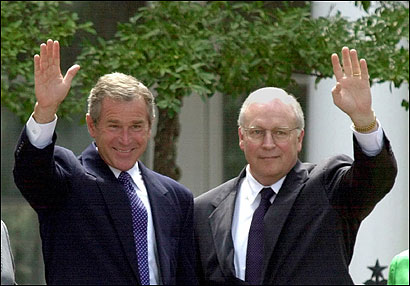
Boston Globe reporter Charlie Savage presents today an excellent analysis of Vice-President Dick Cheney's long-time campaign to extend presidential powers. Looking back to political offices Cheney has held in the Nixon, Ford, Carter, Reagan, and both Bush administrations, Savage studies all manner of media expressions by Cheney on the issue. Well worth reading! Just as an appetizer to get you to the full article,

In July 1987, then-Representative Dick Cheney, the top Republican on the committee investigating the Iran-contra scandal, turned on his hearing room microphone and delivered, in his characteristically measured tone, a revolutionary claim.

President Reagan and his top aides, he asserted, were free to ignore a 1982 law at the center of the scandal. Known as the Boland Amendment, it banned US assistance to anti-Marxist militants in Nicaragua.

"I personally do not believe the Boland Amendment applied to the president, nor to his immediate staff," Cheney said.

Most of Cheney's colleagues did not share his vision of a presidency empowered to bypass US laws governing foreign policy. The committee issued a scathing, bipartisan report accusing White House officials of "disdain for the law."

Cheney refused to sign it. Instead, he commissioned his own report declaring that the real lawbreakers were his fellow lawmakers, because the Constitution "does not permit Congress to pass a law usurping Presidential power.

The Iran-contra scandal was not the first time the future vice president articulated a philosophy of unfettered executive power -- nor would it be the last. The Constitution empowers Congress to pass laws regulating the executive branch, but over the course of his career, Cheney came to believe that the modern world is too dangerous and complex for a president's hands to be tied. He embraced a belief that presidents have vast "inherent" powers, not spelled out in the Constitution, that allow them to defy Congress."


The article refers to Prof. Peter Shane, from Ohio State's law school, as an academic following these issues. Just as an aid to scholars of this issue, here are a few links for Prof. Shane:

Link for SSRN article on Government Watch Lists

Link to NPR report on the limits on Executive Privilege dated 1/28/06

Link to Election Law@Moritz, a website from Ohio State University.

The photo above is from the Globe article, which they titled "Power Couple" showing President Bush and Dick Cheney looking almost like conjoined twins.