Friday, March 24, 2006

Book Review -- Avatars of the Word


Avatars of the Word
by James J. O’Donnell (Harvard University Press, 1998)

This was one of the most exciting books I read in a long time. I reviewed it when it came out, for The Bi-Monthly Review of Law Books.. I'd like to recommend it all over again. Librarians, faculty, cyber-specialists of all types should read this book. If you read Version 2.0 by Esther Dyson, try this for a scholarly extrapolation of her thinking.
O’Donnell is a classicist who extended his range into the early Middle Ages, studying Augustine and Cassiodorus as well as Plato. He is currently at the University of Pennsylvania, and invites visitors to his website. O’Donnell is a lover of books (and libraries!) who is thinking deeply and broadly about how the new technology will affect books, libraries, scholarship and universities. He brings his classics training to bear on contemplations of how the technology of writing, of the codex and of printing have affected society. Then, he uses his experience as a faculty pioneer on the Web and e-mail to consider how those new technologies will affect us now. This is not a simple read, but will richly repay your efforts. He is a very sophisticated library user and an erudite scholar.
Among other topics, O’Donnell considers how new technology has changed the ancient problem of information scarcity to information overload. He recognizes that publishers, faculty and librarians will have to adjust to this new economy, noting that librarians have already led the way in this area. He contemplates the changes that were beginning to be driven by electronic journal publishing: unbundling issues of journals so the reader buys one article or even paragraph as needed; but also the flip side of that change, so that a single article may be listed as affiliated with several different journals, reaching a wider readership.
O’Donnell envisions linking primary materials with the secondary materials, so that a student could read Augustine’s essay, and jump to the commentaries by scholars over the centuries. He thinks about the consequences both for scholars and for universities as well as for teaching. This book is thought-provoking, consoling and challenging at the same time. I highly recommend Avatars of the Word.

The Daffodils


William Wordsworth

The Daffodils

I WANDER'D lonely as a cloud
That floats on high o'er vales and hills,
When all at once I saw a crowd,
A host of golden daffodils,
Beside the lake, beneath the trees,
Fluttering and dancing in the breeze.

Continuous as the stars that shine
And twinkle on the Milky Way,
They stretch'd in never-ending line
Along the margin of a bay:
Ten thousand saw I at a glance,
Tossing their heads in sprightly dance.

The waves beside them danced, but they
Outdid the sparkling waves in glee:—
A poet could not but be gay
In such a jocund company!
I gazed, and gazed, but little thought
What wealth the show to me had brought:

For oft, when on my couch I lie
In vacant or in pensive mood,
They flash upon that inward eye
Which is the bliss of solitude;
And then my heart with pleasure fills,
And dances with the daffodils.


The poem came from Bartleby.com, and the image is from www.gardens-to-go.org.uk/. I long for spring!

What is the Effect of a Presidential Signing Statement?

When President Bush signed the reauthorization of the USA PATRIOT Act earlier this month, he attempted to modify the carefully crafted piece of legislation through his own signing statement. He added a comment to the effect that he felt no obligation to keep Congress informed of the FBI's use of its expanded powers under the act. That was in direct contravention of provisions in the act that required reports to Congress about how often the FBI uses its new powers, in what situations. The reports are due from the executive branch to Congress by dates certain. There was a big signing ceremony with a political statement from the president about the law as a tool against terror. But after the guests and press left, the White House quietly appended this executive statement to the signed legislation:

President's Statement on H.R. 199, the "USA PATRIOT Improvement and Reauthorization Act of 2005"

Today, I have signed into law H.R. 3199, the "USA PATRIOT Improvement and Reauthorization Act of 2005," and then S. 2271, the "USA PATRIOT Act Additional Reauthorizing Amendments Act of 2006." The bills will help us continue to fight terrorism effectively and to combat the use of the illegal drug methamphetamine that is ruining too many lives.

The executive branch shall construe the provisions of H.R. 3199 that call for furnishing information to entities outside the executive branch, such as sections 106A and 119, in a manner consistent with the President's constitutional authority to supervise the unitary executive branch and to withhold information the disclosure of which could impair foreign relations, national security, the deliberative processes of the Executive, or the performance of the Executive's constitutional duties.

The executive branch shall construe section 756(e)(2) of H.R. 3199, which calls for an executive branch official to submit to the Congress recommendations for legislative action, in a manner consistent with the President's constitutional authority to supervise the unitary executive branch and to recommend for the consideration of the Congress such measures as he judges necessary and expedient.

GEORGE W. BUSH

THE WHITE HOUSE,

March 9, 2006.


See link here

What, if any, is the legal significance of this executive statement? It nearly slid by unnoticed. Senator Leahy of Vermont caught the statement and raised the alarm with this statement:

Opening Statement Of Sen. Patrick Leahy
Ranking Member, Judiciary Committee
On USA Patriot Improvement And Reauthorization Act Of 2005
Executive Business Meeting
March 15, 2006

Last week, the USA PATRIOT Improvement and Reauthorization Act of 2005 was signed into law. I was one of ten Senators who voted against this legislation. As a co-author of the original PATRIOT Act, and as someone who supported reauthorizing an improved version of the Act, this was a difficult vote. The legislation enacted last week contains several “sunshine” provisions that I proposed to facilitate oversight and ensure some measure of public accountability for how the Government uses its powers. Regrettably, other provisions fell short of what the American people expected and deserved.

I would have liked to have voted for the provisions that I felt improved the law, and against the provisions that give the government too much power with too little accountability. But that is not the way the legislative process works. When it is time to vote, we have to vote the whole bill “up or down.” So, with some regret, I voted against the defective reauthorization legislation.

As I said in a floor statement on March 2, the defects in the reauthorization legislation are particularly dangerous because we currently have an Administration that does not believe in checks and balances and prefers to do everything in secret. We know that the Bush-Cheney Administration has engaged in secret, warrantless wiretapping of Americans’ emails and telephone calls contrary to the FISA law; we know that it attempted to rush the Dubai Ports deal through in secret, without following legally required review procedures; and we have reason to suspect that it has secretly engaged in extraordinary rendition and created conditions for torture of prisoners, again contrary to law.

I also remarked on the President’s claims that he need not fulfill his constitutional responsibility to faithfully execute the laws but can pick and choose among the laws he decides to recognize. Confronted with claims of inherent and unchecked powers, I concluded, the restraints we were able to include in this reauthorization of the PATRIOT Act were not sufficient.

It took no time at all for the Administration to prove me right. In the very act of signing the reauthorization bill into law, the President signaled that he intends to follow that law only insofar as it suits him, and to ignore its minimal requirements of public accountability. Sections 106A and 119 of the Act requires the Justice Department’s Office of the Inspector General to perform comprehensive audits of the effectiveness and use, including any improper or illegal use, of two investigative authorities provided to the government by the original PATRIOT Act. These audits must be presented in unclassified form, although a classified annex may be included, and must be submitted to the Judiciary Committees of the House and the Senate as well as the Intelligence Committees.

Sections 106A and 119 have been a part of this reauthorization legislation since last November, when the first version of the House-Senate conference report circulated. During the months of negotiation that followed, they remained unchanged. Never, during all that time, did the Administration raise any objection to these provisions. To the contrary, it called on Congress to pass the conference report without changes, and attacked the bipartisan group of Senators who held out for further improvements.

But when the compromise crafted by Congress reached the President’s desk, there was an ambush waiting. In his signing statement, the President declared that he would construe sections 106A and 119 in a manner consistent with his authority to supervise “the unitary executive branch.” That means, he said, that his Administration would “withhold infor­mation the disclosure of which could impair foreign relations, national security, the deliberative processes of the Executive, or the performance of the Executive's constitutional duties.” At the same time, the President also brushed off section 756(e)(2), which requires the Attorney General to submit to the Congress recommendations for further legislation, by saying that the Administration will do so only when the President judges it “necessary and expedient” to do so.

In other words, contrary to the express requirements of the law he himself was signing into effect, the President declared that he will withhold information from Congress and the American people whenever he unilaterally declares that disclosure could impair the “deliberative processes” or “performance” of any part of the federal government, and that he will deign to talk to the People’s representatives in Congress only when he sees fit. This is the perfect expression of what Senator Feingold has so aptly called the Administration’s pre-1776 mentality.

The President’s signing statement poses two profound threats to our constitutional system of checks and balances. First, his unorthodox but repeatedly invoked unitary executive theory is really a unilateral executive theory. This President appears to believe that he can pick and choose which laws to obey and need never submit to congressional oversight. As we learned in an earlier signing statement, the President believes that the law against torture that he signed does not entirely bind him. And as we were reminded by Attorney General Gonzales’s recent stonewalling on the Administration’s domestic spying program, the Administration’s approach to congressional oversight is that it will tell Congress only what it chooses to tell Congress, and will refuse to divulge the “evolution” of its activities and legal theories.

Second, this President appears to hold a strange and novel view of the appropriate role of the President in the legislative process. The Constitution provides that legislation shall be presented by Congress to the President, who shall then either sign it into law or veto it. In other words, to borrow a familiar phrase, he must “vote it up or down” in its entirety, just as we do in Congress. If he vetoes it, a two-thirds majority in both Houses can override his veto.

Despite various threats on stem cells and Dubai Ports, for example, and despite having signed profoundly irresponsible fiscal and other legislation that should never have been enacted, this President has not vetoed a single bill in 5 years. Instead, he has repeatedly waited until legislation is final to issue “signing statements” that purport to pick and choose – usually on “unitary executive” grounds – which provisions he will deem himself bound by.

These signing statements are a clever device if Congress will let him get away with them. As he did with the torture legislation, the President can publicly take credit for signing popular legislation while in fact fighting it all the way and refusing to commit to abide by it. At the same time, he can sidestep a veto override. Instead of engaging constructively with Congress in the process of drafting and negotiating legislation, he can duck the responsibility of voting it up or down and ambush the congressional compromise after the fact.

This Administration’s “unitary executive” doctrine and the signing statements that articulate it are nothing short of a radical effort to re-shape the constitutional separation of powers and evade accountability and responsibility for following the law. We in Congress have a constitutional duty to prevent this. The President’s signing statements are not the law, and we should not allow them to be the last word. The President’s constitutional duty is to faithfully execute the laws as written by the Congress. It is our duty to ensure, by means of congressional oversight, that he does so.

In connection with the legislation we are now considering I have also recently written the Attorney General asking what the Bush-Cheney Administration’s theories of executive power mean in connection with our immigration laws. I ask that a copy of that letter be made part of the record. I have not received a timely reply for purposes of this Committee’s consideration of this legislation.


See link to Leahy's website here.

This is just the latest in a series of outright challenges to Congress by the Bush Administration. Recall the anger by Republican senators McCain, Warner and Graham in early January, 2006 when Bush declared that his war powers allowed his administration to waive the restrictions on the use of cruel, inhuman, and degrading treatment against detainees to protect national security.

'We believe the president understands Congress's intent in passing, by very large majorities, legislation governing the treatment of detainees," the senators said. ''The Congress declined when asked by administration officials to include a presidential waiver of the restrictions included in our legislation. Our committee intends through strict oversight to monitor the administration's implementation of the new law."

Separately, the third primary sponsor of the detainee treatment law, Senator Lindsey O. Graham, Republican of South Carolina, told the Globe in a phone interview that he agreed with everything McCain and Warner said ''and would go a little bit further."

''I do not believe that any political figure in the country has the ability to set aside any . . . law of armed conflict that we have adopted or treaties that we have ratified," Graham said. ''If we go down that road, it will cause great problems for our troops in future conflicts because [nothing] is to prevent other nations' leaders from doing the same."

The White House did not return calls yesterday about the senators' statements. On Friday, in signing the ban on torture, Bush issued a ''signing statement," saying he would interpret the restrictions in the context of his broader constitutional powers as commander in chief. A ''signing statement" is an official document in which a president lays out his interpretation of a new law.

A senior administration official later confirmed that the president believes the Constitution gives him the power to authorize interrogation techniques that go beyond the law to protect national security. But in enacting the law, Congress intended to close every loophole and impose an absolute ban on all forms of torture, no matter the circumstances, Graham said.

David Golove, a New York University law professor who specializes in executive power issues, said the senators' statements ''mean that the battle lines are drawn" for an escalating fight over the balance of power between the two branches of government.

''The president is pointing to his commander in chief power, claiming that it somehow gives him the power to dispense with the law when he's conducting war," Golove said. ''The senators are saying: 'Wait a minute, we've gone over this. This is a law Congress has passed by very large margins, and you are compelled and bound to comply with it.' "

Elisa Massimino, Washington director of Human Rights First, said the senators' statement should send a clear warning to military and CIA interrogators that they would be subject to criminal prosecution if they abuse a detainee.

''That power [to override the law] was explicitly sought by the White House, and it was considered and rejected by the Congress," she said. ''And any US official who relies on legal advice from a government lawyer saying there is a presidential override of a law passed by Congress does so at their peril. Cruel inhuman and degrading treatment is illegal."

But Golove said that it is politically unlikely that Attorney General Alberto R. Gonzales would prosecute an official for taking an action Bush ordered him to take. Still, he said, Congress has a number of tools for compelling the president to obey the law. Congress can withhold funds for programs. It can subpoena administration officials to testify under oath. It can pass stricter laws or block legislation Bush needs. In an extreme and politically unlikely scenario, it can impeach the president.

Bush's interpretation of another detainee-related provision in the new law sparked further friction yesterday with some lawmakers.

The provision stripped courts of the jurisdiction to hear most lawsuits from detainees held at the US naval base at Guantanamo Bay, Cuba.

Citing that provision, the administration said this week that it would ask courts to dismiss more than 180 Guantanamo lawsuits.


"3 GOP senators blast Bush bid to bypass torture ban
Reject assertion he has right to waive rules to protect US security"

By Charlie Savage, Boston Globe Staff | January 5, 2006 link here

And now, about two months later, here we are again, with a more in-your-face challenge, if that were possible. The same writer for the Boston Globe finds the following statements:

''The president's signing statements are not the law, and Congress should not allow them to be the last word," Leahy said in a prepared statement. ''The president's constitutional duty is to faithfully execute the laws as written by the Congress, not cherry-pick the laws he decides he wants to follow. It is our duty to ensure, by means of congressional oversight, that he does so."

The White House dismissed Leahy's concerns, saying Bush's signing statement was simply ''very standard language" that is ''used consistently with provisions like these where legislation is requiring reports from the executive branch or where disclosure of information is going to be required."

''The signing statement makes clear that the president will faithfully execute the law in a manner that is consistent with the Constitution," said White House spokeswoman Dana Perino. ''The president has welcomed at least seven Inspector General reports on the Patriot Act since it was first passed, and there has not been one verified abuse of civil liberties using the Patriot Act."

David Golove, a New York University law professor who specializes in executive power issues, said the statement may simply be ''bluster" and does not necessarily mean that the administration will conceal information about its use of the Patriot Act.

But, he said, the statement illustrates the administration's ''mind-bogglingly expansive conception" of executive power, and its low regard for legislative power.

''On the one hand, they deny that Congress even has the authority to pass laws on these subjects like torture and eavesdropping, and in addition to that, they say that Congress is not even entitled to get information about anything to do with the war on terrorism," Golove said.


here.

Unlike Prof. Golove, I am not an expert on executive powers. I do not know what effect a presidential signing statement has on a piece of legislation. I suppose we will find out if somebody litigates it far enough.

Thursday, March 23, 2006

Measuring Library Quality


By now, most law librarians have probably run into Lib-Qual, the ARL product for measuring library quality. If you follow the link in the title above, you will see a series of PowerPoint slideshows about that and other developments.

The ARL looked at the problems of measuring library quality. They, like law libraries generally, were frustrated. Existing statistics being gathered focused on library expenditures, acquisitions and holdings. We might agree that these have some relationship to quality -- if you are spending no money, or have very few materials, it may be a problem supporting your institution. But it is a more complex relationship than just a direct correlation. There has never been any demonstration that expenditure or size directly affects service quality. So, it makes it very hard to make clear and reasoned arguments countering the deans of unaccredited law schools who want, for instance, to seriously dilute or do away with the ABA standard 7 on library quality and level of support.

The ARL concluded that libraries need to focus, not on books or other materials, or on money spent, but on measuring success from the library user's point of view. What a brilliant idea!

This is the idea behind LibQual, for instance. Measure the outcomes; ask the library patrons if they are happy with the services. Institutions (law schools, law firms or courts in our case) are under budget pressure. They want to know that their library is
* Supporting them in important ways;
* Making the best use of the resources (money) the institution gives the library:
* And working with other libraries to develop best practices to save resources or reallocate them to better serve the institution.

There are actually more measuring programs than just LibQual. There is DigiQual, MINES (developed to measure the use of networked electronic services, by both university and medical school libraries), and SAILS. While the statistics are only available to ARL members, the PowerPoint slides explaining the philosophy and development of some of these measures are open to the inquiring mind. Thank you, ARL!

I don't know if any of this will illuminate our discussions about the ABA statistics that we gather, or help us think about quality in our own libraries beyond the use of LibQual. In fact, I am not sure LibQual works very well with a law school customer base -- I would love to hear from librarians who are using it. What kind of report rate do you seem to get? How much effort do you have to put into cheerleading? But I know for a fact that we need to go beyond counting beans of whatever kind. Like porn, most of us feel we know quality when we see it. But that is not a good way to measure it, either at home or on inspection trips!

Wednesday, March 22, 2006

Webcasts of Oral Arguments Allow SJC Justice to Continue Through Illness


By Jonathan Saltzman, Boston Globe Staff | March 21, 2006

When the Supreme Judicial Court began broadcasting oral arguments on the Internet last May, proponents predicted that the webcasts would be must-see viewing for appellate lawyers, law students, and court buffs with a taste for something besides the latest sensational murder trial.

It turns out that the webcasts have also proved vital to helping an ailing justice continue her duties.

Justice Martha B. Sosman, who was diagnosed with breast cancer in mid-2005, has relied on the webcasts to view oral arguments she has missed at the John Adams Courthouse, said Joan Kenney, a spokeswoman for the court.

Sosman did not attend arguments for dozens of cases in September, October, December, and this month, Kenney said. The oral arguments take place the first full week of each month.

But the 55-year-old jurist watched many of those arguments at home on webcasts, live or archived, to flesh out the issues outlined in legal briefs read by all justices, court officials say.

SJC/Suffolk U. Webcast Archive

They say she has voted on a wide range of cases, regardless of whether she saw the arguments online, as long she discussed them with the other six justices, in person or on the phone, and examined the written briefs. She has not participated at all in a number of cases that have been decided during her illness. For instance, of cases heard in September, when she was absent, and since decided, she voted on at least nine and did not vote on at least three others.

Sosman, who is undergoing chemotherapy and radiation treatments, is a former federal prosecutor and Superior Court judge who was elevated to the high court by Governor Paul Cellucci in 2000. She declined to be interviewed, but the court said in a statement that she ''remains in regular contact with her colleagues, law clerks, and staff members."

Although she has written fewer opinions than usual, the statement said, when listed among the justices who decided a case, ''she has participated fully in all of the deliberations concerning those cases."

Chief Justice Margaret H. Marshall said in a separate statement that the webcasts have allowed Sosman, ''a most valued colleague, to continue to participate actively in our deliberations."

But some lawyers say that Sosman's absence changes the dynamic of oral arguments before the Supreme Judicial Court, which typically gives each side 15 minutes to make its case. They say she is a particularly tough questioner on a court known for trenchant inquiries.

Ellen J. Zucker, who appealed a verdict in a sexual-orientation employment discrimination case in October, said Sosman is respected for ''drilling down on an issue and refining the question in the court's mind."

''She is a very smart justice, and it's always good as an advocate to sharpen your argument when sparring with someone like Justice Sosman," Zucker said. Sosman is ''a very active jurist," said Beth L. Eisenberg, an appellate lawyer for the state public defender agency who most recently argued a case in December, when Sosman was absent. ''I always expect to get questions from her," she said. ''This is a dynamic she obviously finds intellectually satisfying."

Sosman is a skilled classical pianist who enjoys performing for judges and spouses at professional conferences, and her style on the bench is equally robust, said Robert A. Barton, a retired superior court judge.

''She's a player and not a spectator," he said.

The webcasts were made possible as one result of $147.4 million in recent renovations to the 1894 courthouse in Pemberton Square. Since the court began its latest session of arguments in September, the webcasts have received 8,000 hits from people from 30 countries, according to Suffolk University Law School, a partner with the court in the service. Court officials have been pleased with the webcasts' popularity.

Nothing in the rules of the high court, which was established in 1692 and is the oldest appellate court in continuous existence in the Western Hemisphere, requires justices to attend oral arguments to vote on cases.
Video LINK: SJC Webcast archive

Of 18 states that responded to a Globe inquiry relayed by the National Center for State Courts, only one, California, explicitly requires Supreme Court justices to attend oral arguments in order to vote. Even so, California's high court recently made a number of exceptions for a sick justice after lawyers for both sides consented. In some states, such as Pennsylvania, justices make a practice of not voting if they were absent for arguments.

On the federal level, Supreme Court Chief Justice William H. Rehnquist missed oral arguments in a number of cases, but continued to vote until he died last September of thyroid cancer.

Years ago in Massachusetts, justices who missed arguments because of illness generally relied on written briefs, though they could review audio recordings, said Herbert P. Wilkins, who served on the Supreme Judicial Court from 1972 to 1999, retiring as chief justice. ''I wouldn't want to abolish oral arguments," he said. ''They give each party a chance to explain why he or she ought to win the case."

Among the oral arguments that Sosman missed was a closely watched challenge to a 1913 state law that the Commonwealth has used to block out-of-state gay couples from marrying in Massachusetts. The court heard arguments in October, and its decision is eagerly awaited by many in the legal community and gay rights activists.

Sosman, a former board member of the Planned Parenthood League of Massachusetts and a founding partner of an all-female law firm in Boston, surprised some court observers by being among the three dissenters in the landmark 2003 opinion that legalized same-sex marriage in the state. She wrote that Marshall's majority opinion was dogmatic and ''merely repeats the impassioned rhetoric" of gay-marriage advocates.

Given that Sosman's vote in the challenge to the 1913 law could prove pivotal, members of the legal community said they would be surprised if she did not help decide the pending case.

''I have every expectation that she will have watched the [webcast] debate very carefully, read the papers very carefully, and will participate," Zucker said.


I am proud that Suffolk University Law School and Library have been involved in the webcasting, preparation of abstracts and the archiving of the webcasts of the oral arguments over the past year or so. It has been an interesting project to hear about. And I do hear, both from the side of those who produce the webcasts and archives and from the consumer side. I have an attorney friend who had an oral argument before the Court and watched her oral argument (she, like me hates how she looks, so she watched with trepidation). But her husband and partner in a small firm was delighted with the video and will be highlighting it for publicity purposes, and studying it to improve their work.

And now, just before a decision must be made about whether the state is willing to help pay the expenses to continue the service (hmmm), here comes this article about Justice Martha Sosman. I think this is a very interesting use, and as a woman, I have mixed feelings. I support somebody who is going through the trauma of breast cancer treatment. But think about this: if it were your case in front of the court, would you want it decided in part by a justice who wasn't there and was deciding based on the taped arguments?

When I was on the road to tenure, there was one year when neither of the senior faculty who were assigned to view my class who could come. They both viewed a tape. I think they really could not tell what was going on. You can't see anything happening at the board, or on the drop-down screen. You can't hear asides or "mutterances." And more to the point, Justice Sosman, noted above as an active Justice (and she is!), was not present in the mix of questioning.

Should she just have recused herself? Is viewing tapes of an oral argument good enough? Will it one day be enough to view a tape of the trial? Wow? How far can we push it? And why? What are the grounds on which we decide which is OK and which is not OK? But then, you read in the article that in the past and in some other states, justices have participated in decisions in which they only read the briefs -- never saw or heard the oral argument, because of course, archived video is new. Maybe I should just be glad that she has the diligence to do this and only participate in decisions in which she viewed the oral arguments. I do think the oral arguments vastly modify what is presented in the briefs -- or should. I participated in both phases in my short career as an attorney, and found the oral argument was an important adjunct to the briefs.

As I said, I have mixed feelings. Maybe I can be a beach librarian and just manage the library from a PDA. That would be nice. Warmer weather would agree with me.

Gay Marriage Updates


The link above is to Lambda Legal, a non-profit legal assistance organization for gay and lesbian civil rights issues. Their website is a good place for information on many legal issues affecting the gay community, and has lots of useful materials for legal researchers, including briefs, complaints and decisions in the many suits filed by Lambda on the various issues: gay marriage, discrimination in employment, in school settings and military recruitment bias. There are lots and lots of good resources at this site.

They do not include all information, however. New Hampshire's House voted 207 - 125 against a proposed amendment to the state's constitution that would define marriage as the union of one woman and one man. See the story from the AP here.

State law does not permit gays and lesbians to marry in New Hampshire, nor does the state recognize marriages and civil unions performed out of state.

But supporters of the amendment insisted it was needed to prevent the courts from forcing a decision, as happened in Vermont and Massachusetts. Gay-marriage supporters had said no such lawsuits were planned in New Hampshire


****

The Lambda site also does not seem to refer to the news about Connecticut lawsuit by eight gay couples here.

Jeffrey Busch and Stephen Davis of Wilton say the civil union that gives them the same legal rights as married couples in Connecticut also makes them feel inferior to heterosexuals.

Busch and Davis were among eight couples Tuesday challenging the state's ban on gay marriage in Superior Court.

A bill that last year legalized civil unions but defined marriage as only between a man and a woman "is nothing less than the government's announcement that these are second-class citizens," Ben Klein, a senior attorney for Gay and Lesbian Advocates and Defenders, told Judge Patty Jenkins Pittman.

GLAD, which used a similar argument to win gay marriage in Massachusetts, filed suit on behalf of the couples in 2004.

Similar lawsuits are pending in several other states. In January, a Baltimore judge ruled that a law against gay marriage violates the Maryland Constitution's guarantee of equal rights.

The Connecticut couples are not challenging the civil union law, but say the state's refusal to issue the same marriage licenses to gay and heterosexual couples is unconstitutional.

Assistant Attorney General Jane Rosenberg defended that refusal, arguing that there is no fundamental right to marry under Connecticut law and that marriage has traditionally been defined as between a man and a woman.

"What the plaintiffs are apparently seeking is for Connecticut to change the definition of marriage itself," she said.

She said it was reasonable for the state to create civil unions to give gay couples the legal rights of marriage while also dealing with administrative issues, such as federal Medicaid and Medicare programs, which do not recognize gay marriage.

Jenkins Pittman said she is struggling with whether giving gay couples the same legal rights as heterosexual couples but calling them something different is so harmful that it requires a court remedy.

Klein argued that the word marriage carries such weight in society that denying it to same-sex couples is harmful. He also argued that it is important for gay couples to be able to say they are married when they travel to other states and want to, for instance, visit their partners in the hospital.

"Marriage is privileged legal, cultural and social status," he said.

Jenkins Pittman also asked Rosenberg whether Connecticut's law preventing same-sex couples from marrying is any different from a Virginia law that prevented interracial couples from marrying until it was declared unconstitutional.

Rosenberg said the difference is that race is not an essential part of marriage but that the gender of the participants is.

Jenkins Pittman said she expects whoever loses to appeal. A spokeswoman for GLAD said the case will likely end up before the state Supreme Court in about a year.


GLAD, the organization assisting in the Connecticut case (and that assisted in the Goodridge case as well), has a helpful website, too, with briefs and other materials mounted here.

****

There is a Kansas church group that attends the funerals of American soldiers killed in Iraq, demonstrating to show that the soldiers were struck down by God as punishment because this country tolerates homosexuality... Here is the latest:

-A Kansas-based church that has disrupted the funerals of U.S. soldiers in other states will be barred from the grounds of Oxford Hills Comprehensive High School [in Maine] during the funeral Saturday of a soldier from Norway,[Maine] who was killed in Iraq.

The Westboro Baptist Church, of Topeka, Kan., said it plans to send delegates to Sgt. Corey Dan's funeral to express its belief that American soldiers are being struck down by God as retribution for the nation's tolerance of homosexuality.

The superintendent of SAD 17 said that if the protesters want to demonstrate, they will have to do so off school property.

"We do not have an open forum that allows open demonstration and there's no provision for that," Mark Eastman said. "If (the protesters) want to demonstrate, they have to demonstrate off school property."

Local police departments were prepared to keep order Saturday in the event the protesters show up, Paris Police Chief David Verrier said.

"We'll have a strong show of force," said Verrier, noting that Oxford and Norway officers would also be present. The Oxford County Sheriff's Department agreed to provide deputies, if necessary.

Members of the Patriot Guard Riders, a national motorcycle riders' group formed in response to the church's demonstrations at soldier funerals, received an invitation to the service from Dan's family and planned to attend.

"We're expecting at least 30 motorcycles," said Asha Lamy of Naples, a ride captain in Maine. She said members of other other motorcycle clubs, including the Maine and New Hampshire chapters of Vietnam Veterans, expected to show up.

Dan, a 22-year-old Oxford Hills graduate, was killed March 13 when his Humvee was attacked by a roadside bomb and small arms fire while he was serving with the 101st Airborne Division.

Dan had planned to become a police officer after he got out of the service. A scholarship fund has been established in his memory to benefit an Oxford Hills senior seeking to pursue a career in law enforcement.


March 25 update to this story says the funeral went of quietly. Apparently the protesters failed to show up. Corey Dan was laid to rest without any incident.

Laptops Banned from Law School Classroom

U.S.A. Today reports that a professor at the University of Memphis School of Library banned laptops from her classroom, telling students to come to class with paper and pen so that they could take notes: http://www.usatoday.com/tech/news/2006-03-21-professor-laptop-ban_x.htm?POE=TECISVA. Students were predictably angry, and are circulating petitions to protest the ban. I see both sides of this issue. It is really disconcerting to have students using laptops during class for things that are totally unconnected with class. You can see the lack of engagement clearly written on their faces. It's particularly demoralizing when they start laughing and you haven't made a joke! Is the answer to ban laptops? Probably not, because then you curtail the use of technology in the classroom and the pedagogical benefits it can bring. In an ideal world, students would be so engaged in the class that they wouldn't want to IM, surf the Net, or order from L.L. Bean. I haven't figured out yet how to make my classes so interesting that every student attends every class and is totally engaged all the time.

Tuesday, March 21, 2006

The ACLU Finds Concrete Evidence: FBI Spying On Pacificist Orgs


The American Civil Liberties Union released on March 14 concrete evidence that the FBI has been spying on pacifist organizations for no other reason than that their members took part in peaceful anti-war activities. The Thomas Merton Center in Pittsburgh was the centerpiece of the case made public by the ACLU.

Including documents from the FBI that define the Catholic center as a "left-wing organization advocationg, among many political causes, pacifism." (from the Anti-war Investigation Memo). Go to the link in the title above for documents collected by the ACLU including fliers handed out by volunteers from the Merton Center (geez, they were trying to get people to a rally). You can see the deleted pages where the FBI used the exemptions to the Freedom of Information Act. And the "Terrorism Memo" which quotes from the Merton Website, again getting people to a peace rally, "All who desire peace and an end to war..." Really, this memo is headed "International Terrorism Matters."

Bless their hearts, the Merton Center is still at it! The photo above is from their website -- apparently they are still marching for peace. Thank heavens for the ACLU's doggedness in this matter. You can join up at the website above in the title link.

Well, now we know what it takes to be an enemy of our government.

Roe v. Wade ... for Men


The National Center for Men searched for a long time for Matt Dubay. Matt Dubay is the plaintiff in the new law suit just filed March 9 in Federal District Court in Michigan, sponsored by the National Center for Men and dubbed by them Roe v. Wade for Men. The suit is actually a motion to stay the court's order that Dubay pay child support. They want to make the point that abortion rights along with birth control, have given women control over whether they want to have a child and be responsible for the raising and expense of that young person for twenty-one years. Men, if they are misled by a feminine partner about her reproductive status, are liable for such costs and have no control. They cannot choose abortion -- it is not their body. And yet, they are being told they have to pay for child support for a child they never meant to father.

That is the story of Matt Dubay, at least his side of it. He says his former girlfriend told him she was unable to conceive. So he never used birth control himself. Then, she ended up pregnant, did not choose abortion, and he is liable for child support under Michigan's laws. This can amount to a quarter to a third of his earnings for 21 years, so it is a pretty big chunk of income. This can seriously cut into his plans for a family with a woman he meets later and wants to have children with. My first reaction, frankly, was, use birth control, dude! But isn't that the response that women got when they asked for abortion rights? And this man, at least claims that he was misled.

While Matt and the National Center for Men do not necessarily expect to win their law suit, they hope to raise some issues and start a discussion. Are men being treated unfairly? Is there any way to treat the genders fairly? Considering how many single mothers fail to seek child support for their out-of-wedlock children, perhaps the current system is not doing the best job protecting children, either. That is the justification for the rule, and would certainly be my reason for keeping Matt and others on the child support hook (including non-custodial mothers, by the way).

The National Center for Men link above, does not include their brief or much of anything helpful. While it is official (if that means anything with this organization), it is not very rich. Try this CNN link for more info. And this AP article by David Crary is quite good and thought-provoking:

State courts have ruled in the past that any inequity experienced by men like Dubay is outweighed by society's interest in ensuring that children get financial support from two parents. Melanie Jacobs, a Michigan State University law professor, said the federal court might rule similarly in Dubay's case.

"The courts are trying to say it may not be so fair that this gentleman has to support a child he didn't want, but it's less fair to say society has to pay the support," she said.

Feit, however, says a fatherhood opt-out wouldn't necessarily impose higher costs on society or the mother. A woman who balked at abortion but felt she couldn't afford to raise a child could put the baby up for adoption, he said.

Jennifer Brown of the women's rights advocacy group Legal Momentum objected to the men's center comparing Dubay's lawsuit to Roe v. Wade, the 1973 Supreme Court ruling establishing a woman's right to have an abortion."Roe is based on an extreme intrusion by the government _ literally to force a woman to continue a pregnancy she doesn't want," Brown said. "There's nothing equivalent for men. They have the same ability as women to use contraception, to get sterilized."

Feit counters that the suit's reference to abortion rights is apt. (snip)

Feit doesn't advocate an unlimited fatherhood opt-out; he proposes a brief period in which a man, after learning of an unintended pregnancy, could decline parental responsibilities if the relationship was one in which neither partner had desired a child.

"If the woman changes her mind and wants the child, she should be responsible," Feit said. "If she can't take care of the child, adoption is a good alternative."


Their argument is apparently based in Equal Protection theories under the Constitution. I have not yet found a copy of the brief in the case.

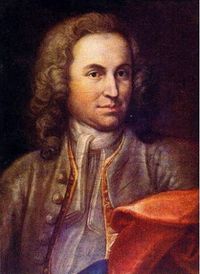
Happy Birthday, J.S. Bach!


If you go to the Wikipedia biography of Johann Sebastian Bach, you get a very nice media file of a number of his pieces of music:

Chorus of the Christmas Oratorio

Last Movement of the Brandenburg Concerto No. 4

Opening of Singet Den Herrn

Gloria from the Mass in B Minor

Prelude and Fugue No. 20 in A Minor

...and on and on. Bach was such a prolific composer that his output of magnificent music is staggering. When I listen to Bach's instrumental music, it sounds like architecture and math turned into music. It sounds like reason triumphing over the pains and trials of the world. According to musicians, this is because he uses a dense contrapuntal style, which, I suppose sounds to me like bridge struts in tension, or thesis, anti-thesis and synthesis.

Bach was born March 21, 1685 (old style calendar) in Eisenach, Germany. He died July 28, 1750 (new style calendar), in Leipzig, Germany, after moving around ten times, always looking for a better sponsor. He was orphaned himself at 10 (I didn't know that!), and went to live with an older brother. Both his father and his older brother were musicians, and many of his sons went on to be talented composers and musicians. He influenced many other composers with his music, and went on influencing the music world through his sons' music, too.

I like this portrait of J.S. Bach in his youth. The painting you always sees makes him look like a terrible grump, which he may have been by then. But this guy looks like he may be the guy that actually composed That the Sheep May Safely Graze. Thank you Johann!