Wednesday, September 06, 2006

More on the legal Canon


On Prawfsblawg, in the posting linked above, Matt Brodie sets up a list of legal subjects, and declares a project to try to list a canon of must-read materials for each substantive area. This is aimed at academics, but what a great list (and argument!) this is going to be. Librarians ought to watch with glee, and link for bibliographic use. We might also sign on to do a couple topics if nobody else picks up a topic.

This builds sideways from my post here on OOTJ about who decides what is in the legal canon, and the effects of computerized databases on what gets cited. See Aug. 11, 2006, What Defines the Canon?"

My question now is,

Is this the Serial that's shot from guns?

Cannon image courtesy of www.nps.gov/fomc/archeology/cannon.jpg

Another Victory for the Open Access Movement

Today's issue of Inside Higher Ed has an article on a recent victory for the open access movement. The presidents of 53 liberal arts colleges (called the "Oberlin group" because the effort was organized at Oberlin College) issued a joint letter on Tuesday expressing their support for the Federal Public Research Access Act. "In July, the provosts of 25 research universities came out in favor of the legislation, saying that the current system of research publishing leads to outrageously high journal costs that are harming libraries and making it impossible for people to follow research." The interest of the college presidents goes beyond the financial; according to Nancy S. Dye, president of Oberlin College, there is also "'a philosophical view' that is spreading: 'Knowledge is made to be shared.'"

Predictably, there was opposition from the Association of American Publishers. Alan Adler, vice president for legal and government affairs, "charged that colleges are looking for short-term financial gain at the expense of journal publishers." Adler also said that peer review ensures the high quality of scholarly journals, and that the open access model does not provide the funds to support that. In what has to be the most outlandish argument against open access that I've heard so far, Adler said that "it was in the national interest for it to be restricted to those who could pay subscription fees. 'Remember--you're talking about free online access to the world,' he said. 'You are talking about making our competitive research available to foreign governments and corporations.'" President Dye of Oberlin rightly shot down this argument, "noting that any journal available for a fee in the United States is hardly limited to American readership, and that such an approach is antithetical to science." Perhaps Adler doesn't understand that research, in all disciplines, has always built on the work of others, wherever they happened to be located, or perhaps he just doesn't care.

Tuesday, September 05, 2006

Tenure and Academic Freedom -- What about Librarians?

The link in the title here is to an interesting online article by professors Barbara Bintliff and Dick Danner, in PDF at Duke University eprints. It's a good overview of academic freedom and tenure in universities generally, and looking at the importance of those privileges for librarians, in particular. I recommend going to the site and reading the article in full.

From my own experience, I feel very strongly that librarians need the protections of academic freedom and tenure more than many substantive law faculty. How many times have I been grateful for those shields against undue pressure when:

* I have to tell a faculty member that the book, journal or other item they pass along to me is not a good investment for this library; faculty have passed along deals from former students, fellow politicoes and friends. Sometimes the suggestion is good and I am grateful. But sometimes, it is a really bad deal or a title not appropriate for our library either due to the level of the product or the quality or the focus. The other side of the coin is selecting items to represent more than one side of politically sensitive issues -- something I think is an important duty of libraries. If I felt the pressure of termination hanging over me when I make a professional judgement about collecting for the library, I couldn't do a good job selecting and spending the budget I have for the good of the entire law school and university community;

* I have to make tough personnel decisions. If I felt that my decision would come back to haunt me, I would be constrained in doing my management as well as I can. The law school and university would not benefit from my experience and judgement in managing the library and its personnel;

* I have to make budget decisions about how to spend for library acquisitions, for faculty research support, and for continuing education and professional memberships for library staff. I try to take the long view on decisions both budgetary and other, thinking about the situation of the library and the school in one year, five years, ten and fifty years. If I had to look over my shoulder at every decision, I would have much more trouble looking at the long-term interests of the library, the law school, the university and the legal profession;

* I make decisions about protecting user information from unwarranted scrutiny by government agencies.

Danner and Bintliff make excellent points, commenting on the new impact of the USA PATRIOT ACT on privacy concerns in libraries. While tenure may not be comfortable for everybody, and the process is undoubtedly tough to go through, I hope to see it always available for librarians. Already available at most law schools for the director of the law library, tenure is a key component of faculty protection. I hate to see the movement way from tenure, especially for directors, but also for other librarians, and for clinicians, legal writing professors. One of the most chilling part of that movement is that all three groups are heavily populated by women. Am I paranoid?

Death of Constitutional Scholar Leonard Levy

The New York Times of September 1 (page C11) in an obituary by Adam Liptak reports the death of Leonard Levy, a well-known expert on constitutional law and constitutional history. Professor Levy had taught at Brandeis University and Claremont Graduate School.

Professor Levy won the Pulitzer Prize in history in 1969 for his Origins of the Fifth Amendment; the Prize recognized the quality of Professor Levy's prose as well as of his scholarship. Professor Levy was non-partisan in his scholarship, and, according to Liptak, "disdained judges on the right and the left who molded history to their advantage." His work was cited many times by the United States Supreme Court, even though Professor Levy was not a lawyer. Professor Levy took "no pleasure" in the multiple citations of his works, because, as he once said, "'Two of my books'--those on the Fifth and First Amendments--'have been cited 10 or 12 times each and not once accurately, significantly or responsibly.'" This failure by the Court to understand his writing made Professor Levy feel that he had not "'contributed to any public understanding.'"

I was particularly interested to learn that Professor Levy had been "an active participant in Reagan-era debates over a mode of constitutional interpretation known as originalism." Professor Levy disagreed with this theory, calling it "a disservice to the grand, open-textured phrases in the Constitution, formulations that he said required fresh interpretation by each generation. 'The framers...had a genius for studied imprecision.'"

It is tragic to lose a scholar of Professor Levy's stature at any time, but it is particularly tragic to lose him at a time when the Constitution is under assault by the very people who are charged with upholding it.

What Becomes of Books?

Well, here's an interesting suggestion about what to do with all of those old reporters we no longer need:

BYU law books finally meet their end: composting

Brigham Young University’s Howard W. Hunter Law Library recently sent 3,000 excess law books to the BYU compost grinder.

Online access to various duplicate law books allowed the library to reduce its holdings and free up more than 1,100 feet of shelf space. The library first contacted the Utah State law librarian and offered the volumes on a national listserve to anyone willing to pay the cost of shipping. One thousand volumes went to six law libraries in California,Illinois, Ohio, South Carolina and Utah.

Recycling these hardcover books would require a costly and labor-intensive process, including stripping the paper from the cover and glue, so the seven tons of books were run through BYU’s tree shredder.

Mixed with wood chips and grass clippings, the books will be composted at BYU’s compost facility in Mapleton and brought back to campus at the end of fall semester to be used in the flower, shrub and tree beds.

For more information, contact Bill Rudy, BYU Recycling (422-4662 or recycling@byu.edu) or Dianne Davenport, Howard W. Hunter Law Library (422-7475 or davenportd@lawgate.byu.edu).

Monday, September 04, 2006

Bread and Roses: Labor Day

It's Labor Day. In honor of the day, I am linking to a very nice article about the Bread and Roses strike in 1912 in Lawrence, MA. The article is by Lynn Neeley in Workers' World, dated January 9, 1998. The strike itself was on January 12, 1912 and erupted over a cut in wages. It was unusual in its time for the participation of women. At the time, the AFL would not organize women or non-whites. So this spontaneous strike by the textile workers was not endorsed by the AFL. It was organized by the "Wobblies," the International Workers of the World, who organized labor with socialist ideals.

BREAD AND ROSES

As we go marching, marching, in the beauty of the day,
A million darkened kitchens, a thousand mill lofts gray,
Are touched with all the radiance that a sudden sun discloses,
For the people hear us singing: Bread and Roses! Bread and Roses!

As we go marching, marching, we battle too for men,
For they are women's children, and we mother them again.
Our lives shall not be sweated from birth until life closes;
Hearts starve as well as bodies; give us bread, but give us roses.

As we go marching, marching, unnumbered women dead
Go crying through our singing their ancient call for bread.
Small art and love and beauty their drudging spirits knew.
Yes, it is bread we fight for, but we fight for roses too.

As we go marching, marching, we bring the greater days,
The rising of the women means the rising of the race.
No more the drudge and idler, ten that toil where one reposes,
But a sharing of life's glories: Bread and roses, bread and roses.

Our lives shall not be sweated from birth until life closes;
hearts starve as well as bodies; bread and roses, bread and roses.


Words by James Oppenheim
Thanks to http://www.columbia.edu/~melissa/petronella/songs/bread-roses.html

The workers were earning a mere $6 a week. When Congress passed a law limiting the work week from 56 hours to only 54, the mill owners cut the wages. At the time, this put the workers below starvation level, and they spontaneously went out on strike. The name of the strike, "Bread and Roses," came from the plea of the women workers to "Give us bread but give us roses." That is, they wanted not only a living wage, but leisure to enjoy the beauty of life: a mere 54 hour work week and a living wage.

In recent decades, labor unions have taken a beating in the popular press and the relevance of the unions seems to be fading. But without unions, we would not have the 40 work week, over time pay, or many of the benefits we now enjoy. At a time when managment held all the cards, they struggled against huge odds to rebalance power in the United States. Many scholars suspect that the intervention of labor unions prevented revolution in this country where, as happened elsewhere, the working classes might have risen up to seize a share of power and wealth by force. Thanks to labor unions and the federal laws that supported them, the redistribution of power and wealth that created our middle class happened under the rule of law.

So, on this Labor Day, let's give a nod of thanks to those brave union organizers and the workers who struck to demand Bread but also Roses.


Then type the rest between these "span" tags (turn on "Edit HTML" to view the tags). The post will be abbreviated on the main page, with a "Read more:" link.

Saturday, September 02, 2006

Stagefright and teaching


Stagefright

I just read the report on stagefright in the New Yorker for August 28, 2006. “Petrified,” by John Lahr, reports on disastrous attacks of stagefright on various actors, and quotes many actors and writers trying to describe the effects. At first, I thought, “Whew! I’m sure glad I’m not an actor!” But, as I read, I felt more and more uncomfortable, aware that I knew some of these feelings too well:

Instead of being protected , as usual, by the character he is
playing, he suddenly stands helpless before the audience as
himself; he loses the illusion of invisibility. His authority
collapses and he feels naked, as if he were exposing to the
judgmental spectators “an image of the man behind the
mask,” says the American psychoanalyst Christopher
Bollas,.... “There is this catastrophic loss of confidence, ...
You lose your radar–like a surfer. You can ride a ten-foot
wave with real confidence, not thinking about it, just doing
it. Then all of a sudden, you become too self-aware. You
think too much. You get wiped out.”

P.39


This is eerily like my experiences when I lose concentration while teaching. Aaagh! Stagefright can attack professors, librarians, anybody who performs in front of others. I usually sail along blithely, connecting to the class and building my confidence from that connection. But once in a while, a student who is IM-ing or
just not into it throws off my concentration and I have to really fight that sense of sudden exposure. It is a terrible thing to suddenly be aware of those judging eyes looking at you with no sense of partnership. “Petrified” discusses it:


The actor’s success depends on his ability to conquer the
audience, which is why the encounter is so often fraught
with excitement and danger. “The relationship is
undoubtedly sexual,” [yipes!] the British character actress
Anna Massey says. "You get to know an audience very,
very quickly. within the first five minutes. They become
your friends or they become difficult to woo. Sometimes
they’re never won.”

[snip]

All the central traumas of childhood–being alone,
abandoned, unsupported, emotionally abused–are revived
for an actor [or a teacher!] when he appears before the
paying customers, who have the power to either starve him
of affection or reward him with approval. ... When things
are going well, the stage and the house merge and a sort of
imaginative union is achieved. The intimacy is palpable on
both sides of the footlights; the audience seems to breathe
with the actors. “There is brilliant intellectual clarity, a
sense of boundless, inexhaustible energy as the chambers of
the brain open up,” [Ian] Holms says of a successful
performance. “Your whole existence is lit up by a dazzling
sense of potential,” [Stephen] Fry, explaining why he put
himself through the stress of acting says, “You’re trying to
recapture the ‘first fine, careless rapture.’ The first time
you felt king of time and space, the first spinning joy of it
all.”

P. 40


The essay thus neatly captures both the heaven of intense and satisfying connection to the students and the absolute hell of missing that connection! It’s been a while since I thought of teaching as being this intense of an experience. But I certainly
experienced that when I started out. And when I “hit the sweet spot” with a class, it is, indeed exhilarating still. Perhaps you have to risk the terrible abandonment and terror of stagefright to achieve that “dazzling sense of potential!” Sleepwalking professors may not ever have experienced the awful sense of standing naked to the judgement of the class, just as they never have that sense of intense connection with their audience.

I have had faculty friends describe a bad class as “crashing and burning.” I have faculty friends who prepare for class and seem to me to be absolutely sizzling with energy. I only teach one class a week, and had not thought of these polar extremes applying to myself for quite a while. Maybe it’s time to give myself over to the muse if I’m going to go on teaching. Come to think of it, both these friends were rather young at the time I am recalling. I wonder if my faculty friends who’ve been teaching longer have that same sense now? Is it a matter of maturing as a prof or is it a matter of skating the edge of disaster in service of the art?


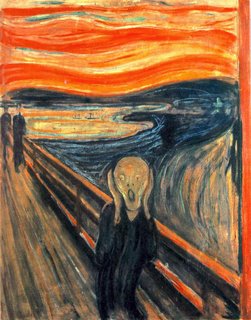
The decoration is Edvard Munch's The Scream, courtesy of an art education page, http://www.angelo.edu/faculty/rprestia/1301/images/IN495%20munch%20BST%20%20Scream%201893.jpg

Friday, September 01, 2006

Virtual Reality Merges with Plain Old Reality


The link above is to a brief article in today's Boston Globe about a deal between Electronic Arts, maker of many video games to present real-time ads on billboards in upcoming games. Users of Microsoft's X-box Need for Speed Carbon, and several other games from EA, when connected live via X-box or PC platforms will see billboard ads that change in real time.

This is one more example of the blurring of the lines between virtual reality and real life. The fabulous popularity of games such as Second Life (see Jim's note here of Wed., Aug. 30, 2006, and my earlier posts about Virtual reality July , April, and March, 2006. The fact that Second Life has a librarian presence on Knowledge Island is terrific! I am fascinated by the use of Second Life for teaching courses at Harvard, in Jim's post, and by the use for speaking engagements noted in other posts here. The rise of quasi-constitutions, behavior rules and statements of rights in these virtual worlds is also fascinating.

See this helpful webography of virtual reality on the Web. And this page on the social effects of Virtual Reality. That's the part that really gets my interest. That last page is the source of the cool image decorating this entry. Humans are hard-wired to build relationships, and maybe hierarchies. Virtual reality is just a new mode. cool!

Update on Compounding Pharmacies

In the title above is a link to another Boston Globe article today reporting on the decision by US District Judge Robert Junell (5th Circuit, W.D. Texas) on the case between the FDA and several compounding pharmacists over whether the FDA has jurisdiction to regulate the specialty drugs created in compounding pharmacies as a new medicine.

... FDA enforcement agents overstepped the agency's jurisdiction by attempting to inspect the records of pharmacists in good standing with state regulators. Legislation passed by Congress that exempts compounding pharmacies from such detailed FDA inspections ``demonstrates Congress's intent to carve out a niche for compounded drugs," he (Judge Junell) said.

The ruling said that unless pharmacies disobey local laws or dispense compounded drugs without a doctor's prescription written for an individual patient, the FDA can only conduct ``limited" inspections of such items as equipment, materials, and labels.


From the Globe.


See this helpful Link from the American Association of Physicians and Surgeons for press releases, and full text of the complaint, briefs and motions in the case. I expect they will have the decision posted soon.

See also Pharmalive, a website for the pharmaceutical industry, which summarizes the decision:

The case -- Medical Center Pharmacy, et al. v. Gonzalez, et al., No. MO-04-CV-130, in the United States District Court for the Western District of Texas, Midland-Odessa Division -- was filed in September 2004 by 10 pharmacies against the Food and Drug Administration and addressed a number of issues affecting the practice of pharmacy compounding.

First, the Court ruled that "compounded drugs do not fall under the new drug definitions" and, as a result, are legal. Judge Junell explained: "If compounded drugs were required to undergo the new drug approval process, the result would be that patients needing individually tailored prescriptions would not be able to receive the necessary medication due to the cost and time associated with obtaining approval ... It is in the best interest of public health to recognize an exemption for compounded drugs that are created based on a prescription written for an individual patient by a licensed practitioner."

Second, the Court ruled that pharmacies are exempt from the requirement to submit to an FDA inspection of their records unless FDA can demonstrate that the pharmacy is not compliant with applicable state laws and does not operate as a retail pharmacy. The Court also ruled that each of the 10 plaintiffs met the requirements for exemption.

Third, the Court ruled that compounding from bulk pharmaceutical ingredients for non-food animals is legal. This is an important issue for animal owners and their veterinarians who prescribe compounded medications to treat a variety of conditions, many of which require medications that are only available by compounding bulk pharmaceutical ingredients. Without them, animals may needlessly suffer or even die. Until now, FDA asserted that prescribing and preparing these treatments was illegal.


Also helpful, TPA, the Texas Pharmacy Association website.

And of interest if you are researching the issue, This link to a communication from Senator Charles Grassley of Iowa to the FDA and the Centers for Medicare-Medicaid Services. The letter outlines information regarding the misuse of compounded drugs, and is dated July 13, 2006.

Mid-size firms picking up China trade business

The Boston Globe ran this terrific article about mid-size law firms picking up business representing mid-size businesses with China trade and business. The article discusses the challenges of working in China, beyond the language and legal barriers. They discuss the efforts of Boston firms to get their staffs up to speed on cultural rules for success in China. Covers issues from how to properly exchange business cards, to dinner and drinking etiquette to properly selecting Mandarin Chinese translations of the firm name and even personal names. Very interesting article. An excellent opportunity for associates (and librarians!) with good language and culture skills to make themselves invaluable.