Wednesday, March 08, 2006

Tulane Law School: "Katrina Stories

Tulane Law School - Resource Network:

Tulane law students will perform 'Katrina Stories,' a gripping story of how Tulane Law School and the New Orleans community experienced Hurricane Katrina and its aftermath at Le Chat Noir Theater (715 Saint Charles Ave.) on Tuesday, March 21 at 8pm.

This hour-and-a-half theatrical production artfully weaves together the stories of more than 50 law students and faculty* as they cope with the chaos and struggles of evacuating, living in exile and returning to New Orleans. Playwright Mary Nagle, a first year Tulane law student, powerfully blends the hardships faced by all New Orleanians during Katrina with funny caricatures of national media personalities and political figures. This fast-paced play moves through the sometimes heart wrenching, sometimes hilarious, experiences of the Tulane Law and New Orleans community.
*No librarians?

Vendors, Publishers & Librarians - a Symbiotic Relationship


Symbiotic relationships can take various forms. There are forms where the relationship is only advantageous to one party and either damaging to one or does not affect the other party at all. But the way most of us think of symbiotic relationships is the kind called "mutualism" where both parties benefit from the relationship. This is like bees pollinating flowers, where the bees get nectar and pollen and the flowers get pollinated. Or the sharks getting their teeth cleaned by the little cleaner wrasses on Jacques Cousteau specials -- both parties benefit. Read more about symbiotic relationships and mutualism in particular on Wikipedia:
Mutualism
http://en.wikipedia.org/wiki/Mutualism

I believe that legal vendors and publishers have a mutually beneficial symbiotic relationship with librarians. I am not speaking of buying and selling, although that is certainly an important aspect. I am thinking of the product reviews and independent research that librarians perform for free on the products vendors and publishers produce. These are useful for marketing purposes, but far more important for product development. You have independent, highly trained, consumer-oriented testers examining your products. They are evaluating the publication or database for you; testing how user-friendly it is; comparing the quality of data, currency, and finding aids.

A really good published article doing an in-depth review and analysis of the workings of your database should be invaluable. While I can appreciate the amount of trepidation that the vendors and publishers may feel over such impending articles, and certainly have encountered and seen others run into attempts at spin and stone-walling, I hope the vendor/publisher CEOs realize that the insights in these articles can be pure gold for your development team. We are not "out to get" anybody. We want to improve the working of an already esteemed tool. Often, the article may include suggestions for improvements that might or might not have been thought of by your staff. And the level of confidence that an independent review inspires in the library community is (naturally) beyond price.

So, please, vendors, publishers, all, can we work together to improve and review products? We do not expect or want to have access to trade secrets. We are very grateful for the level of trust and access many of us have already been granted by many large vendors. I think it has been a good outcome. We have the same end in view: we want the best product for you.

This picture is actually a moray eel having its teeth cleaned by a cleaner wrasse. The image is from www.geocities.com/seasidepix, and has a signature on it.

Tuesday, March 07, 2006

What do law students want?


Our law school is participating in a survey of our students to determine what the students want and feel they are getting from the school. I will be interested to see what level of participation is achieved, and what the results are.

My own memories of law school, plus observiations and conversations, lead me to a few conclusions that will be interesting to test:

1) Students attend law school for a wide variety of reasons, not all having to do with interest in justice or desire to practice law;

2) Students who are serious about learning to be lawyers have very different priorities from less serious students, but all...

3) Students want to get through their school day as efficiently and pain-free as possible;

4) Students want to pass the bar on the first try (if they plan to take the bar);

5) Students want to get a well-paying, interesting and fulfilling job when they graduate (sometimes these 3 criteria are mutually exclusive, sad to say);

6) Students want to have a low or manageable debt-load (again, this may interfere with the job choice -- the pain-free part may lead them to choose to vacation in Hawaii between semesters, then the debt goes up, leading them to pass up the fulfilling job as prosecutor or public defender because the pay is too low to cover the crushing debt they incurred during law school) This last parenthetical, while true for some of our students, alas, mis-represents the truth, which is that the debt load is crushing even without trips to Hawaii. They take loans to cover their undergraduate education and come to law school already thousands of dolllars in debt. Then, they add more on that for our law school tuition. Bummer.

There is also the problem that the job market periodically dries up, and is especially tight in major urban areas. Our students tend to like to stay in Boston or at least the Massachusetts/New England area. Our legal market is not growing very strongly, with law firms merging left and right. So it takes a very strong student, with an engaging interview to get a placement of their dreams and still pay their debts.

There is the added problem that law firm life at some places may be less pleasant now than in past years. There seem to be a lot of pressures on young associates, and less chances to make partner. Even when folks make partner, it does not seem to be the clover-filled life it once was. Unless a student finds a boutique firm, or a very pleasant small firm, or sets off to found their own firm, life seems increasingly grim. There are government placements, but some of those pay well (federal jobs) and the competition is fierce. State jobs pay poorly and there competition is less fierce, but who can afford to pay their debts on the pay?

And yet, people are still coming to law school. It is an incredibly flexible degree. You can do many things with a J.D. besides traditional law practice. Management, all sorts of banking and business work are enhanced with that law degree. If you already have the library degree, there are few hotter job markets than law librarianship, but few students are willing to tack on another degree's worth of debt -- especially if you read my rants about pink collar pay! You have to advance pretty far into administration before you start making better money in law librarianship, or else specialize in computer or international/foreign law aspects.

The reality of law practice does not often measure up to the television series that may be luring students to our law schools. While you may wear spiffy clothes, you are not supposed to act out like the actors in L.A. Law and its more recent T.V. legal cousins. No sex in the stacks, no back-stabbing in the courtrooms. There is a lot more reading fine print and statutes and writing contracts and agreements. It's not a bad way to make a living, and you can do a lot of good in the world with a law degree. Some people do come hoping to make LAW = JUSTICE.


The Cluetrain Manifesto


Heck, this was initially written in 1999, so it is already seven years old. But I am a librarian, and regularly deal in dusty manuscripts. The Cluetrain Manifesto is partly up on the web, as you can see by following the above link. It also exists in a more fleshed-out version in a book (now out of print). And its authors and radical thinkers have moved on to other projects long since.

But the initial thoughts have not really been absorbed and spread through the culture yet. These guys were writing from the viewpoint of hackers (the good kind, the guys who built the Internet culture, not the kind commnonly mis-called hackers in the media but more properly called crackers, who have a culture of scoring points with their peers for breaking the security at websites and vandalizing them). The Cluetrain thinkers considered the development of the Internet and what it meant for humankind, for corporations, and for marketing. Here is a nutshell summary:


The Internet is inherently seditious. It undermines unthinking respect for centralized authority, whether that "authority" is the neatly homogenized voice of broadcast advertising or the smarmy rhetoric of the corporate annual report.


Wow! What they mean is that Internet allows even regular folks to interact with their entertainment, rather than passively soaking it in. It encourages one to think and speak back, whether you are a corporate worker, or a consumer. And their point mainly was that organizations that don't get this sea change will be big losers. They will lose their work force and they will lose their customer base because the Internet allows unprecedented communication, choice and interaction. It makes it possible to look behind the curtain at the little man running the Wizard of Oz, and laugh at him. And that is very dangerous to those who want to retain their power through fear or pronouncements, whether they are corporate chiefs, university presidents, or possibly even government leaders.

Shazam!

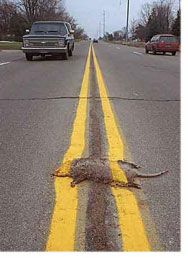
If these guys are right, the Cluetrain has not totally left the station yet. There is still time to get right with the Internet. This image of roadkill on the information highway comes from the Cluetrain Manifesto website.

Funniest Footnote Ever.

From Feministe » Funniest Footnote Ever:

Posted by Jill @ 10:18 am

Motion denied because you’re an idiot. A judge quotes one of my favorite fine films, Billy Madison, in a footnote of a court order. Perfect.

Monday, March 06, 2006

Watch those URL extensions!

I certainly hope this does not apply to law students, but our university paper, The Suffolk Journal reports on Wed., March 1, that a number of confused students went to

http://www.fafsa.com

http://www.fafsa.org

(note: I was fooled by this; the article in the university paper listed this as the free website and I did not look around. I just clicked on it and made sure it was a live URL. An alert reader left me a comment -- which you can read -- but upon reflection, I worried that perhaps blog readers might miss the excellent comment and fall into this misleading website. The .org extension just goes to prove that all you have to do is say you are a not-for-profit organization. I filled out a URL form once for an actual 501(c)(3) organization and it never required me to file any paperwork to prove we had IRS approval, or any reality at all as a non-profit organization.)

The first is a commercial website where they were charged $79.99 to file for their financial aid. They should have gone to the FREE government website (FAFSA stands for Free Application for Federal Student Aid, ironically enough):

http://www.fafsa.ed.gov/

When the Suffolk University financial aid office called to complain, the company's CEO defended the sharp practice claiming that they were offering streamlining of a complicated process. Critics have included the U.S Department of Education, the Federal Trade Commission and a number of other college financial aid administators nation-wide, according to the article in The Suffolk Journal. Apparently so far, no legal challenge to the company has been successful.

Moral of the story: Watch those URL extensions!

Student Feedback

At our law school, the dean has a "town meeting" each semester. It's actually run by the Dean of Students, but the Dean and Associate Deans attend, and all the various adminstrators also attend. Students are invited to come and ask questions, air their concerns. The administrators are supposed to be ready to answer questions on the spot, or, if necessary, to gather information and get back to the inquiring student or organization. We have been doing this for about five or six years now.

The curious thing is how poorly attended it is by the students. We hold it at 5-6 PM, to make it more accessible for our evening students. Year after year, there are more adminstrators than students. There is always somebody taking notes from the law school newspaper, and somebody at least from the Student Bar Association. But beyond that, there just is not a lot of attendance. Yet, you hear that students do have concerns that they feel are not being heard.

I am not sure if it is the array of law school personnel that makes it an intimidating place to come and complain. Or maybe the timing is not as good as they hoped for either the day or evening students. Maybe they ought to hold two sessions. Or maybe they don't really want to hear from the students, and just want to look like it's been open. I don't understand quite what is going on with this. But year after year, I attend, and wait for any library complaints. It used to be a regular complaint that we were open to the public and medical students from a nearby medical school were coming in on a regular basis. They did not get upset about the students from nearby law schools (who really were competing much more directly with them), but just could not abide somebody with a Gray's Anatomy on the desk! Some kind of inherent cat and dog thing between lawyers and doctors, I guess. We closed the access, and I am not hearing a lot of library complaints now. We'll see tonight...

A little something for everybody...


Old professors never die. They just lose their faculties.

Pete: "How old is Professor Greene?"
Sarah: "Pretty old. They say he used to teach Shakespeare."

Old programmers never die...
... They just don't 'C' so good.
... They just branch to a new address.
... They just lose their memory.

Old lawyers never die. They just lose their briefs.

Old librarians never die. They just lose their points of reference.

The student raised his hand in class: “May I be excused now?
My brain is full.”

The law student was unprepared that day for class. He was
called on by the most-feared professor in the school. Everybody
was afraid of Professor X because he would not accept a “Pass,”
from any student. The law student stood up to recite, as required
in Professor X’s class, reached into his back pocket and pulled out
his billfold. He flipped it open and held it up to his face. “Scotty,
beam me up.”

(credits: The first 3 jokes come from Bad Puns, a worthy website full of all kinds of fun wordplay: http://www.badpuns.com/ I just recalled or made up the lawyer and librarian jokes. The student with the full brain is actually the line from a Gary Larsen Far Side cartoon. The last story is a law school legend told me by my sister who attended University of Texas at Austin, where she swore it happened (she just couldn't say to whom). I always loved the story. It ranks way up there in my personal fantasies with riding a big Harley Davidson motorcycle down the stairs in any of the "pit" style classrooms during a particularly boring class. A really impressive horse is another nice alternative to the motorcycle, but less noisy, which I guess is part of the whole point!

The decoration above is from http://www.cookiesbythecrate.com/cookies/brightenyourday.jpg
Cookies, can you imagine?

The Buddha said we make our world with our mind. That seems pretty good. Laughing more seems like a good plan right now. Kind laughter, though.

Sunday, March 05, 2006

Rules of Cuteness -- Look out, Universe!


Jim Milles refers us to Cute Overload
http://mfrost.typepad.com/cute_overload
for a daily application of cuteness. I
actually visited and was very interested
to see that they have a section titled
“The Rules of Cuteness.” This is actually
of great interest to me. I think we are
hard-wired to find certain appearances
irresistible in order to hood-wink mammals
(including humans) into the terribly hard
work of raising our young. I believe this
same hard-wiring is in place for birds as
well, whose young have the same cuteness
factors as mammals.

Mammalian/bird cuteness factors include
large eyes, set wide on a face crowded low
beneath an extra-large forehead. A tiny nose
and mouth or beak, a small chin, a thin neck
and small body with tiny limbs finishes a
summary of the description of our babies. We
find such attributes cute, and long to care for,
cuddle and protect the tiny things that have
such features. So we adopt kittens, puppies,
hamsters, baby birds. And cats willingly
adopt baby rabbits. Dogs will nurse and raise
baby opossums or kittens. We are hard-wired.

I find it a very interesting thing to contemplate
whether, if we ever meet intelligent beings
from other planets, they will have some
similar hard-wired cuteness factors. What will
be their cuteness factors? They need not be
anything like the ones on earth. Though many
of our cuteness factors are simply there because
our young have those features because they
have yet to grow into their adult bodies and
proportions. Perhaps there will be some
universal aspects to baby looks, though baby
reptiles and amphibians do not have that cute look.
Reptiles merely look like smaller versions of the
adult, while juvenile amphibians vary, from tadpoles
to half-formed froglets or salamanders. Cute is not
the word that springs to mind, though. Insects
move through a variety of stages from worm-like
larvae through instars that may or may not look
like smaller versions of adults. It depends on the
species. The difference in most of these animals is
that the parents do not take care of the young. The
reptile, amphibian and insect parents, by and large,
finish their parenting duties when they lay the eggs
in some suitable location. There is no advantage
to the offspring in looking cute. There is no aid
to be sought from the parent – if anything, the parent
might be more inclined to dine if they noticed
their progeny.

So, perhaps, it will depend on the sort of beings
we run across. What sort of life pattern they evolved.
If they have a long childhood, with lots of parenting,
they might have a cuteness factor. If they show up
with better technology than we have, I rather hope
they have superior philosophy or else we fit right into
their cuteness factors! To tell you the truth, they had
better have superior technology though – we are not
really very nice people ourselves. We think we are
warm and friendly, but if you look over our history,
we are pretty destructive folks. Maybe we’ll find
somebody who will enforce some peace.

Saturday, March 04, 2006

I would have preferred Serenity,

or even Cowboy Bebop in a pinch, but Moya is fine with me:


You scored as Moya (Farscape). You are surrounded by muppets. But that is okay because they are your friends and have shown many times that they can be trusted. Now if only you could stop being bothered about wormholes.

Moya (Farscape)


81%

Millennium Falcon (Star Wars)


75%

Babylon 5 (Babylon 5)


63%

Deep Space Nine (Star Trek)


63%

Serenity (Firefly)


56%

FBI's X-Files Division (The X-Files)


56%

Nebuchadnezzar (The Matrix)


56%

SG-1 (Stargate)


50%

Andromeda Ascendant (Andromeda)


44%

Enterprise D (Star Trek)


44%

Galactica (Battlestar: Galactica)


38%

Bebop (Cowboy Bebop)


38%

Your Ultimate Sci-Fi Profile II: which sci-fi crew would you best fit in? (pics)
created with QuizFarm.com