Tuesday, February 14, 2006

Step Right Outside, the View is Fine


Take a trip out to the EU and take a look back inside at the United States. It is an interesting experience for a native-born U.S. citizen who has basically lived all her life in the U.S. the European Union is preparing to investigate the participation of certain member states in hosting torture sites for the United States. This is not comfortable stuff. The problem is that the EU is, quite reasonably, thinking ahead and planning to choose the U.S. government official to speak with with great care. They are cognizant that haughty denial by our government will damage their credibility. I, personally, would root for them to find a DeGaulle to face down our current administration with fierceness despite a lack of military might. But they very sensibly realize that they have to live with the U.S. as a trading partner afterward, and this could strain relations unless they manage to actually unseat the current administration with their accusations. Probably, the red state folks and maybe a good number of blue staters, too, would react to furriners pointing fingers with a "my country right or wrong" knee jerk. Too bad! They need a good hard spank.

Valentine's Day -- Do you sense Doom?


I have included in the title above a link to the very interesting Wikipedia article about St. Valentine's Day. Apparently, there is very little known about any actual St. Valentine. There are three candidates, none of whom are well-known. Only one of them actually had much in his life to do with anything about romance or marriage, and he fell into disfavor with the mainstream church because he followed the Gnostic heresy.

So, why do we even have a St. Valentine's Day? The folks at Wikipedia say it developed mostly to get rid of the pagan festival of Lupercalia. That might make sense. February might be a time in Mediterranean countries to think about fertility festivals, which is what Lupercalia was about. The holiday did not really take off, popularly, as a romantic deal, until the 14th Century, in England and France. It became a popular notion that birds chose their mates on February 14. People began to exchange love notes, I guess following the birds' lead.

Apparently, by the 1840's, the English had already developed printed Valentine's Day cards. One was sent to Esther Howland of Worcester, Massachusetts by a business associate of her father. Her father was a stationer. Esther began designing, making and selling ornate Valentine's Day cards. The first ready-made Valentine's Day cards sold in the United States took off with a whoosh. Her brother took orders the first year for an astonishing $5,000 worth of cards! They were tapping into an existing market that was thirsting for this product. Miss Howland employed friends and built the business to great success before selling it in 1881.

Now, in addition to cards, the chocolate, florist and more recently, jewelry industries have tapped into this holiday. Rather than being a day to express your own feelings of affection, more and more people run on a sense of IF I DON'T GET IT RIGHT, I AM DOOMED TO LIVE IN THE DOG HOUSE FOREVER. That can't be right! And it plays both ways; I don't particularly want chocolates, cut flowers or jewelry or a card. But the industries work hard until I feel devalued if I don't get something. Man, this sucks rocks.

We have been manipulated.

This Valentine of Doom is actually taken completely out of context from a French website that seems to be about a saga of amazing anime entities like this one:
http://tenkai.hen.free.fr/animes/saint-seiya/bonus/mu-fengchun/doom-star.html

Monday, February 13, 2006

Wikipedia, the Ethos

Here is the second of the two-part article from the Boston Globe about Wikipedia. They are interviewing a few of the Wikipedians to talk about the underlying ethos of the project. They have a connected article that you can see by linking above, that interviews more of the Boston area Wikipedians if you are interested. As a librarian, I have truly mixed feelings. I am feeling more drawn to the idealism expressed in the Wiki plan. But I do understand the feelings of Mr. Seigenthaler, Sr., the Nashville, Tennessee, newspaper editor who was libelled on Wikipedia. He protested, and the material was removed. But it remains in the record of edits. That is the policy of Wikipedia, and the record of edits is open to public scrutiny. He complains that his grandchildren could see this, and it is true. The other problem is that there are wikipedians who are so angry at his complaints that they continue to vandalize his article on Wikipedia, so there is a very long and growing list of edits for his grandchildren to see. Poor man!

More on Metadata

I reported earlier on Fun with Metadata. Canadian law librarian, Michel-Adrien Sheppard, blogging at Library Boy http://micheladrien.blogspot.com/, has a very nice report summarizing the best ways of dealing with the metadata problem: Avoiding Problems with Hidden Document Metadata. As I said on comments, you can't just rely on the Microsoft Word by itself to clean up your document. But see the nice links that Michel-Adrien has lined up. Thank you, Michel-Adrien!

Happiness Is ...


Wow, up here in the northeast U.S., we got socked with a big snowstorm last night. NY city got nearly 27 inches. Here in Boston, we got about 12 - 18 inches, depending on where you are in the metro area. It's so beautiful and white, sparkling in the sun. The cars are so quiet as they drive. People are still digging out. And I have the day off work! Wow.

Happiness is a snow day. At home, with folks I love. Just before Valentine's Day. Cocoa and fudge, and good books to read. A fire in the fireplace. A walk in the snowy park with a dog, and coming home to put on slippers. Happiness...

Nobody expressed joy as completely as Charles Schulz' cartoon dog, Snoopy, here with his friend Woodstock. This image is from
http://www.vision.caltech.edu/feifeili/101_ObjectCategories/snoopy/image_0011.jpg

Envisioning The Future of Libraries


Thanks to Penny Hazleton who sent out this link to the DaVinci Institute. This is a very interesting and thought-provoking piece about the future of libraries, mostly from a public library point of view. But there is a lot here to think on for law librarians and their users as well -- they predict the demise of books, and of literacy entirely, for instance by 2050! Wow! That's a little faster than I would have imagined, even on my students' worst days. They also have very thought-provoking suggestions for libraries.

One of the most interesting new developments I have been watching myself is electronic paper. I have a great deal of arthritis in my hands. Books are difficult for me to manipulate. I use book racks, or confine myself to reading light-weight paper-back books for pleasure that I can more easily handle away from my book racks. I also have difficulty bending my head to read; you don't realize how much you bend and move your head in reading. Electronic paper would allow creation of light-weight books of just a few flexible pages that could update the next five pages or page back by touching an arrow. One could have an entire newspaper or magazine delivered this way, to the same five page booklet each morning or month.

Electronic paper may transform both legal research and my leisure reading. Libraries could check out or readers could own these books. The libraries might just "check out" and send to the patron the signal or perhaps give a small, secure device for saving the data of the "book." There could be search functions, as there are for databases now, but the reader would have the advantage of actual, physical browsing, seeing 2 pages open at once, and being able to flip back and forth between pages. There would also still be that possibility of serendipity.

Read here about what Xerox is doing about electronic paper:
http://www2.parc.com/hsl/projects/gyricon/
I could not reach Wikipedia this morning. I wonder if the newspaper articles are causing a huge rush at their website. They do have an article about electronic paper:
en.wikipedia.org/wiki/Electronic_paper

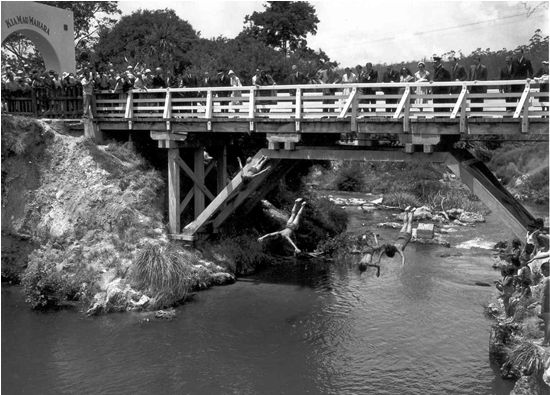
I am not against moving into a digital library. I think we are being pushed into before the kinks are worked out. I think the publishers have not understood what the implications are for their own publishing houses. I also think the legal profession is looking at real implications that need to be addressed. We should not walk blindly into these huge changes if we can plan at all and have some better outcomes, both for the businesses/professions involved and for the society. I just don't want to dive off the bridge until I know what's under the water. This image is from
http://www.nzhistory.net.nz/Gallery/royal-tour/image-page/divers.htm
And says it is the Royal Couple watching Native children diving for coins at Whakarewarewa, Rotorua, 3 January 1954, by courtesy of the Alexander Turnbull Library, Wellington, New Zealand. I'm afraid I feel like one of the Maori kids right now!

Sunday, February 12, 2006

Why Not Get Out of the Email Business?

John Mayer, Executive Director of CALI, asks tonight in an email to the teknoids listserv:


http://www.imagine-wl.com/Education/
Free email hosting for universities, alums - potentially for life.

I understand that Google has a somewhat similar deal, but you get to
specify the domain...

http://googleblog.blogspot.com/2006/02/big-mail-on-campus.html

So why should universities be in the email business at all?
Any thoughts?

Wikipedia Bias and Spin in the News

The Boston Globe is featuring Wikipedia in a two-part article. They focus today in this article looking at the issues brought up earlier here: Capitol Hill aides buffing up their political boss's image or sabotaging opponents. There are interesting interviews with Jimmy Wales and Larry Sanger about how Wikipedia is doing. In-depth coverage of the Wiki-attacks on Nashville newspaperman and former aide to Bobby Kennedy, John Siegenthaler are here, too. Very interesting article.

I also recommend, and cannot seem to find a convenient link to John Dvorak's column in the latest PC Magazine. He discusses Google's apparent plan to light up the dark fiber in order to circumvent the telecommunication giants who are re-congealing into monopolies. Read it!

Pink Alienation


I didn't know if I would be brave enough to blog this part of alienation as a law student, lawyer and even law librarian in a law school environment. I wussed out below, but here it is.

During the professor's colloquium presentation that began this whole series of entries, she spoke about her students coming to her. They spoke of issues that essentially turned around alienation from a heavily male, patriarchal system, law, in a heavily male, patriarchal system, law school. She noted that the systems had changed very little over her 30 years teaching, despite the dramatic changes in proportions of female students in law school. Women are very aware, especially early in their careers and as students, of how terribly vulnerable they are in such a system. They become alienated, and tend to deal with that in two ways. One group denies their feminity, and become one with the masculine majority. That seems safer because then, they are not the hysterical females in studies, they are not the females in cases who lose over and over in the Women and the Law class. Others seek for a sub rosa support group.

Everything she said woke in me an answering voice. All the time I was in law school, and working as a lawyer, and even in my early career as a law librarian, I dealt with my discomfort with the system by denying my femininity. I was one of the guys. Even when I was pregnant (which was really wierd.) Talk about being alienated! I was alienated from my very self; and this is why rediscovering a comfort level with pink and femininity is so important to me now.

I am sure that female law students are not the only ones so deeply alienated by the system that is in place. Gay law students, sensitive guys, any square peg trying to squeeze into LAW's relentlessly round hole probably feel the same sense of alienation. As law librarians, this is one special service we can offer. It was certainly one thing I found and valued in the law library at University of Kentucky: a place of refuge, a sense of solace. The librarians are not sitting in judgement, are not giving out grades (usually) or socratic questions (usually). Most librarians are welcoming and kindly folks, and come like balm to wounded souls.

We can more consciously make our libraries into refuges for the square pegs of our law schools. We can offer a place for people who do not fit, to be more themselves. It will not work for everybody, but it will help a few folks as they pass through. And maybe, after, 20 years or so, they will shed the shell they built, and be reborn!

Saturday, February 11, 2006

Get Wise to Google

Dear Visitors and Fellow Bloggers,
Blogger.com seems to be hiccupping quite a bit lately. All our posts since Feb. 5 have disappeared. I do not know what they are doing or if they are going to get better soon or not. Apologies for the strangeness!

Get Wise to Google

Librarians have mixed feelings about Google. It is a
great search engine. We have to admit it. We use it
ourselves, though we try to use other tools, too. What
bugs us is that we see too many library users who get
so Google-habituated that it’s the only tool they think
to use. That’s a problem!

If you are going to use Google, or any search engine or
database, use it wisely. Get wise to Google. Find out
what makes it work and how to make it work better
for you.

The best place to begin finding out about any search
engine is the help pages that search engines offer now.
Google is very generous that way. They have very
good help pages, if you will just take the few minutes
to read them, and check them from time to time, to
keep up to date. Here are URLs for the two most
helpful parts of the Google help pages:


http://www.google.com/apis/reference.html

This is a quick reference with explanations for a very large
number of special query forms. It has neat tables laying
out in quick outline how the system works. There are lots
of aspects of Google that most users never take advantage
of. What a shame. It’s like owning a Porsche and driving
it 20 miles per hour all the time. This baby has power
that you are missing out on – find out how to shift up,
and corner, and do all those cool sporty things you’ve been
missing out on!


http://www.google.com/help/operators.html

This is another section of the Google help pages. These
explanations are more in-depth on a smaller number of
operators. Very helpful. For instance, you can create a
query that requires the words you are searching for to
be all in the title or all in the URL. You can pull up a
web page and display what other websites link to it.
Pretty cool capabilities.


http://ezbuzz.blogspot.com/2006/01/google-hacks_21.html

EZ Buzz is a blog devoted to improving your chops at
Google searching. It’s pretty good. We noted only one
mistake, where the page still lists a 10 word limit. Now
Google allows 30 words in a search. It may be that the
entry was put in and just not updated. It is, after all,
just one entry on January 21, 2006. Still, it is full of
good ideas and pretty helpful .Here is EZ Buzz’s own
introduction:

Web Search Basics
preface:
Searching in Google doesn't have to
be a case of just entering what you're
looking for in the search box and
hoping for the best. Google offers
you many ways—via special syntax and
search options—to refine your search
criteria and help Google better
understand what you're looking for.
We'll dig into Google's powerful,
all-but-undocumented special syntax
and search options, and show how to
use them to their fullest. We'll
cover the basics of Google searching,
wildcards, word limits, syntax for
special cases, mixing syntax elements,
advanced search techniques, and using
specialized vocabularies, including
slang and jargon.


Librarians hope you will expand your searching horizons
beyond Google. There are other great web browsers you
ought to know about. For instance, there are meta-search
engines that are able to do a creditable job searching
more than one search engine at once. They have to be
able to create a workable query for each search engine
from what you keyed in, and then bring back the results.
Ideally, they would sort out the duplicate results,
though I don’t think I’ve really seen one that does.
Chris Sherman, at Search Engine Watch wrote a wonderful
review of the current crop of MetaSearch Engines and
Meta Crawlers, so I won’t try to go there. See the review:


http://searchenginewatch.com/links/article.php/2156241

This is a great website to visit in order to broaden
your horizons on web surfing generally. There is also the
excellent Search Engine Showdown:


http://www.searchengineshowdown.com/