Showing posts sorted by date for query savage signing statements. Sort by relevance Show all posts

Tuesday, March 10, 2009

Use of Signing Statements Curtailed

Today's New York Times features an article by Charlie Savage on President Obama's ordering "executive officials to consult with Attorney General Eric H. Holder Jr. before relying on [any of President Bush's signing statements] to bypass a statute." Savage is well known for his columns on signing statements, for which he won the 2007 Pulitzer Prize. President Bush issued an unprecedented number of signing statements, more than any other modern President. President Obama did not indicate that he would never issue a signing statement; rather, he "signaled that he intends to use signing statements himself if Congress sends him legislation that has provisions he decides are unconstitutional." The memo to administration officials is here.

Sunday, March 18, 2007

What does it take to radicalize lawyers?

The Washington Post's foreign correspondent (I am so glad some news organiztions are still maintaining them!) Griff White reports today on lawyers taking to the streets in violent protests against General Musarraf.

The latest round of protests came in the eastern city of Lahore, the scene of demonstrations earlier this week. On Saturday, police lobbed tear gas canisters at lawyers in business suits who responded by throwing rocks, according to witness accounts and television footage.

Rashed Rahman, executive editor of the Post newspaper in Lahore, said that about 100 lawyers were injured when police charged them with batons. He said police later ransacked about two dozen offices belonging to the protesters.

"The police apparently had orders to stop the protests at any cost, and they came out swinging," he said. "The level of violence has clearly escalated."

Unrest has grown quickly in Pakistan since March 9, when Musharraf suspended the Supreme Court's chief justice, Iftikhar Mohammed Chaudhry, citing unspecified abuses of power. Chaudhry had been expected to rule on several key cases this year, including the timing of upcoming elections and on whether Musharraf can retain his role as head of the army while also serving as president.


The lawyers and journalists expressed concern that the move against chief justice Chaudhry is the first step in extinguishing democratic institutions and the balance of power in Pakistan. Among other outrages of the day, police opened fire with rubber bullets and tear gas against journalists and cameramen covering the riot. General Musharraf issued a statement that the attack took place without his orders. But he cannot place the removal of Chief Justice Chaudhry at some others' doorstep.

How close is the U.S. to this sort of abuse of power? I certainly hope to never see a dictator in power. But the Bush administration has taken many steps that transfer great amounts of power and discretion from Congress and the judiciary, and concentrate it in the presidency. The most recent example is the firing of the formerly independent attorneys general, known as Gonzalesgate. Other examples that spring to mind are the series of presidential signing statements that claim to considerably alter the effect of the laws as passed by Congress (see here, here and here. Then, there was the Executive Order 13422 (here that was designed to rein in those pesky careerists in various agencies who insist on things like global warming. See this Boston Globe article by Charlie Savage on how VP Cheney has pushed to expand presidential powers.

The Pakistani lawyers and journalists were willing to risk direct confrontation with Musharraf's police and troops; will we ever see American lawyers and journalists so outraged by the actions of our administration that they will take stronger action than the ABA investigation of signing statements (link)?

Friday, October 06, 2006

Bush spits in Congress' Eye!


President Bush, in another signing statement, defied Congress' attempt to protect the FEMA nomination from croneyism like that which resulted in a Bush nominee failing to respond adequately to Hurricane Katrina. Charley Savage, at the Boston Globe writes here that

President Bush this week asserted that he has the executive authority to disobey a new law in which Congress has set minimum qualifications for future heads of the Federal Emergency Management Agency.

Congress passed the law last week as a response to FEMA's poor handling of Hurricane Katrina. The agency's slow response to flood victims exposed the fact that Michael Brown, Bush's choice to lead the agency, had been a politically connected hire with no prior experience in emergency management.

To shield FEMA from cronyism, Congress established new job qualifications for the agency's director in last week's homeland security bill. The law says the president must nominate a candidate who has ``a demonstrated ability in and knowledge of emergency management" and ``not less than five years of executive leadership."

Bush signed the homeland-security bill on Wednesday morning. Then, hours later, he issued a signing statement saying he could ignore the new restrictions. Bush maintains that under his interpretation of the Constitution, the FEMA provision interfered with his power to make personnel decisions.

The law, Bush wrote, ``purports to limit the qualifications of the pool of persons from whom the president may select the appointee in a manner that rules out a large portion of those persons best qualified by experience and knowledge to fill the office."

The homeland-security bill contained measures covering a range of topics, including terrorism, disaster preparedness, and illegal immigration. One provision calls for authorizing the construction of a 700-mile fence along the Mexican border.

But Bush's signing statement challenged at least three-dozen laws specified in the bill. Among those he targeted is a provision that empowers the FEMA director to tell Congress about the nation's emergency management needs without White House permission. This law, Bush said, ``purports . . . to limit supervision of an executive branch official in the provision of advice to the Congress." Despite the law, he said, the FEMA director would be required to get clearance from the White House before telling lawmakers anything.

Bush said nothing of his objections when he signed the bill with a flourish in a ceremony Wednesday in Scottsdale, Ariz. At the time, he proclaimed that the bill was ``an important piece of legislation that will highlight our government's highest responsibility, and that's to protect the American people."

The bill, he added, ``will also help our government better respond to emergencies and natural disasters by strengthening the capabilities of the Federal Emergency Management Agency."

Bush's remarks at the signing ceremony were quickly e-mailed to reporters, and the White House website highlighted the ceremony. By contrast, the White House minimized attention to the signing statement. When asked by the Globe on Wednesday afternoon if there would be a signing statement, the press office declined to comment, saying only that any such document, if it existed, would be issued in the ``usual way."

The press office posted the signing-statement document on its website around 8 p.m. Wednesday, after most reporters had gone home. The signing statement was not included in news reports yesterday on the bill-signing.


The Globe article continues:

In the past, the administration has defended the legality of its signing statements. It has also argued that because Congress often lumps many laws into a single package, it is sometimes impractical to veto a large bill on the basis of some parts being flawed .

At a June hearing before the Senate Judiciary Committee, a Bush administration attorney, Michelle Boardman , noted that other US presidents have also used signing statements. She asserted that Bush's statements ``are not an abuse of power."

Bush's use of signing statements has attracted increasing attention over the past year. In December 2005, Bush asserted that he can bypass a statutory ban on torture. In March 2006, the president said he can disobey oversight provisions in the Patriot Act reauthorization bill.

In all, Bush has challenged more than 800 laws enacted since he took office, most of which he said intruded on his constitutional powers as president and commander in chief. By contrast, all previous presidents challenged a combined total of about 600 laws.

At the same time, Bush has virtually abandoned his veto power, giving Congress no chance to override his judgments. Bush has vetoed just one bill since taking office, the fewest of any president since the 19th century.

Earlier this year, the American Bar Association declared that Bush's use of signing statements was ``contrary to the rule of law and our constitutional separation of powers."

Last month, the nonpartisan Congressional Research Service concluded that Bush's signing statements are ``an integral part" of his ``comprehensive strategy to strengthen and expand executive power" at the expense of the legislative branch.


On the same day, the AP issued this article reporting on Bush's signing statement. The bill in question was HR 5441
Title: Making appropriations for the Department of Homeland Security for the fiscal year ending September 30, 2007, and for other purposes. Became Public Law No: 109-295. Visit Thomas Website to search for the text of the Public Law, the bill, House Reports, and the signing statement. The AP report by Leslie Miller states
President Bush, again defying Congress, says he has the power to edit the Homeland Security Department's reports about whether it obeys privacy rules while handling background checks, ID cards and watchlists.

In the law Bush signed Wednesday, Congress stated no one but the privacy officer could alter, delay or prohibit the mandatory annual report on Homeland Security department activities that affect privacy, including complaints.

But Bush, in a signing statement attached to the agency's 2007 spending bill, said he will interpret that section "in a manner consistent with the President's constitutional authority to supervise the unitary executive branch."

White House spokeswoman Dana Perino said it's appropriate for the administration to know what reports go to Congress and to review them beforehand.

"There can be a discussion on whether to accept a change or a nuance," she said. "It could be any number of things."

The American Bar Association and members of Congress have said Bush uses signing statements excessively as a way to expand his power.

The Senate held hearings on the issue in June. At the time, 110 statements challenged about 750 statutes passed by Congress, according to numbers combined from the White House and the Senate committee. They include documents revising or disregarding parts of legislation to ban torture of detainees and to renew the Patriot Act.

Privacy advocate Marc Rotenberg said Bush is trying to subvert lawmakers' ability to accurately monitor activities of the executive branch of government.

"The Homeland Security Department has been setting up watch lists to determine who gets on planes, who gets government jobs, who gets employed," said Rotenberg, executive director of the Electronic Privacy Information Center.

He said the Homeland Security Department has the most significant impact on citizens' privacy of any agency in the federal government.

Homeland Security agencies check airline passengers' names against terrorist watch lists and detain them if there's a match. They make sure transportation workers' backgrounds are investigated. They are working on several kinds of biometric ID cards that millions of people would have to carry.

The department's privacy office has put the brakes on some initiatives, such as using insecure radio-frequency identification technology, or RFID, in travel documents. It also developed privacy policies after an uproar over the disclosure that airlines turned over their passengers' personal information to the government.

The last privacy report was submitted in February 2005.

Bush's signing statement Wednesday challenges several other provisions in the Homeland Security spending bill.


The article then mentions the FEMA director requirements that Charley Savage reported on. See also the Homeland Security agency website, which includes a short press release on the new law, but makes no mention of the Presidential Signing Statement. See earlier OOTJ posts with links about the signing statement issue March 24, 2006, May 22, 2006, May 5, 2006, and May 28, 2006. Here is a handy blog link for No More King George, which pulls together links for signing statements by President George W. Bush since 2001 to 2006 (so far). You can double check the correctness using Thomas' link above.

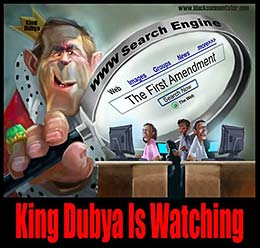
Excellent illustration of King W spying on U.S. citizens, from http://www.peaceworkmagazine.org/pwork/0603/060310.htm

Sunday, June 04, 2006

ABA to investigate constitutionality of signing statements

(Can it be? Did I scoop Betsy on a story in her hometown Boston Globe?)

Bar group will review Bush's legal challenges

WASHINGTON -- The board of governors of the American Bar Association voted unanimously yesterday to investigate whether President Bush has exceeded his constitutional authority in reserving the right to ignore more than 750 laws that have been enacted since he took office....

"The American Bar Association feels a very serious obligation to ensure that when there are legal issues that affect the American people, the ABA adopts a policy regarding such issues and then speaks out about it," [ABA President Michael] Greco said. "In this instance, the president's practice of attaching signing statements to laws squarely presents a constitutional issue about the separation of powers among the three branches."

The signing statements task force, which was recruited by Greco, a longtime Boston lawyer who served on former Governor William F. Weld's Judicial Nominating Council, includes several Republicans. Among them are Mickey Edwards , a former Oklahoma representative from 1977 to 1993, and Bruce Fein , a Justice Department official under President Reagan...

William Sessions , a retired federal judge who was the director of the FBI under both Reagan and President George H.W. Bush , said he agreed to participate because he believed that the signing statements raise a "serious problem" for the American constitutional system....

Another member, Patricia Wald, is a retired chief judge of the US Court of Appeals for the District of Columbia, appointed by President Carter.

She said she had monitored the use of signing statements by previous administrations, but "the accelerated use in recent years presents a real question about separation of powers and checks and balances."

Wald also said she was especially interested in studying how signing statements affect the federal bureaucracy. As a judge, Wald said, she dealt with many cases involving challenges to decisions made by administrative agencies. She said that courts are deferential to such decisions because they are supposed to be made by objective specialists in the agencies. But a heavy use of signing statements could call that assumption into question.

Read the whole story here.

Sunday, May 28, 2006

Presidential Signing Statements? How about Vice-Presidential Legislative Screening?


Charlie Savage, in another blockbuster in the Boston Globe, says that Cheney has an aide screening all legislation to look for potential infringements on executive power! Read it at the link above.

...former White House and Justice Department officials.

The officials said Cheney's legal adviser and chief of staff, David Addington , is the Bush a dministration's leading architect of the ``signing statements" the president has appended to more than 750 laws. The statements assert the president's right to ignore the laws because they conflict with his interpretation of the Constitution.


While the use of presidential signing statements began to expand during the Reagan presidency, former Reagan aides draw a distinction between that administration's use and the current use:

Douglas Kmiec , who as head of the Office of Legal Counsel helped develop the Reagan administration's strategy of issuing signing statements more frequently, said he disapproves of the ``provocative" and sometimes ``disingenuous" manner in which the Bush administration is using them.

Kmiec said the Reagan team's goal was to leave a record of the president's understanding of new laws only in cases where an important statute was ambiguous. Kmiec rejected the idea of using signing statements to contradict the clear intent of Congress, as Bush has done. Presidents should either tolerate provisions of bills they don't like, or they should veto the bill, he said.

``Following a model of restraint, [the Reagan-era Office of Legal Counsel] took it seriously that we were to construe statutes to avoid constitutional problems, not to invent them," said Kmiec, who is now a Pepperdine University law professor.

By contrast, Bush has used the signing statements to waive his obligation to follow the new laws. In addition to the torture ban and oversight provisions of the Patriot Act, the laws Bush has claimed the authority to disobey include restrictions against US troops engaging in combat in Colombia, whistle-blower protections for government employees, and safeguards against political interference in taxpayer-funded research.


Zowie! Read the full article.

Friday, May 05, 2006

More on Presidential Signing Statements

From today's New York Times:

Editorial
Veto? Who Needs a Veto?

Published: May 5, 2006
One of the abiding curiosities of the Bush administration is that after more than five years in office, the president has yet to issue a veto. No one since Thomas Jefferson has stayed in the White House this long without rejecting a single act of Congress. Some people attribute this to the Republicans' control of the House and the Senate, and others to Mr. Bush's reluctance to expend political capital on anything but tax cuts for the wealthy and the war in Iraq. Now, thanks to a recent article in The Boston Globe, we have a better answer.

President Bush doesn't bother with vetoes; he simply declares his intention not to enforce anything he dislikes. Charlie Savage at The Globe reported recently that Mr. Bush had issued more than 750 "presidential signing statements" declaring he wouldn't do what the laws required. Perhaps the most infamous was the one in which he stated that he did not really feel bound by the Congressional ban on the torture of prisoners.

In this area, as in so many others, Mr. Bush has decided not to take the open, forthright constitutional path. He signed some of the laws in question with great fanfare, then quietly registered his intention to ignore them. He placed his imperial vision of the presidency over the will of America's elected lawmakers. And as usual, the Republican majority in Congress simply looked the other way.

Many of the signing statements reject efforts to curb Mr. Bush's out-of-control sense of his powers in combating terrorism. In March, after frequent pious declarations of his commitment to protecting civil liberties, Mr. Bush issued a signing statement that said he would not obey a new law requiring the Justice Department to report on how the F.B.I. is using the Patriot Act to search homes and secretly seize papers if he decided that such reporting could impair national security or executive branch operations.

In another case, the president said he would not instruct the military to follow a law barring it from storing illegally obtained intelligence about Americans. Now we know, of course, that Mr. Bush had already authorized the National Security Agency, which is run by the Pentagon, to violate the law by eavesdropping on Americans' conversations and reading Americans' e-mail without getting warrants.

We know from this sort of bitter experience that the president is not simply expressing philosophical reservations about how a particular law may affect the war on terror. The signing statements are not even all about national security. Mr. Bush is not willing to enforce a law protecting employees of nuclear-related agencies if they report misdeeds to Congress. In another case, he said he would not turn over scientific information "uncensored and without delay" when Congress needed it. (Remember the altered environmental reports?)

Mr. Bush also demurred from following a law forbidding the Defense Department to censor the legal advice of military lawyers. (Remember the ones who objected to the torture-is-legal policy?) Instead, his signing statement said military lawyers are bound to agree with political appointees at the Justice Department and the Pentagon.

The founding fathers never conceived of anything like a signing statement. The idea was cooked up by Edwin Meese III, when he was the attorney general for Ronald Reagan, to expand presidential powers. He was helped by a young lawyer who was a true believer in the unitary presidency, a euphemism for an autocratic executive branch that ignores Congress and the courts. Unhappily, that lawyer, Samuel Alito Jr., is now on the Supreme Court.

Since the Reagan era, other presidents have issued signing statements to explain how they interpreted a law for the purpose of enforcing it, or to register narrow constitutional concerns. But none have done it as profligately as Mr. Bush. (His father issued about 232 in four years, and Bill Clinton 140 in eight years.) And none have used it so clearly to make the president the interpreter of a law's intent, instead of Congress, and the arbiter of constitutionality, instead of the courts.

Like many of Mr. Bush's other imperial excesses, this one serves no legitimate purpose. Congress is run by a solid and iron-fisted Republican majority. And there is actually a system for the president to object to a law: he vetoes it, and Congress then has a chance to override the veto with a two-thirds majority.

That process was good enough for 42 other presidents. But it has the disadvantage of leaving the chief executive bound by his oath of office to abide by the result. This president seems determined not to play by any rules other than the ones of his own making. And that includes the Constitution.

Monday, May 01, 2006

Happy Law Day!

Jack Balkin at Balkinization:

Today, May the 1st, is Law Day, celebrating the Rule of Law, which, under this Administration, has been honored more in the breach than the observance. Indeed, this article by Charlie Savage in the Boston Globe points out that
President Bush has quietly claimed the authority to disobey more than 750 laws enacted since he took office, asserting that he has the power to set aside any statute passed by Congress when it conflicts with his interpretation of the Constitution. Among the laws Bush said he can ignore are military rules and regulations, affirmative-action provisions, requirements that Congress be told about immigration services problems, ''whistle-blower" protections for nuclear regulatory officials, and safeguards against political interference in federally funded research.
Savage is pointing to one of the effects of the explosion of Presidential signing statements under the Bush Presidency: Bush's decision-- instead of vetoing legislation-- to state that certain parts of laws that he signs are unconstitutional and will not be enforced or will be applied in very limited ways. One effect of this policy, as I've described here, is that the President may be directing his subordinates to refuse to enforce a wide variety of federal laws in secret, with little or no public accountability, and with no effective way for the courts or Congress to hold him to his duties to enforce the law and "take care that the laws be faithfully executed" under the Constitution....

The irony is that, at least in the early years of the Republic, the only time that Presidents tended to use their power of veto was when they believed that a law was unconstitutional. Bush's decision *never* to veto any bills he believes are unconstitutional is in some tension with his duties under the Constitution, at least if his views about unconstitutionality are in good faith. Surely Presidents shouldn't be required to veto every bill that passes their desk that has a constitutional difficulty, especially if the problem is a relatively minor part of a major piece of legislation. However, it is hard to argue that none of the 750 bills he claims are unconstitutional don't deserve a veto if he is serious about the constitutional claims he is making. One suspects that the President is primarily interested in escaping accountability for executive actions rather than having courts determine the constitutionality of provisions the President objects to; this is especially the case in the area of foreign relations, prisoner detention and prisoner interrogation.

The Bush Administration didn't want Congress regulating how the it treated prisoners, regarding any such interventions as unconstitutional; at the same time, it didn't want the courts deciding the question of constitutionality either. It simply wanted to be free of legal obligations or responsibilities in this area other than those that it choose for itself.
Rule of Law, R.I.P.

Friday, March 24, 2006

What is the Effect of a Presidential Signing Statement?

When President Bush signed the reauthorization of the USA PATRIOT Act earlier this month, he attempted to modify the carefully crafted piece of legislation through his own signing statement. He added a comment to the effect that he felt no obligation to keep Congress informed of the FBI's use of its expanded powers under the act. That was in direct contravention of provisions in the act that required reports to Congress about how often the FBI uses its new powers, in what situations. The reports are due from the executive branch to Congress by dates certain. There was a big signing ceremony with a political statement from the president about the law as a tool against terror. But after the guests and press left, the White House quietly appended this executive statement to the signed legislation:

President's Statement on H.R. 199, the "USA PATRIOT Improvement and Reauthorization Act of 2005"

Today, I have signed into law H.R. 3199, the "USA PATRIOT Improvement and Reauthorization Act of 2005," and then S. 2271, the "USA PATRIOT Act Additional Reauthorizing Amendments Act of 2006." The bills will help us continue to fight terrorism effectively and to combat the use of the illegal drug methamphetamine that is ruining too many lives.

The executive branch shall construe the provisions of H.R. 3199 that call for furnishing information to entities outside the executive branch, such as sections 106A and 119, in a manner consistent with the President's constitutional authority to supervise the unitary executive branch and to withhold information the disclosure of which could impair foreign relations, national security, the deliberative processes of the Executive, or the performance of the Executive's constitutional duties.

The executive branch shall construe section 756(e)(2) of H.R. 3199, which calls for an executive branch official to submit to the Congress recommendations for legislative action, in a manner consistent with the President's constitutional authority to supervise the unitary executive branch and to recommend for the consideration of the Congress such measures as he judges necessary and expedient.

GEORGE W. BUSH

THE WHITE HOUSE,

March 9, 2006.


See link here

What, if any, is the legal significance of this executive statement? It nearly slid by unnoticed. Senator Leahy of Vermont caught the statement and raised the alarm with this statement:

Opening Statement Of Sen. Patrick Leahy
Ranking Member, Judiciary Committee
On USA Patriot Improvement And Reauthorization Act Of 2005
Executive Business Meeting
March 15, 2006

Last week, the USA PATRIOT Improvement and Reauthorization Act of 2005 was signed into law. I was one of ten Senators who voted against this legislation. As a co-author of the original PATRIOT Act, and as someone who supported reauthorizing an improved version of the Act, this was a difficult vote. The legislation enacted last week contains several “sunshine” provisions that I proposed to facilitate oversight and ensure some measure of public accountability for how the Government uses its powers. Regrettably, other provisions fell short of what the American people expected and deserved.

I would have liked to have voted for the provisions that I felt improved the law, and against the provisions that give the government too much power with too little accountability. But that is not the way the legislative process works. When it is time to vote, we have to vote the whole bill “up or down.” So, with some regret, I voted against the defective reauthorization legislation.

As I said in a floor statement on March 2, the defects in the reauthorization legislation are particularly dangerous because we currently have an Administration that does not believe in checks and balances and prefers to do everything in secret. We know that the Bush-Cheney Administration has engaged in secret, warrantless wiretapping of Americans’ emails and telephone calls contrary to the FISA law; we know that it attempted to rush the Dubai Ports deal through in secret, without following legally required review procedures; and we have reason to suspect that it has secretly engaged in extraordinary rendition and created conditions for torture of prisoners, again contrary to law.

I also remarked on the President’s claims that he need not fulfill his constitutional responsibility to faithfully execute the laws but can pick and choose among the laws he decides to recognize. Confronted with claims of inherent and unchecked powers, I concluded, the restraints we were able to include in this reauthorization of the PATRIOT Act were not sufficient.

It took no time at all for the Administration to prove me right. In the very act of signing the reauthorization bill into law, the President signaled that he intends to follow that law only insofar as it suits him, and to ignore its minimal requirements of public accountability. Sections 106A and 119 of the Act requires the Justice Department’s Office of the Inspector General to perform comprehensive audits of the effectiveness and use, including any improper or illegal use, of two investigative authorities provided to the government by the original PATRIOT Act. These audits must be presented in unclassified form, although a classified annex may be included, and must be submitted to the Judiciary Committees of the House and the Senate as well as the Intelligence Committees.

Sections 106A and 119 have been a part of this reauthorization legislation since last November, when the first version of the House-Senate conference report circulated. During the months of negotiation that followed, they remained unchanged. Never, during all that time, did the Administration raise any objection to these provisions. To the contrary, it called on Congress to pass the conference report without changes, and attacked the bipartisan group of Senators who held out for further improvements.

But when the compromise crafted by Congress reached the President’s desk, there was an ambush waiting. In his signing statement, the President declared that he would construe sections 106A and 119 in a manner consistent with his authority to supervise “the unitary executive branch.” That means, he said, that his Administration would “withhold infor­mation the disclosure of which could impair foreign relations, national security, the deliberative processes of the Executive, or the performance of the Executive's constitutional duties.” At the same time, the President also brushed off section 756(e)(2), which requires the Attorney General to submit to the Congress recommendations for further legislation, by saying that the Administration will do so only when the President judges it “necessary and expedient” to do so.

In other words, contrary to the express requirements of the law he himself was signing into effect, the President declared that he will withhold information from Congress and the American people whenever he unilaterally declares that disclosure could impair the “deliberative processes” or “performance” of any part of the federal government, and that he will deign to talk to the People’s representatives in Congress only when he sees fit. This is the perfect expression of what Senator Feingold has so aptly called the Administration’s pre-1776 mentality.

The President’s signing statement poses two profound threats to our constitutional system of checks and balances. First, his unorthodox but repeatedly invoked unitary executive theory is really a unilateral executive theory. This President appears to believe that he can pick and choose which laws to obey and need never submit to congressional oversight. As we learned in an earlier signing statement, the President believes that the law against torture that he signed does not entirely bind him. And as we were reminded by Attorney General Gonzales’s recent stonewalling on the Administration’s domestic spying program, the Administration’s approach to congressional oversight is that it will tell Congress only what it chooses to tell Congress, and will refuse to divulge the “evolution” of its activities and legal theories.

Second, this President appears to hold a strange and novel view of the appropriate role of the President in the legislative process. The Constitution provides that legislation shall be presented by Congress to the President, who shall then either sign it into law or veto it. In other words, to borrow a familiar phrase, he must “vote it up or down” in its entirety, just as we do in Congress. If he vetoes it, a two-thirds majority in both Houses can override his veto.

Despite various threats on stem cells and Dubai Ports, for example, and despite having signed profoundly irresponsible fiscal and other legislation that should never have been enacted, this President has not vetoed a single bill in 5 years. Instead, he has repeatedly waited until legislation is final to issue “signing statements” that purport to pick and choose – usually on “unitary executive” grounds – which provisions he will deem himself bound by.

These signing statements are a clever device if Congress will let him get away with them. As he did with the torture legislation, the President can publicly take credit for signing popular legislation while in fact fighting it all the way and refusing to commit to abide by it. At the same time, he can sidestep a veto override. Instead of engaging constructively with Congress in the process of drafting and negotiating legislation, he can duck the responsibility of voting it up or down and ambush the congressional compromise after the fact.

This Administration’s “unitary executive” doctrine and the signing statements that articulate it are nothing short of a radical effort to re-shape the constitutional separation of powers and evade accountability and responsibility for following the law. We in Congress have a constitutional duty to prevent this. The President’s signing statements are not the law, and we should not allow them to be the last word. The President’s constitutional duty is to faithfully execute the laws as written by the Congress. It is our duty to ensure, by means of congressional oversight, that he does so.

In connection with the legislation we are now considering I have also recently written the Attorney General asking what the Bush-Cheney Administration’s theories of executive power mean in connection with our immigration laws. I ask that a copy of that letter be made part of the record. I have not received a timely reply for purposes of this Committee’s consideration of this legislation.


See link to Leahy's website here.

This is just the latest in a series of outright challenges to Congress by the Bush Administration. Recall the anger by Republican senators McCain, Warner and Graham in early January, 2006 when Bush declared that his war powers allowed his administration to waive the restrictions on the use of cruel, inhuman, and degrading treatment against detainees to protect national security.

'We believe the president understands Congress's intent in passing, by very large majorities, legislation governing the treatment of detainees," the senators said. ''The Congress declined when asked by administration officials to include a presidential waiver of the restrictions included in our legislation. Our committee intends through strict oversight to monitor the administration's implementation of the new law."

Separately, the third primary sponsor of the detainee treatment law, Senator Lindsey O. Graham, Republican of South Carolina, told the Globe in a phone interview that he agreed with everything McCain and Warner said ''and would go a little bit further."

''I do not believe that any political figure in the country has the ability to set aside any . . . law of armed conflict that we have adopted or treaties that we have ratified," Graham said. ''If we go down that road, it will cause great problems for our troops in future conflicts because [nothing] is to prevent other nations' leaders from doing the same."

The White House did not return calls yesterday about the senators' statements. On Friday, in signing the ban on torture, Bush issued a ''signing statement," saying he would interpret the restrictions in the context of his broader constitutional powers as commander in chief. A ''signing statement" is an official document in which a president lays out his interpretation of a new law.

A senior administration official later confirmed that the president believes the Constitution gives him the power to authorize interrogation techniques that go beyond the law to protect national security. But in enacting the law, Congress intended to close every loophole and impose an absolute ban on all forms of torture, no matter the circumstances, Graham said.

David Golove, a New York University law professor who specializes in executive power issues, said the senators' statements ''mean that the battle lines are drawn" for an escalating fight over the balance of power between the two branches of government.

''The president is pointing to his commander in chief power, claiming that it somehow gives him the power to dispense with the law when he's conducting war," Golove said. ''The senators are saying: 'Wait a minute, we've gone over this. This is a law Congress has passed by very large margins, and you are compelled and bound to comply with it.' "

Elisa Massimino, Washington director of Human Rights First, said the senators' statement should send a clear warning to military and CIA interrogators that they would be subject to criminal prosecution if they abuse a detainee.

''That power [to override the law] was explicitly sought by the White House, and it was considered and rejected by the Congress," she said. ''And any US official who relies on legal advice from a government lawyer saying there is a presidential override of a law passed by Congress does so at their peril. Cruel inhuman and degrading treatment is illegal."

But Golove said that it is politically unlikely that Attorney General Alberto R. Gonzales would prosecute an official for taking an action Bush ordered him to take. Still, he said, Congress has a number of tools for compelling the president to obey the law. Congress can withhold funds for programs. It can subpoena administration officials to testify under oath. It can pass stricter laws or block legislation Bush needs. In an extreme and politically unlikely scenario, it can impeach the president.

Bush's interpretation of another detainee-related provision in the new law sparked further friction yesterday with some lawmakers.

The provision stripped courts of the jurisdiction to hear most lawsuits from detainees held at the US naval base at Guantanamo Bay, Cuba.

Citing that provision, the administration said this week that it would ask courts to dismiss more than 180 Guantanamo lawsuits.


"3 GOP senators blast Bush bid to bypass torture ban
Reject assertion he has right to waive rules to protect US security"

By Charlie Savage, Boston Globe Staff | January 5, 2006 link here

And now, about two months later, here we are again, with a more in-your-face challenge, if that were possible. The same writer for the Boston Globe finds the following statements:

''The president's signing statements are not the law, and Congress should not allow them to be the last word," Leahy said in a prepared statement. ''The president's constitutional duty is to faithfully execute the laws as written by the Congress, not cherry-pick the laws he decides he wants to follow. It is our duty to ensure, by means of congressional oversight, that he does so."

The White House dismissed Leahy's concerns, saying Bush's signing statement was simply ''very standard language" that is ''used consistently with provisions like these where legislation is requiring reports from the executive branch or where disclosure of information is going to be required."

''The signing statement makes clear that the president will faithfully execute the law in a manner that is consistent with the Constitution," said White House spokeswoman Dana Perino. ''The president has welcomed at least seven Inspector General reports on the Patriot Act since it was first passed, and there has not been one verified abuse of civil liberties using the Patriot Act."

David Golove, a New York University law professor who specializes in executive power issues, said the statement may simply be ''bluster" and does not necessarily mean that the administration will conceal information about its use of the Patriot Act.

But, he said, the statement illustrates the administration's ''mind-bogglingly expansive conception" of executive power, and its low regard for legislative power.

''On the one hand, they deny that Congress even has the authority to pass laws on these subjects like torture and eavesdropping, and in addition to that, they say that Congress is not even entitled to get information about anything to do with the war on terrorism," Golove said.


here.

Unlike Prof. Golove, I am not an expert on executive powers. I do not know what effect a presidential signing statement has on a piece of legislation. I suppose we will find out if somebody litigates it far enough.